
Importing Shrink Film from China: A Buyer's Guide
Source, sample, spec-lock and clear customs on PETG shrink film from China: Incoterms, payment, export packing, HS 3920.62 and the pitfalls importers miss.

Importing PETG shrink film from China is a documented sequence — sourcing a supplier, sampling, locking specifications, agreeing Incoterms and payment, arranging shipment, and clearing customs — that moves a compliant roll onto a production line at a controlled landed cost.
Key takeaways:
- Under both FOB and CIF, transit risk passes to the buyer the moment the goods are loaded on board at the Chinese port; CIF only adds a seller-bought minimum insurance that excludes theft, water and rough handling.
- Finished PETG shrink film classifies under HS heading 3920.62, “Of poly(ethylene terephthalate)” — confirm the full destination code and duty rate with a licensed customs broker, never a guessed number.
Which specifications must you lock in the purchase order?
Shrinkage is reported in two directions for a structural reason: transverse-direction (TD) shrinkage, typically in a 70–80% band for these films, governs how a full-body sleeve hugs a contoured container, while machine-direction (MD) shrinkage is held low so registered artwork does not distort lengthwise.
| Specification | What it governs | How to lock it |
|---|---|---|
| TD shrinkage (~70–80%) | Fit to container geometry | Stated alone, referenced to a shrink method such as ASTM D2732 |
| MD shrinkage | Lengthwise artwork distortion | Reported separately and held low |
| Certificate of analysis | Proof the lot was measured, not described | One per batch, tied to a lot number |
Background on recycled grades is covered in RPET packaging explained and PET shrink sleeve recyclability.
FOB, CIF or DDP — which Incoterm should a shrink film importer choose?
FOB is the practical default for a first China import, because it splits the transaction where each party operates best: the Chinese seller handles inland haulage and export clearance, and the buyer controls the ocean freight and import side through a chosen forwarder.
| Incoterm | Main ocean freight | Insurance | Risk transfers | Import clearance | Fits |
|---|---|---|---|---|---|
| FOB | Buyer | Buyer | On board at the China port | Buyer | Most first-time and repeat importers |
| CIF | Seller | Seller (minimum) | On board at the China port | Buyer | Buyers accepting minimum marine cover |
| DDP | Seller | Seller | At the buyer’s delivery point | Seller | Buyers wanting a single all-in price |
How do you clear customs — HS code, documents and duties?
Finished PETG shrink film clears under HS heading 3920.62, the subheading for film of poly(ethylene terephthalate), and getting the classification right is the first step to a clean release. The six-digit heading is internationally harmonised, but the full code and the duty rate depend on the destination country and change over time, so the exact figure should be confirmed with a licensed customs broker rather than pulled from an online lookup and never invented.
The document set that accompanies the shipment is standard but unforgiving of inconsistency:
- Commercial invoice — the value and duty basis, carrying the agreed Incoterm.
- Packing list — quantities, weights and dimensions, with no pricing.
- Bill of lading or air waybill — the transport contract and title document.
- Certificate of origin — proof of China origin; a preferential form such as Form E or an RCEP certificate can cut the tariff where a free-trade agreement applies.
Frequently Asked Questions
What HS code applies to PETG shrink film?
Does FOB or CIF put the ocean transit risk on the buyer?
How is a supplier stopped from sending a sample that outperforms the bulk run?
Related Articles
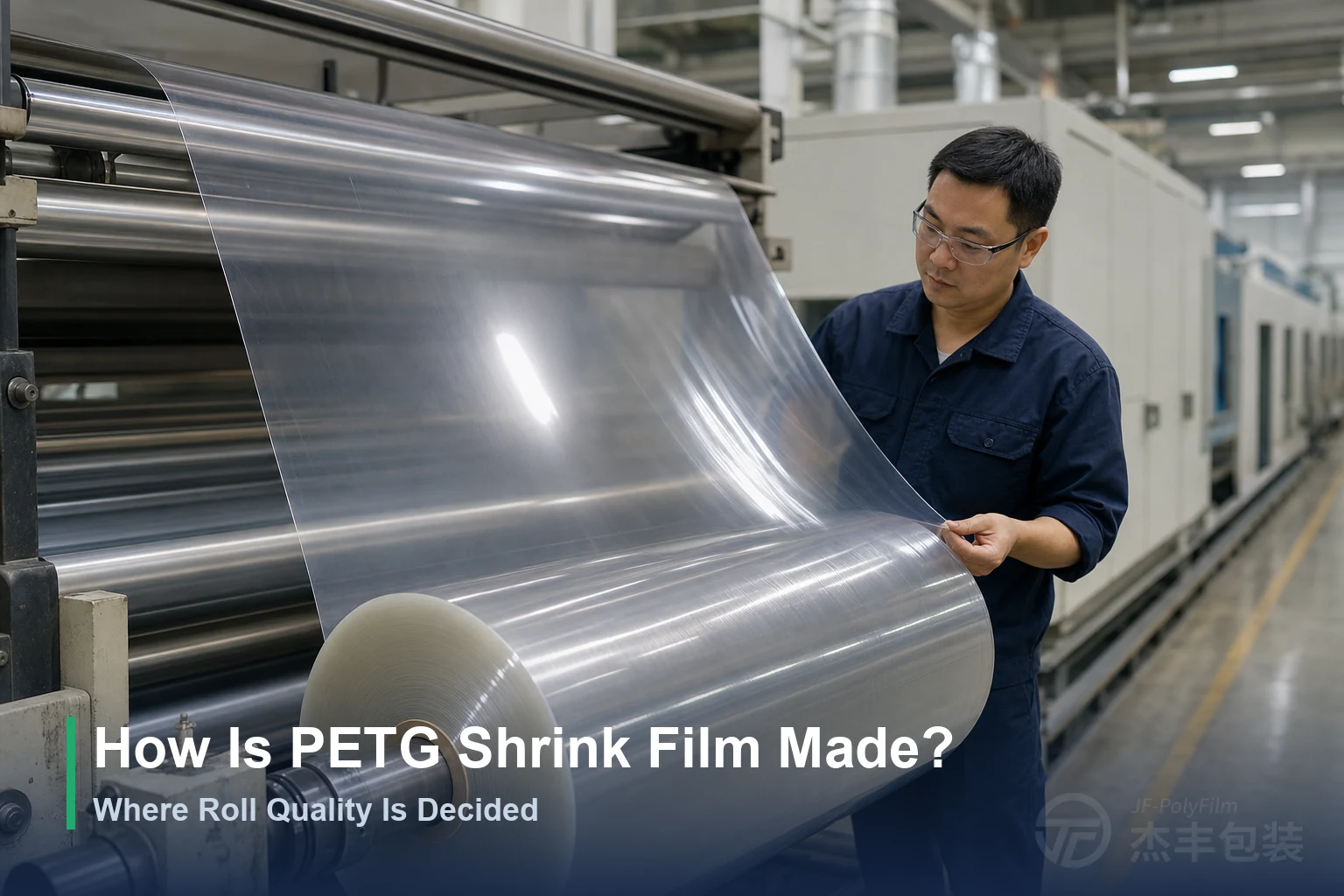
How Is PETG Shrink Film Made? Where Roll Quality Is Decided
How PETG shrink film is made, and which production stage sets each line buyers check on arrival: gauge tolerance, TD/MD shrink, haze, tensile strength, roll labels.
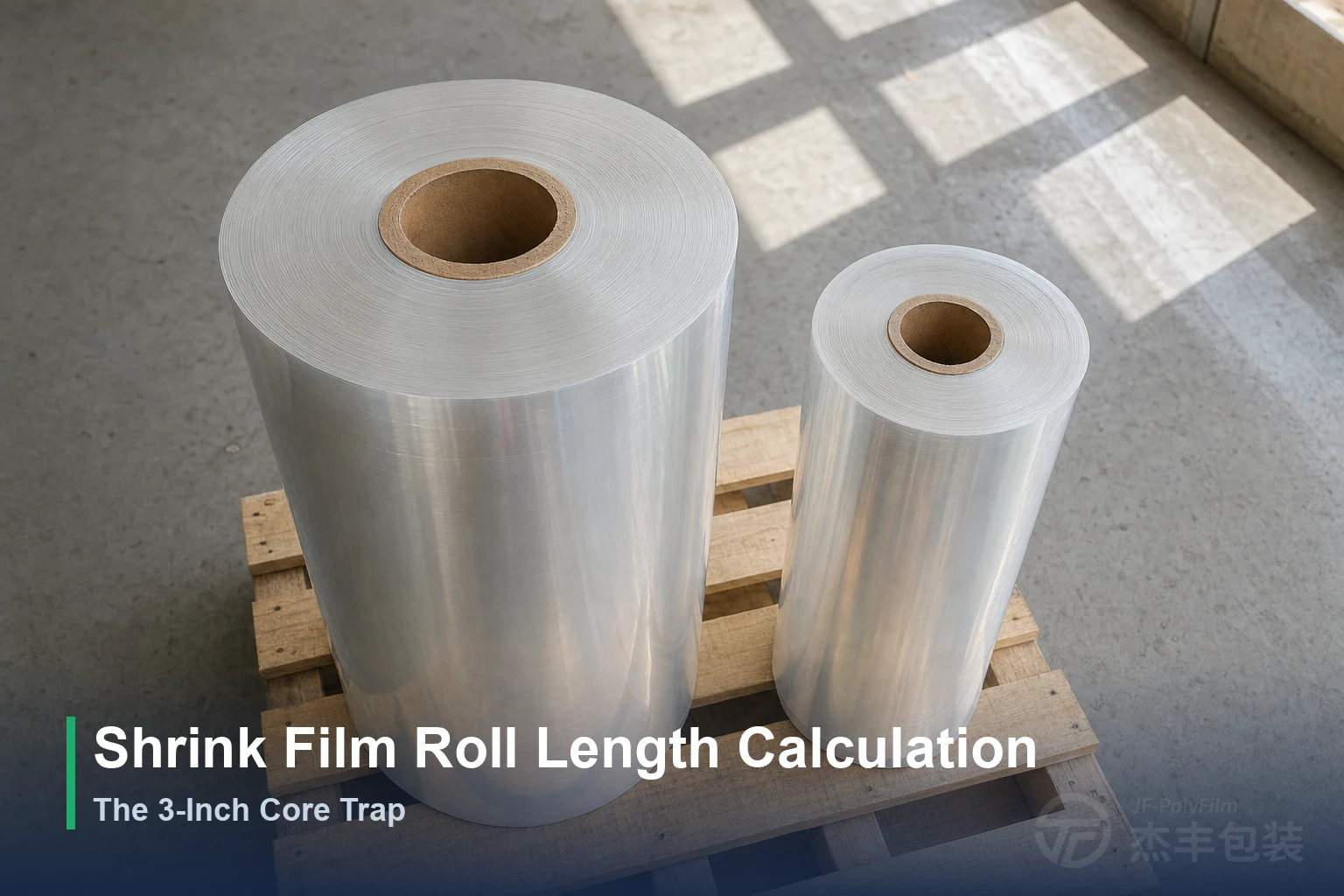
Shrink Film Roll Length Calculation: The 3-Inch Core Trap
Formulas linking roll diameter, length and weight, worked metric and imperial examples, a 30–60 μm diameter table, and why core size and trapped air shift the result.
Need Expert Advice on Shrink Film?
Our technical team can help you choose the right film for your application.
Contact Us