
PETG Shrink Film
Our PETG shrink film range covers five films for shrink sleeve labels and tamper-evident bands: Clear, White, CPET, RPET and Bidirectional. Compare them below by shrink performance; each film's page has the full ASTM property table and shrink curve.
PETG shrink sleeve film range: five films compared
Shrink values are measured to ASTM D 1204 at 95°C for 10 seconds.
| Film | TD shrink (%) | MD shrink (%) | Built for |
|---|---|---|---|
| Clear PETG shrink film | ≥ 65 / ≥ 75 / ≥ 80 (three shrink-rate tiers) | ≤ 3.0 | Transparent, high-gloss full-body sleeves |
| White PETG shrink film | ≥ 75 | ≤ 3.0 | Opaque white sleeves that block light and give print a solid base |
| CPET shrink film | 74 ± 2 | ≤ 5.0 | RIC 1 sleeves recycled together with the PET bottle; melting point 230°C |
| RPET shrink film | ≥ 75 | ≤ 3.0 | GRS-certified recycled content, customizable 30 / 50+ % |
| PETG Bidirectional shrink film | ≥ 70 | 35 ± 5 | Adhesive-backed wash-off labels for returnable glass bottles |
Source: JFPolyFilm technical data sheets, ASTM D 1204 (95°C, 10 s). Full property tables, test methods and shrink curves are on each film page.
Clear PETG is also available as unprinted shrink tubing on rolls.
Full specifications for each product

Clear PETG Shrink Film

White PETG Shrink Film

CPET Shrink Film

RPET Shrink Film

PETG Bidirectional Shrink Film
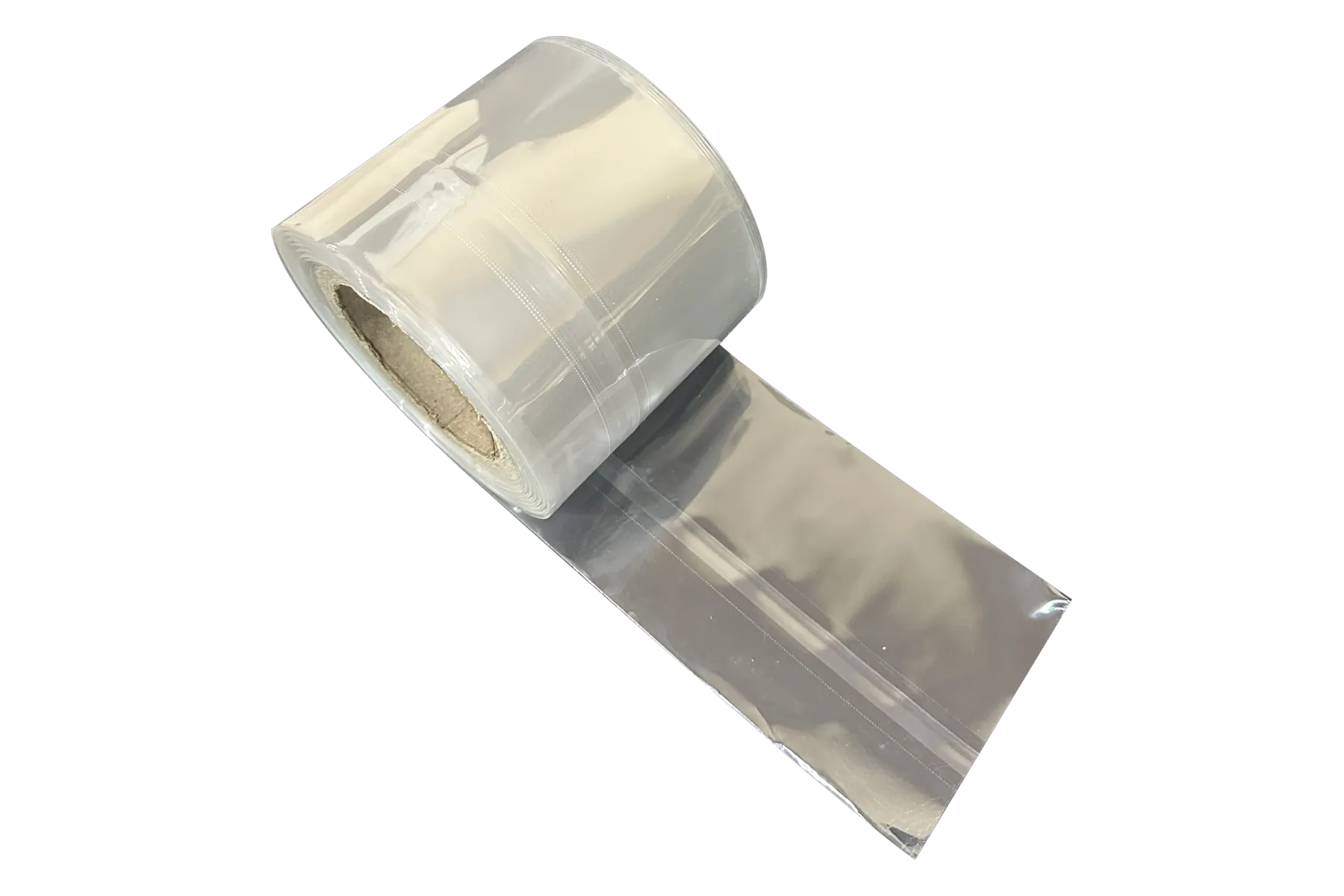
Clear PETG Shrink Tubing
How PETG heat shrink film behaves on the line
The film stays flat and stable through normal storage, printing and seaming, and only contracts once the shrink tunnel brings the film itself to about 95–100°C — in steam, hot air or a hot-water bath. Because the sleeve films in the range are stretched across the width only, nearly all of that shrink goes around the container. Sleeve height barely changes (MD ≤ 3.0% on Clear, White and RPET), which is what keeps logos, barcodes and small type in proportion.
The mechanism is explained in how PETG shrink film works; zone-by-zone tunnel settings are in PETG shrink tunnel temperature.
Shared across the range
| Property | Value |
|---|---|
| Density (ASTM D 1505) | 1.32 ± 0.02 g/cm³ (Clear, CPET, RPET) · 1.32 ± 0.03 (Bidirectional) · 1.40 ± 0.02 (White) |
| Surface tension (ASTM D 2578) | ≥ 38 mN/m — takes gravure, flexo and UV inkjet ink without corona pre-treatment |
| Friction coefficient (ASTM D 1894) | Static ≤ 0.60 · dynamic ≤ 0.55 |
| Shrink test condition | ASTM D 1204, 95°C, 10 s |
| Film temperature for full shrink | 95–100°C |
| Certifications | GRS · REACH · RoHS |
PETG vs PVC vs OPS shrink film
PETG, PVC and OPS are the three sleeve films most programs choose between.
| PETG | PVC | OPS | |
|---|---|---|---|
| Polymer family | Polyester (glycol-modified PET copolyester), chlorine-free | Chlorine-containing vinyl polymer | Oriented polystyrene (styrenic), resin code RIC 6 |
| Transverse shrink | Highest of the three; holds deep and full-body contours | Lower ceiling; fine on cylinders and gentle tapers | Moderate to high; best on straight-wall shapes |
| Machine-direction shrink | Low and controlled | Higher, less controlled | Very low |
| Tunnel behavior | Wants a hotter, even tunnel; wide, forgiving shrink window | Shrinks at lower temperature and reacts fast; narrow margin before over-shrink | Lowest onset temperature and low shrink force |
| In PET bottle recycling | A polyester the PET melt can tolerate as off-spec material; the CPET film is recovered with the bottle | Trace amounts contaminate recycled PET | A foreign styrenic in the PET stream |
| Relative resin cost | Premium | Lower | Economical, high-yield |
| Best fit | Deep contours and full-body sleeves, premium transparent finishes, programs with a recycling commitment | Simple cylindrical shapes on cost-driven, non-export runs | Squeezable and soft-wall containers, heat-sensitive products, low-energy lines; brittle under impact and cold |
Full comparisons: PETG vs PVC shrink film and PETG vs OPS shrink film. Bundling films and compostable films are different questions again — see PETG vs POF and PETG vs PLA.
PETG or PET shrink film? One family, two names
Buyers ask for this material under both names. In shrink sleeves, a request for PET shrink film is in practice a request for PETG: the glycol-modified grade stays amorphous and shrinks smoothly, whereas plain bottle-grade PET crystallizes when it is reheated — ideal for a bottle, wrong for a sleeve. Two names in our range deserve a word. RPET is a PETG grade made with recycled content and is specified in the same way as the clear film. CPET film is the one crystalline PET grade in the range, made so that a sleeve can be recycled together with the PET bottle. The chemistry is set out in PET vs PETG shrink film.
PETG shrink film by application
These are the films converters most often specify in each industry; every industry page has its own film-selection table and FAQ.
| Industry | Films most often specified | Film-selection page |
|---|---|---|
| Food and beverage — bottles, cans, cups, dairy | Clear PETG · White PETG · CPET · RPET · PETG Bidirectional | Shrink sleeve film for beverage bottles |
| Cosmetics and personal care — perfume bottles, jars, pump bottles | Clear PETG · White PETG · RPET · CPET | Shrink sleeve film for cosmetics |
| Pharmaceutical and health products — medicine and supplement bottles | Clear PETG · CPET | Shrink sleeve film for pharmaceutical packaging |
| Home and daily necessities — trigger sprays, detergent bottles | Clear PETG · White PETG · RPET · PETG Bidirectional | Shrink sleeve film for household products |
| Electronics and appliances — battery multi-packs, blister-card sleeves | Clear PETG · RPET | Shrink sleeve film for battery packaging |
| Automotive and industrial — lubricant and engine-oil bottles | Clear PETG · PETG Bidirectional | Shrink sleeve film for automotive and industrial |
Guides for specifying PETG shrink film
References buyers and converters use when writing a film specification.

How to Choose a PETG Shrink Film Supplier
A buyer's framework for sourcing PETG shrink film: which specs, COA line items, certifications, sample terms, and export-packing details to demand before paying.

PETG Shrink Film Problems: Defects, Causes & Fixes
How the common PETG shrink-sleeve defects arise across tunnel type, tension, temperature, and film grade — and how to diagnose, fix, and prevent each on the production line.
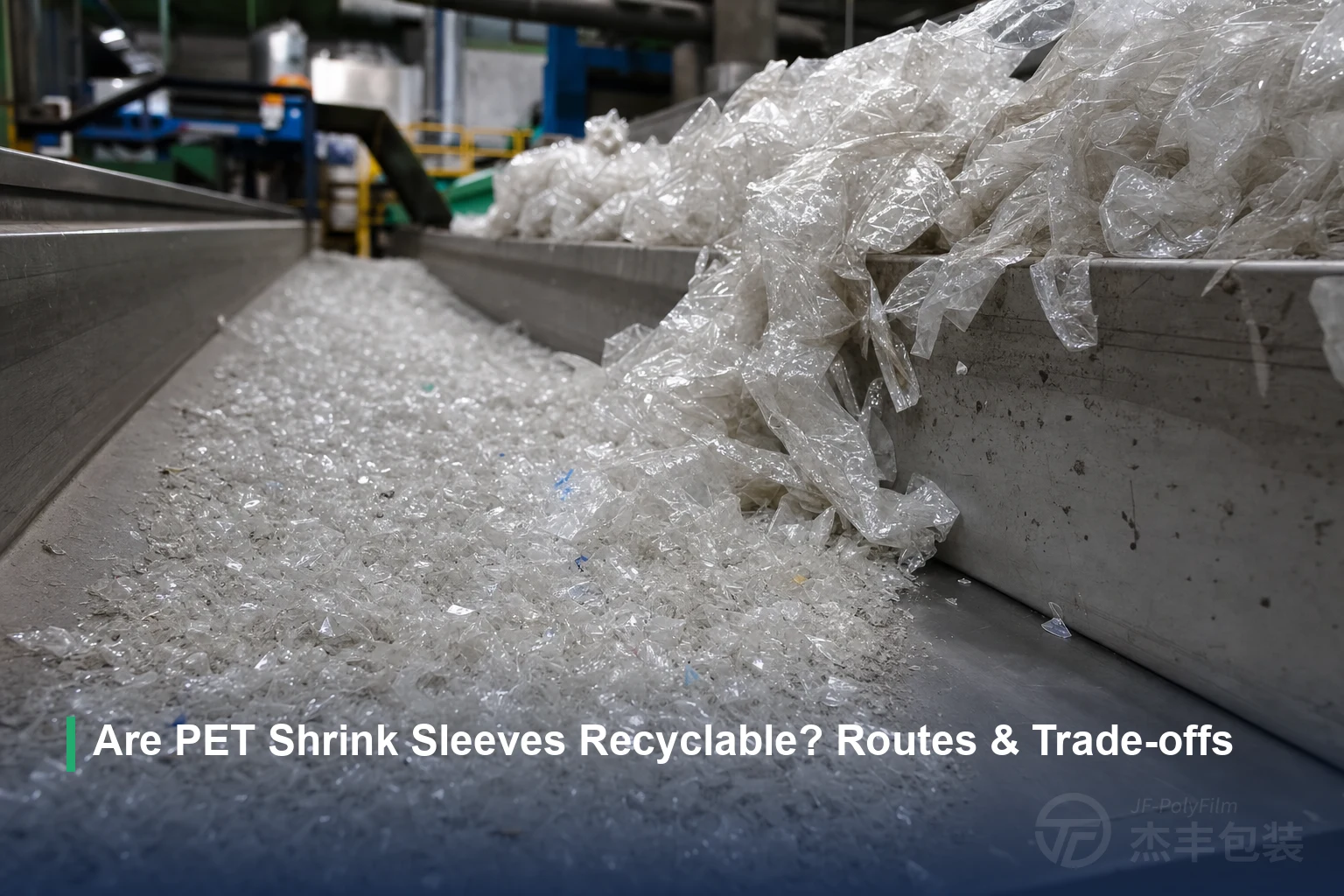
Are PET Shrink Sleeves Recyclable? Routes & Trade-offs
How PET shrink sleeve labels move through bottle recycling — the three design routes that keep them out of the contamination pile, and how US, EU, and China rules now judge them.

What Is a Shrink Sleeve Label?
How shrink sleeve labels wrap a container 360°, why the film shrinks, the materials they use (PETG, PVC, OPS, PLA), how they print and recycle, and how to choose a grade.
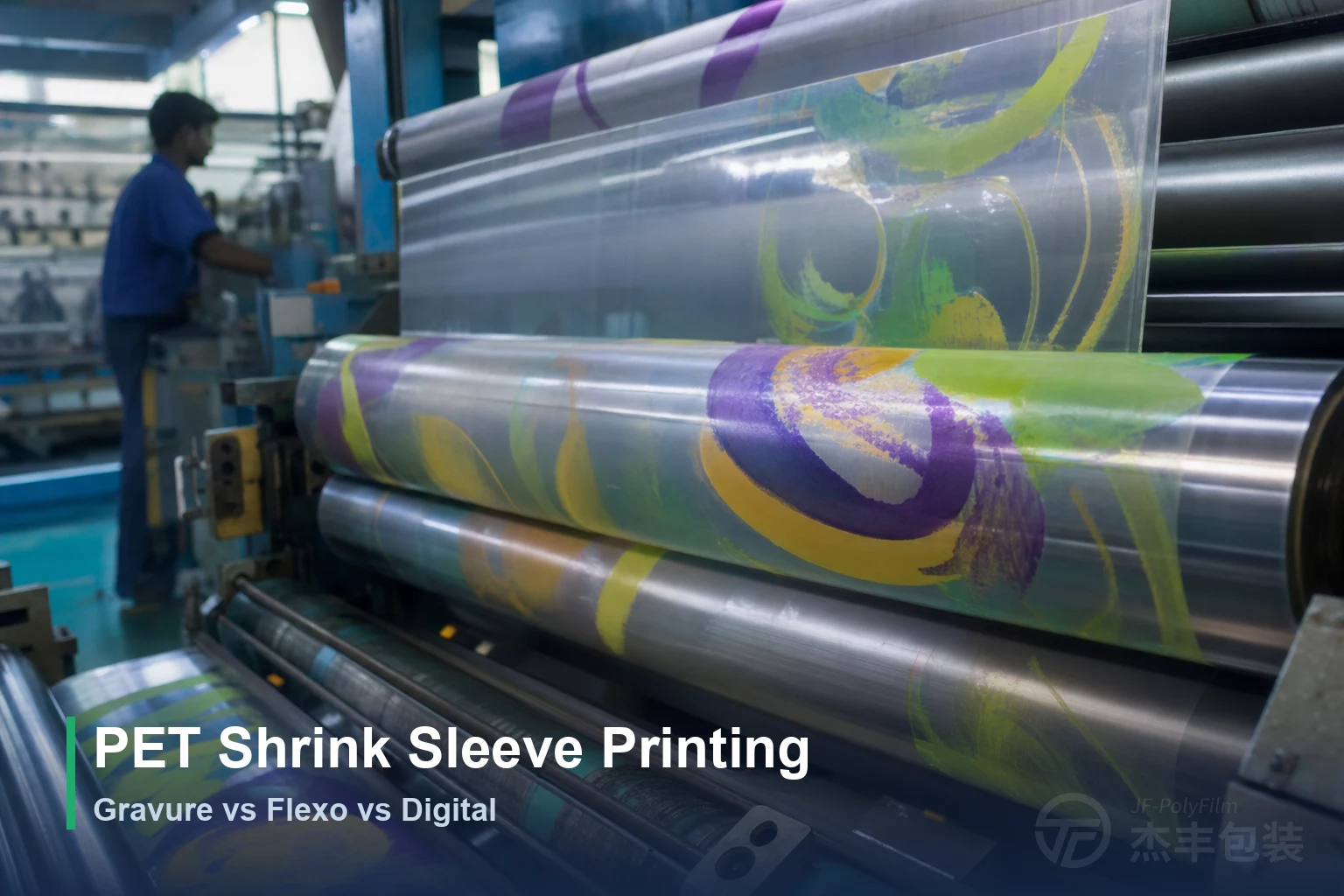
PET Shrink Sleeve Printing: Gravure vs Flexo vs Digital
How rotogravure, flexography, and digital printing differ on PET shrink sleeves — plate cost, run-length economics, variable data, reverse printing, distortion compensation, and ink-to-shrink matching.
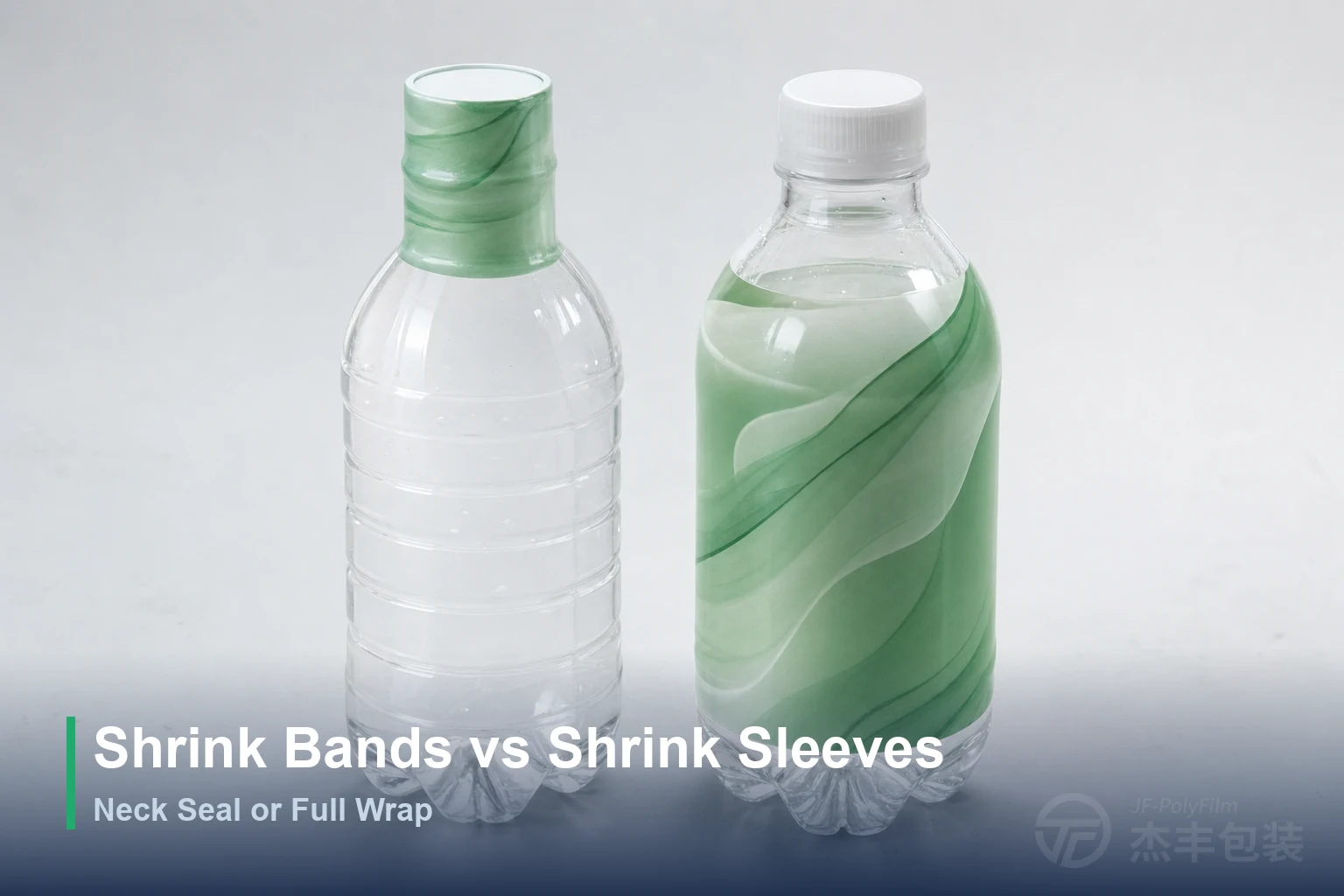
Shrink Bands vs Shrink Sleeves: Neck Seal or Full Wrap
Choosing between a tamper-only neck band and a full-body shrink sleeve — what each format covers, the film and converting behind them, and when one film does both jobs.
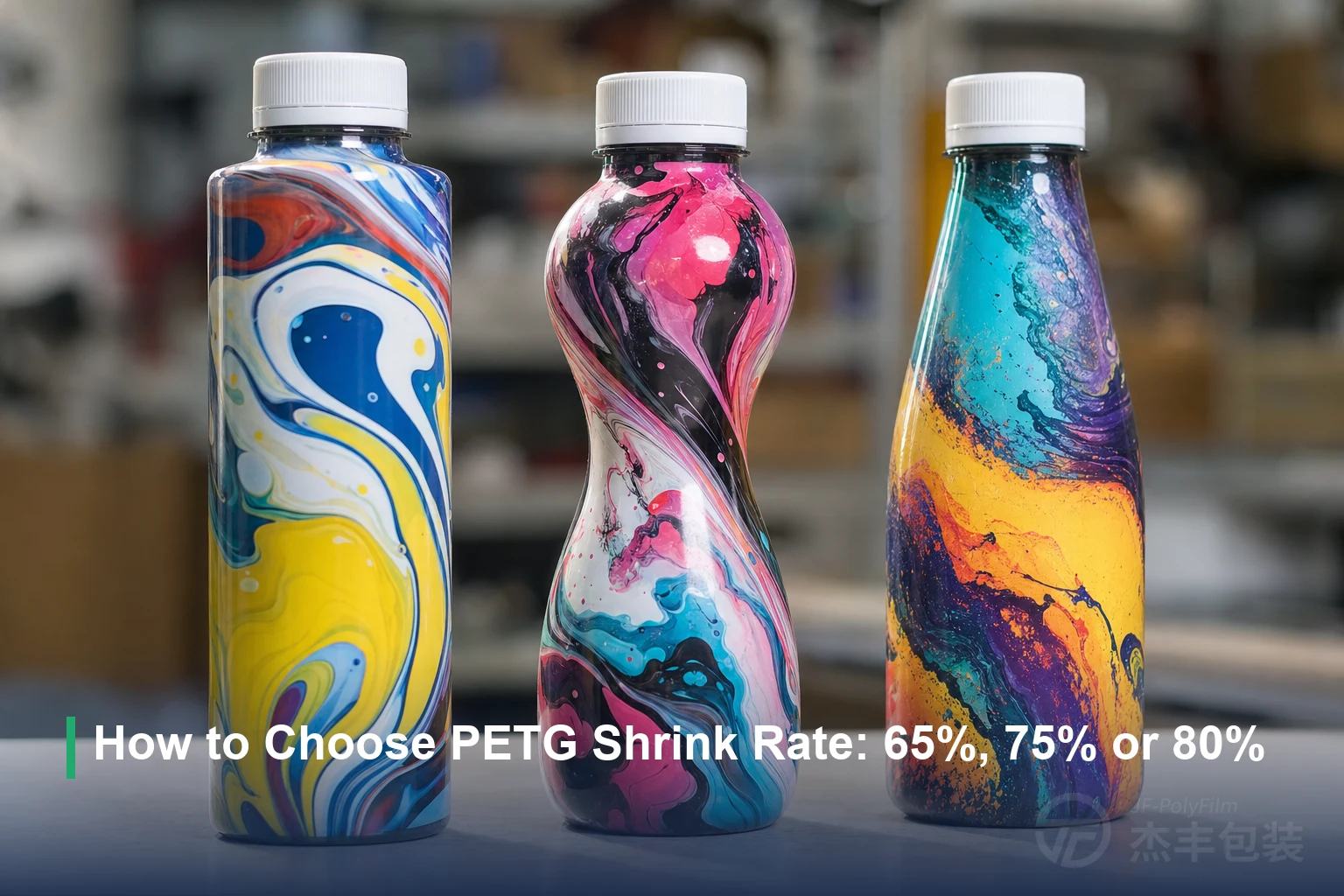
How to Choose PETG Shrink Rate: 65%, 75% or 80%
Size a PETG shrink sleeve by bottle shape: measure the curve, calculate the shrink you need, and route it to the 65%, 75%, or 80% tier without over-buying.

Clear vs White PETG Shrink Film: Which to Choose
Choosing clear vs white PETG shrink film comes down to two questions: does the pack need to show the product, and does the fill need protection from light? A practical selection guide.
PETG Shrink Film FAQ
We currently run PVC shrink film. What changes if we switch to PETG?
Is the same film used for full-body sleeves and tamper-evident neck bands?
What should I send to get a quotation for PETG shrink film?
Why does one film in the range shrink in both directions?
Ready to discuss your shrink film project?
Send your specifications — shrinkage, thickness, volume, destination — and we will respond within 24 hours with samples and a quote.