
PETG Shrink Film Problems: Defects, Causes & Fixes
How the common PETG shrink-sleeve defects arise across tunnel type, tension, temperature, and film grade — and how to diagnose, fix, and prevent each on the production line.

PETG shrink film is the glycol-modified PET material printed and seamed into full-body sleeve labels and tamper-evident bands, and its defects are best understood as a single material reacting to mismatched conditions. The film carries stored orientation that releases as heat lifts it toward its softening range; whenever heat, application tension, container geometry, or film grade fall out of alignment, that release goes wrong and a recognizable defect appears on the sleeve. Five defect families account for nearly all of them: bubbling and fisheyes, tearing and cracking, incomplete shrink, wrinkling and uneven shrink, and graphic distortion.
Key takeaways
- A film grade chosen with too little transverse-direction shrink cannot be rescued with extra tunnel heat, so grade selection — not line tuning — decides whether a deep contour will ever seat.
- Graphic distortion is intrinsic to the format and is corrected in prepress, never on the line, by pre-warping artwork against measured TD/MD ratios.
Why PETG shrink defects happen: heat, tension, geometry, film grade
| Defect | Likely cause | Fix |
|---|---|---|
| Bubbling and fisheyes | Tunnel set too hot, uneven heat distribution, conveyor too fast for trapped air to vent, or film that absorbed storage moisture | Lower the set point in 2–3°C steps, balance airflow or steam distribution, slow the conveyor, and keep rolls sealed and dry until they reach the line |
| Tearing and cracking | Application tension too high (or too low), stress concentration at shoulders and faceted edges, film too thin for the contour, or local embrittlement from overheating | Trim applicator tension to the minimum that places the sleeve cleanly, match thickness to the deepest contour within 30–60 μm, and ramp heat gradually across zones |
| Incomplete shrink | Set point too low, dwell time too short, conveyor too fast, or a grade whose transverse-direction shrink ceiling sits below what the container demands | Confirm the grade’s TD figure against the deepest taper first; if the grade can reach it, add heat, extend dwell, or slow the line |
| Wrinkling and uneven shrink | Asymmetric heat across zones, off-center or skewed sleeve placement, stray external air currents, or unequal steam pressure between the two tunnel sides | Use independent multi-zone control, balance airflow or steam distribution, close off stray drafts, and center the sleeve before it enters heat |
| Graphic distortion | Intrinsic to the format — printed film changes dimension as it conforms — not a line fault | Compensate in prepress: pre-warp artwork against measured TD/MD ratios and verify with a printed grid sample before the run |
Incomplete shrink: temperature, dwell, and grade selection
Raising tunnel temperature to chase incomplete shrink will often start producing bubbles if the real fault was dwell time or grade selection.
This is where PETG’s headroom matters — its TD shrink ceiling near 75–80% reaches well past the 50–60% range typical of PVC, as the broader PETG versus PVC shrink film comparison details, which is why deep contours are a PETG application in the first place.
Matching film grade to bottle geometry
Standard clear and white PETG, along with recycled-content RPET, reach a transverse-direction shrink of ≥75% with machine-direction movement held to ≤3.0%, which suits the majority of full-body sleeves on contoured bottles where nearly all travel is around the container. White grades add light-blocking opacity, carrying haze ≥100% and transmittance ≤30% for dairy and light-sensitive contents, while holding the same shrink profile.
Prevention over troubleshooting: storage, sampling, and shrink testing
Storage comes first: PETG slowly absorbs ambient moisture, and a roll held in humidity will fisheye and blister regardless of tunnel tuning, so stock belongs at 10–30°C in a dry, dark space inside sealed packaging, worked through within roughly a twelve-month window.
Frequently Asked Questions
Why does PETG shrink film bubble during the shrinking process?
What causes a PETG shrink sleeve to tear or crack?
How is incomplete or low shrinkage on PETG sleeves corrected?
Related Articles
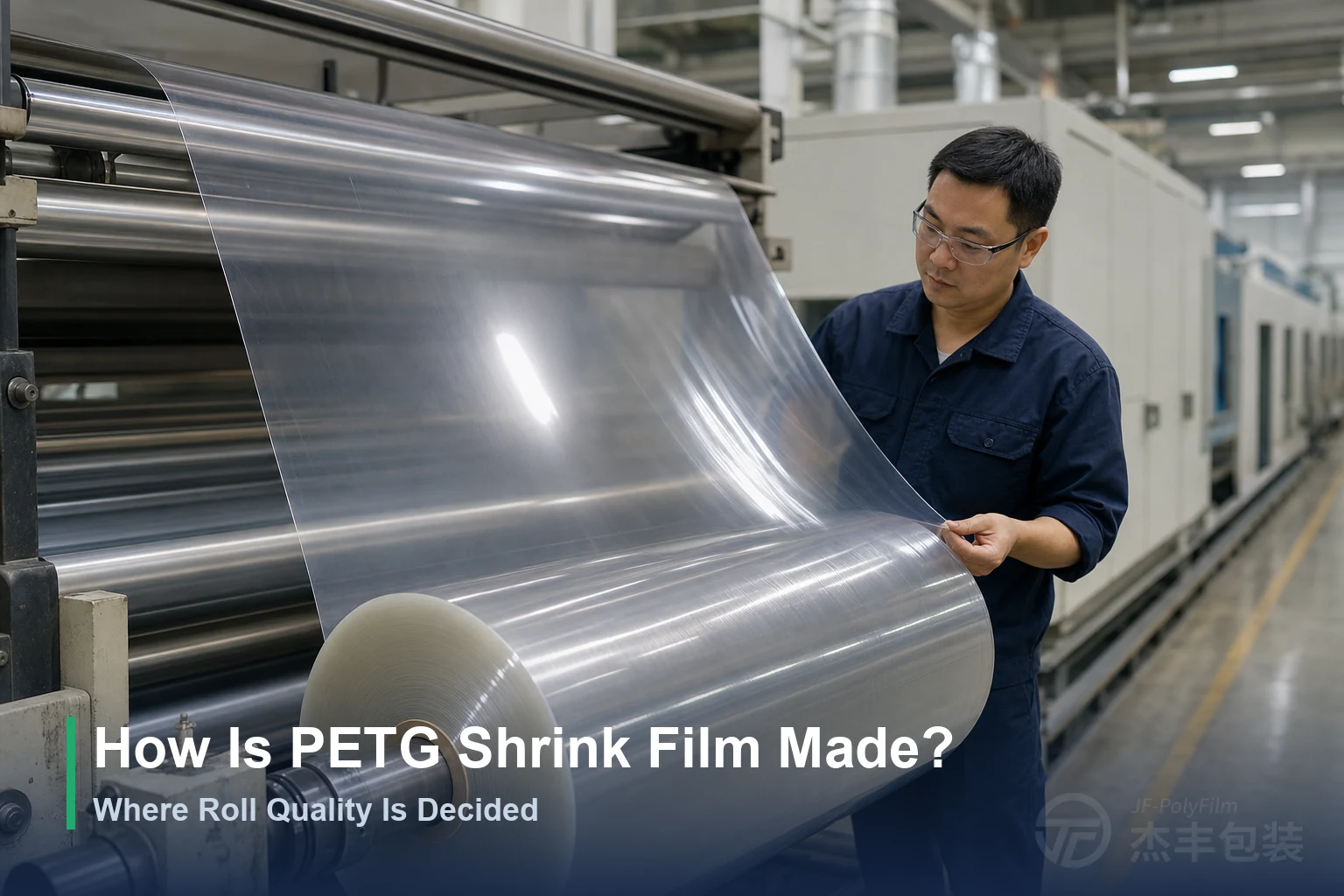
How Is PETG Shrink Film Made? Where Roll Quality Is Decided
How PETG shrink film is made, and which production stage sets each line buyers check on arrival: gauge tolerance, TD/MD shrink, haze, tensile strength, roll labels.
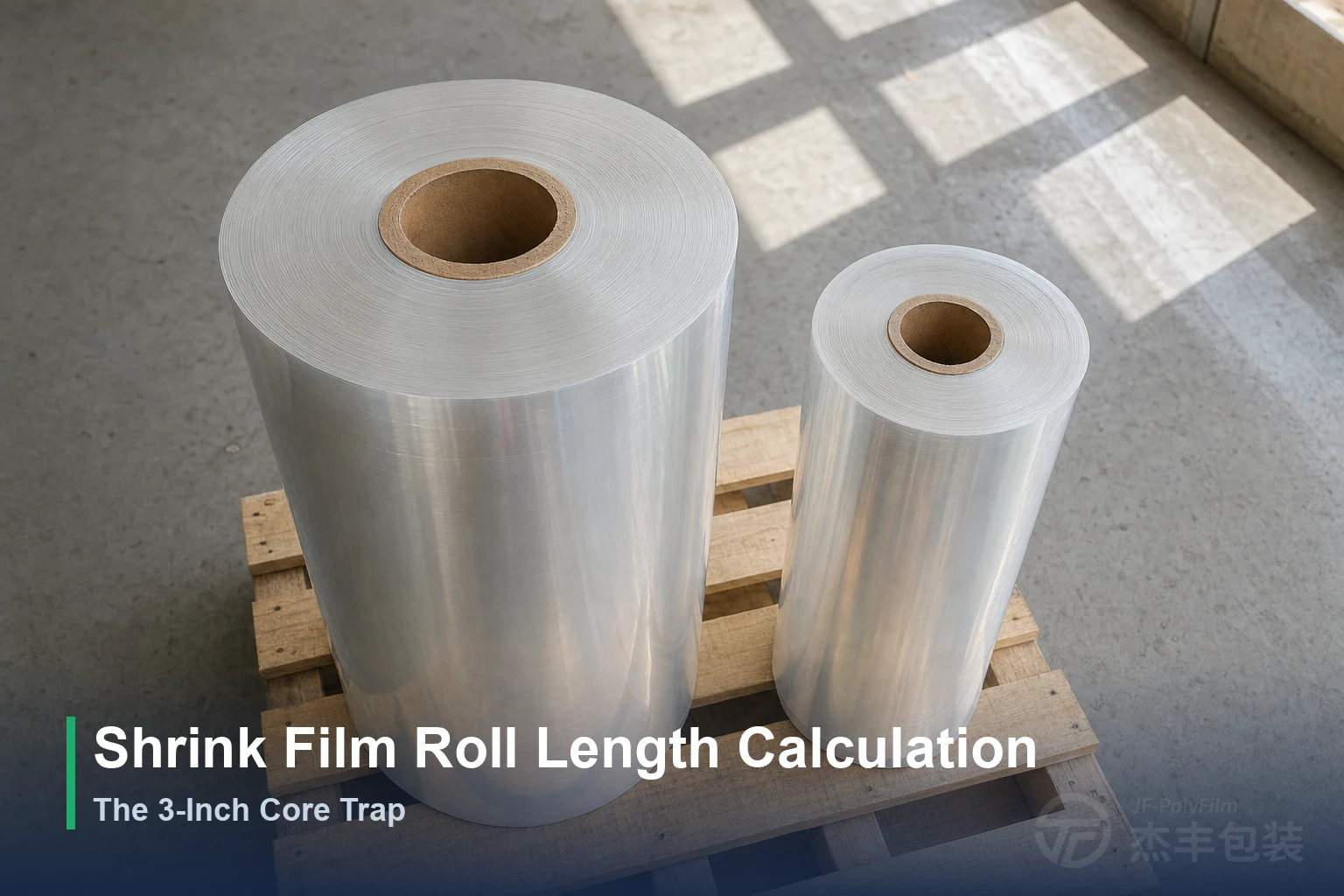
Shrink Film Roll Length Calculation: The 3-Inch Core Trap
Formulas linking roll diameter, length and weight, worked metric and imperial examples, a 30–60 μm diameter table, and why core size and trapped air shift the result.
Need Expert Advice on Shrink Film?
Our technical team can help you choose the right film for your application.
Contact Us