
PETG vs PVC Shrink Film: Shrinkage, Recycling & Cost
PETG vs PVC shrink film compared on shrinkage, distortion control, clarity, PET recycling, chlorine, and delivered cost — plus where each still fits.
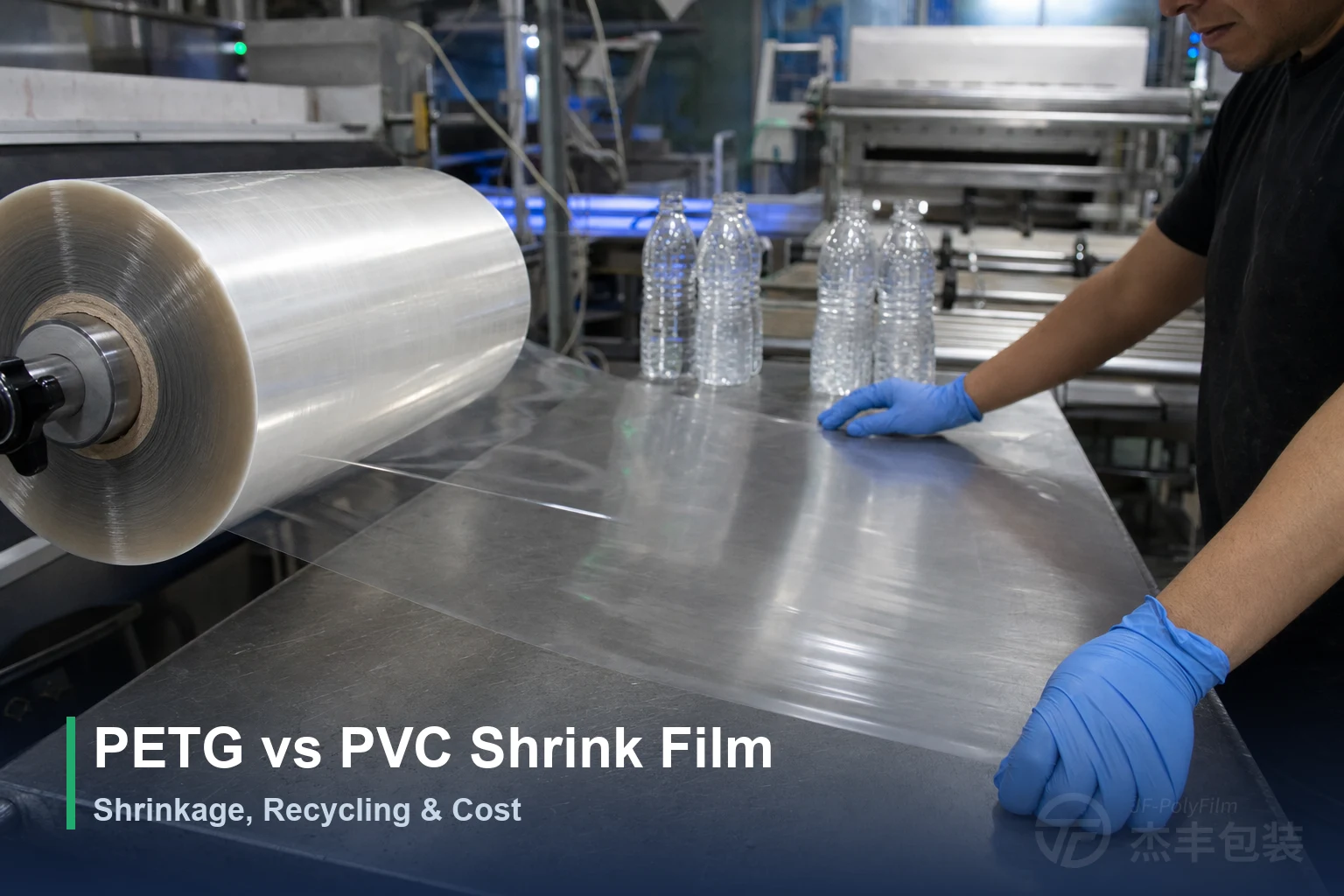
PETG is a higher-shrink, chlorine-free polyester film that conforms tightly to shaped bottles, while PVC holds a lower resin cost but a lower shrink ceiling and carries chlorine through incineration and recycling. A new sleeve program therefore usually defaults to PETG — though the recycling question is subtler than the slogans suggest, which is where most of this comparison goes.
- PETG reaches roughly 70-78% transverse shrink (commonly specified at ≥75%) against PVC’s ~50-60%, the single biggest reason brands switch for shaped containers.
- PVC is about 57% chlorine by weight; incineration can form dioxins, and even trace PVC degrades recycled PET, whereas PETG entering the same stream is melt-filterable.
PETG vs PVC at a glance
For shaped containers and recycling-conscious programs, the films supplied here include high-clarity PETG shrink film at ≥75% TD shrinkage, alongside a bottle-compatible CPET grade for RIC 1 recovery.
| Property | PETG | PVC |
|---|---|---|
| Transverse shrink (TD) | ~70-78% (commonly ≥75%) | ~50-60% |
| Machine-direction shrink (MD) | Low, typically ≤3% | Higher, less controlled |
| Clarity / gloss | Glass-clear, high gloss, holds clarity | Good, lower gloss, yellows with age |
| Chlorine | Chlorine-free | ~57% chlorine by weight |
| Behavior in PET recycling | Off-spec but melt-filterable; CPET variant recovers with bottle | Trace amounts contaminate recycled PET |
| Relative resin cost | Modest premium | Lower |
Optical targets — light transmission, haze, and gloss thresholds, and how to read them on a spec sheet — are covered in the transparent label film performance guide.
Shrinkage and fit: why curvature decides
A sleeve has to contract by whatever percentage the deepest waist or narrowest neck demands, and a film topping out near 60% cannot close that gap on a deeply contoured or full-body shape.
Uneven heat is the usual cause of distortion on either film — a tunnel-tuning matter rather than a material fault — and the common PETG application defects are treated separately.
Recyclability: the part most comparisons get wrong
The honest, bottle-compatible route is crystallizable PET — CPET shrink film shares the bottle’s chemical composition and a 230°C melting point, so the sleeve recovers together with the bottle in the RIC 1 PET stream with no separation step required. The wider toolkit of floatable grades, perforations, and wash-off inks that let a sleeve release in the wash is covered in the PET shrink sleeve recyclability guide.
Chlorine, incineration, and the regulatory direction
Chlorine is the root of PVC’s regulatory exposure, and it is structural: PVC is about 57% chlorine by weight, not an additive that can be reformulated out. Incinerated, that chlorine can combine with organic matter to form dioxins and furans, a class of persistent pollutants, and the same chlorine is what contaminates recycled PET.
Cost: resin price versus delivered cost
On raw resin, PVC is the cheaper film and PETG commands a modest premium — that part of the old reputation is accurate, and worth stating plainly. PETG’s higher shrinkage lets a single sleeve geometry run on less film, and the same shrink reserve allows down-gauging to thinner stock while still drawing in tightly, so each finished label consumes less material. Both effects pull consumption down and partly offset the higher per-kilogram price, making the delivered-cost gap narrower than the resin quotes alone imply.
When PVC is still the honest choice
PVC has not vanished, and pretending it has would not help a buyer. It stays defensible in a specific corner: simple cylindrical or lightly tapered geometries that never test the shrink ceiling, cost-driven domestic or non-export runs where the lowest material price genuinely dominates, and lines built around existing PVC tunnels — PET-family labels generally run on those tunnels without major retooling, but a converter already amortized on PVC has little reason to switch on a job PVC handles well.
Frequently Asked Questions
Can PETG shrink film be recycled in the PET bottle stream?
Is PVC shrink film banned for packaging?
Does switching from PVC to PETG raise packaging cost?
Related Articles
How Is PETG Shrink Film Made? Where Roll Quality Is Decided
How PETG shrink film is made, and which production stage sets each line buyers check on arrival: gauge tolerance, TD/MD shrink, haze, tensile strength, roll labels.
Shrink Film Roll Length Calculation: The 3-Inch Core Trap
Formulas linking roll diameter, length and weight, worked metric and imperial examples, a 30–60 μm diameter table, and why core size and trapped air shift the result.
Need Expert Advice on Shrink Film?
Our technical team can help you choose the right film for your application.
Contact Us