
Transparent Label Film: What Determines Optical Performance
How haze, transmittance, clarity, and gloss define a transparent label film, what material and thickness do to each, how shrinking changes the optics, and how to read a spec sheet.

A transparent label film is a clear plastic film, usually amorphous PETG, printed and heat-shrunk into a full-body sleeve so the container shows through while branding and regulatory text ride on the film. Its “transparency” is not a single property but four measurable ones: light transmittance, haze, clarity, and gloss.
The four optical metrics that define transparency
“Transparency” on a spec sheet is four separate measurements, each capturing a different way light behaves as it passes through the film.
| Metric | What it measures | What it controls visually |
|---|---|---|
| Light transmittance | Share of light passing through | Brightness and color fidelity |
| Haze | Wide-angle scatter (>2.5°) | Milky vs. truly clear |
| Clarity | Narrow-angle scatter (<~0.1°) | Sharpness of detail seen through |
| Gloss (45°) | Surface specular reflection | Wet, premium shine vs. matte |
Why clarity is not haze
Clarity and haze answer two different questions and are not interchangeable, even though both describe a clear film. Haze describes how milky the film looks overall; clarity describes how sharply detail resolves through it. A film can score well on one and poorly on the other.
What determines a film’s optical performance
PETG is glycol-modified: bulky cyclohexanedimethanol ring units are built into the chain, disrupting the regular packing that crystals need. The result is an amorphous polymer with essentially no crystallites to scatter light, which is the physical reason PETG reaches glass-like clarity and transmittance above 90 percent.
A thicker film gives light more material to travel through, so transmittance edges down and haze edges up as gauge increases.
How shrinking changes the optics
Three effects are at work. First, as the film contracts in the transverse direction it thickens locally, and the added material path raises haze slightly and trims transmittance, the same thickness effect introduced by the process rather than the order.
Diagnosing and tuning those tunnel conditions is a process discipline in its own right, walked through in the guide on solving PETG shrink film problems.
Staying clear over time: yellowing and UV resistance
Optical performance also has to survive the shelf, and the property that decides this is resistance to yellowing, the trait behind the reputation of an anti-yellowing shrink film.
PETG holds b* well under normal indoor and retail conditions, which is its clearest optical advantage over PVC; PVC can yellow and embrittle as it ages, while polyester chemistry stays neutral far longer.
Claiming a standard transparent grade is fully UV-proof would overstate it; the accurate statement is that PETG resists yellowing very well in normal use and benefits from added stabilization for harsh, sun-exposed service.
Reading a transparent film spec sheet
A transparent-film spec sheet is only meaningful when each optical value names the test method beside it, because the same film measured on different instruments and geometries can report different numbers.
| Optical property | ASTM method | GB/T equivalent | Reported as |
|---|---|---|---|
| Light transmittance | ASTM D1003 | GB/T 2410 | % of light passing through |
| Haze | ASTM D1003 | GB/T 2410 | % wide-angle scatter |
| Clarity | ASTM D1746 | — | narrow-angle, lower is sharper |
| Gloss (45°) | ASTM D2457 | GB/T 8807 | gloss units |
Keeping clarity consistent in production
Day-to-day optical consistency comes down to controlling the variables that move haze and clarity from roll to roll, where production discipline matters more than any single headline number.
A clear sleeve that holds its optics from the production line through the retail shelf is the result of that control rather than the resin alone, and clear PETG shrink film is built and tested to that standard for full-body transparent sleeve applications.
Frequently Asked Questions
A spec sheet lists haze but no clarity figure. Is that enough to judge the no-label look?
If ordinary PET is already used for clear bottles, why specify PETG for a transparent sleeve?
Does heat shrinking make a transparent film hazier?
Related Articles
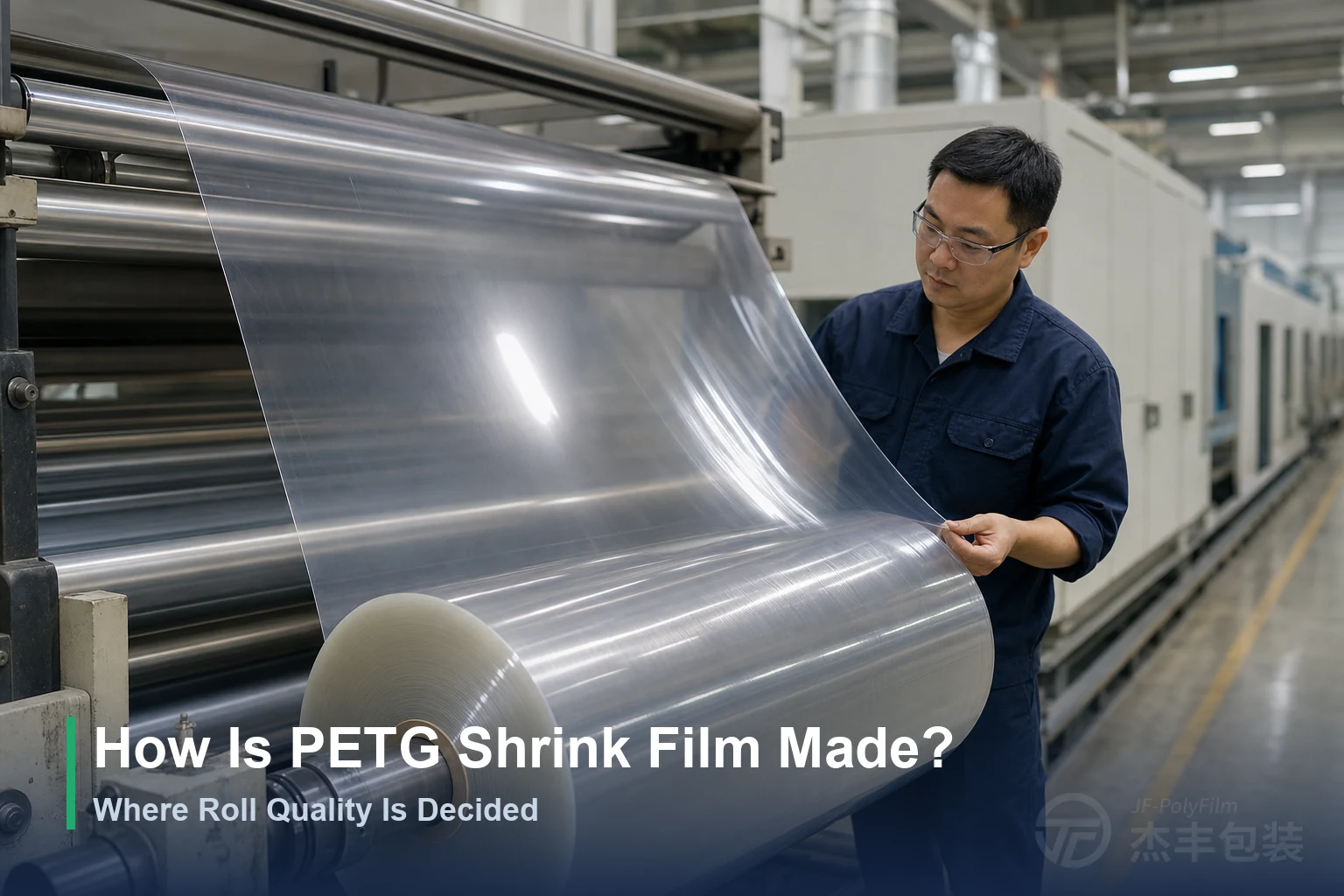
How Is PETG Shrink Film Made? Where Roll Quality Is Decided
How PETG shrink film is made, and which production stage sets each line buyers check on arrival: gauge tolerance, TD/MD shrink, haze, tensile strength, roll labels.
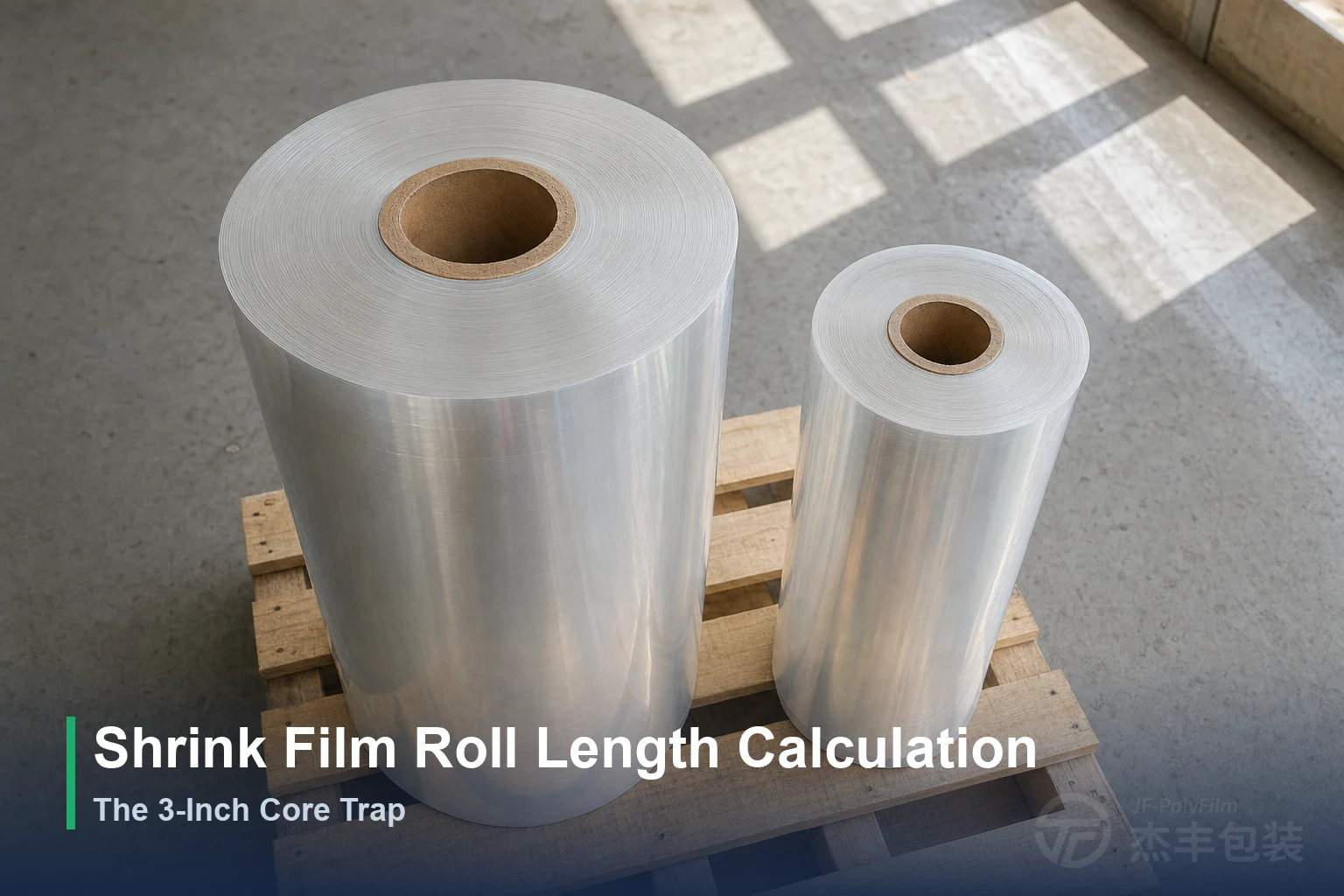
Shrink Film Roll Length Calculation: The 3-Inch Core Trap
Formulas linking roll diameter, length and weight, worked metric and imperial examples, a 30–60 μm diameter table, and why core size and trapped air shift the result.
Need Expert Advice on Shrink Film?
Our technical team can help you choose the right film for your application.
Contact Us