
PETG vs POF Shrink Film: Which Fits the Job?
PETG vs POF shrink film compared by job — directional vs biaxial shrink, recycling streams, gauges and crosslinking — so the right film matches the package.

A search for “PETG vs POF shrink film” usually pits two films that were never built to compete. PETG is a high-shrink polyester used to print full-body sleeve labels that wrap one bottle 360°; POF (polyolefin) is a clear polyethylene-family film used to overwrap or bundle products together. The two solve different problems, so the right pick follows from the job being bought for.
- A sleeve film and a bundling film are not graded on the same scale: one carries print, the other carries load.
- PETG sleeve grade shrinks hard across the bottle — high in the transverse direction — while staying almost still lengthwise, which keeps artwork undistorted.
- POF shrinks by similar amounts in both directions — independent industry sources cite roughly 45–70% — so it closes evenly over a box or bundle.
- PET and CPET sink in water (about 1.28–1.38 g/cm³) and sort into the RIC 1 PET stream; polyolefins float (below 1.0 g/cm³) into a separate stream.
The core split: a label film versus a load film
PETG and POF are best understood as answers to two different questions rather than two grades of one product. One question is how do we put high-resolution graphics on a contoured container? The other is how do we hold a pack of items together, or give a box a clean retail finish? A label film carries print around a single body; a load film encloses one or more items. Almost every “PETG vs POF” decision collapses once the job is named.
The sleeve side has its own internal contest, set out in the PETG vs PVC shrink film comparison.
Directional shrink is the real dividing line
The factor that actually separates these films is not how much they shrink but in which direction.
PETG sleeve film is built for directional shrink: high in the transverse direction (TD, around the body) and very low in the machine direction (MD, along the length). POF is built for near-balanced biaxial shrink: it contracts by comparable amounts on both axes — even enough in each direction to close over every side of a box or bundle without twisting.
Density and the recycling stream: why the resin choice routes the package
PET and CPET are denser than water at roughly 1.28–1.38 g/cm³ and sink; polyolefins fall below 1.0 g/cm³ and float.
A sleeve added to a PET bottle should read as PET; a wrap added to a polyolefin pack should read as polyolefin.
Choosing the right film: matching the film to the job
The decision comes down to one routing question asked before any spec sheet: is the film carrying the brand, or carrying the load? Brand goes on a sleeve-label film; load goes on polyolefin.
| Dimension | PETG shrink film | POF shrink film |
|---|---|---|
| Primary job | Printed sleeve label (carries print) | Bundle / overwrap (carries load) |
| Shrink direction | High TD / low MD (TD ≥75% / MD ≤3.0%) | Balanced biaxial (~45–70%) |
| Resin family / density | PET stream, RIC 1, ~1.28–1.38 g/cm³ (sinks) | Polyolefin, below 1.0 g/cm³ (floats) |
| Ordered by | Thickness in microns (30–60 μm) | Gauge (~45–100) |
| Best fit | Conformable full-body and shaped-bottle labels | Multipacks, frozen, overwrap, pallet loads |
Frequently Asked Questions
Is PETG or POF better for shrink sleeve labels?
What is the difference between POF and PE shrink film?
Can POF film be recycled with PET bottles?
Related Articles
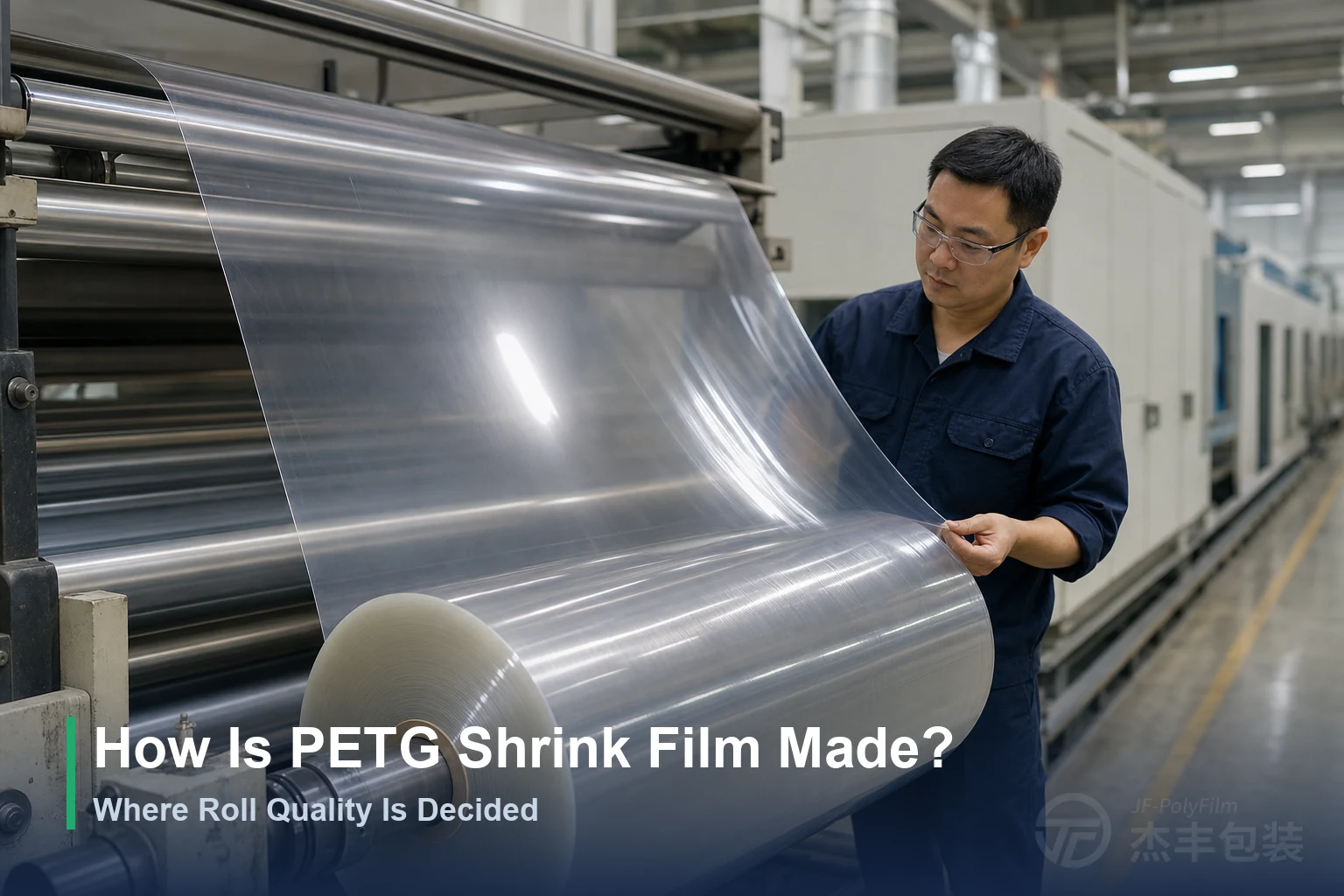
How Is PETG Shrink Film Made? Where Roll Quality Is Decided
How PETG shrink film is made, and which production stage sets each line buyers check on arrival: gauge tolerance, TD/MD shrink, haze, tensile strength, roll labels.
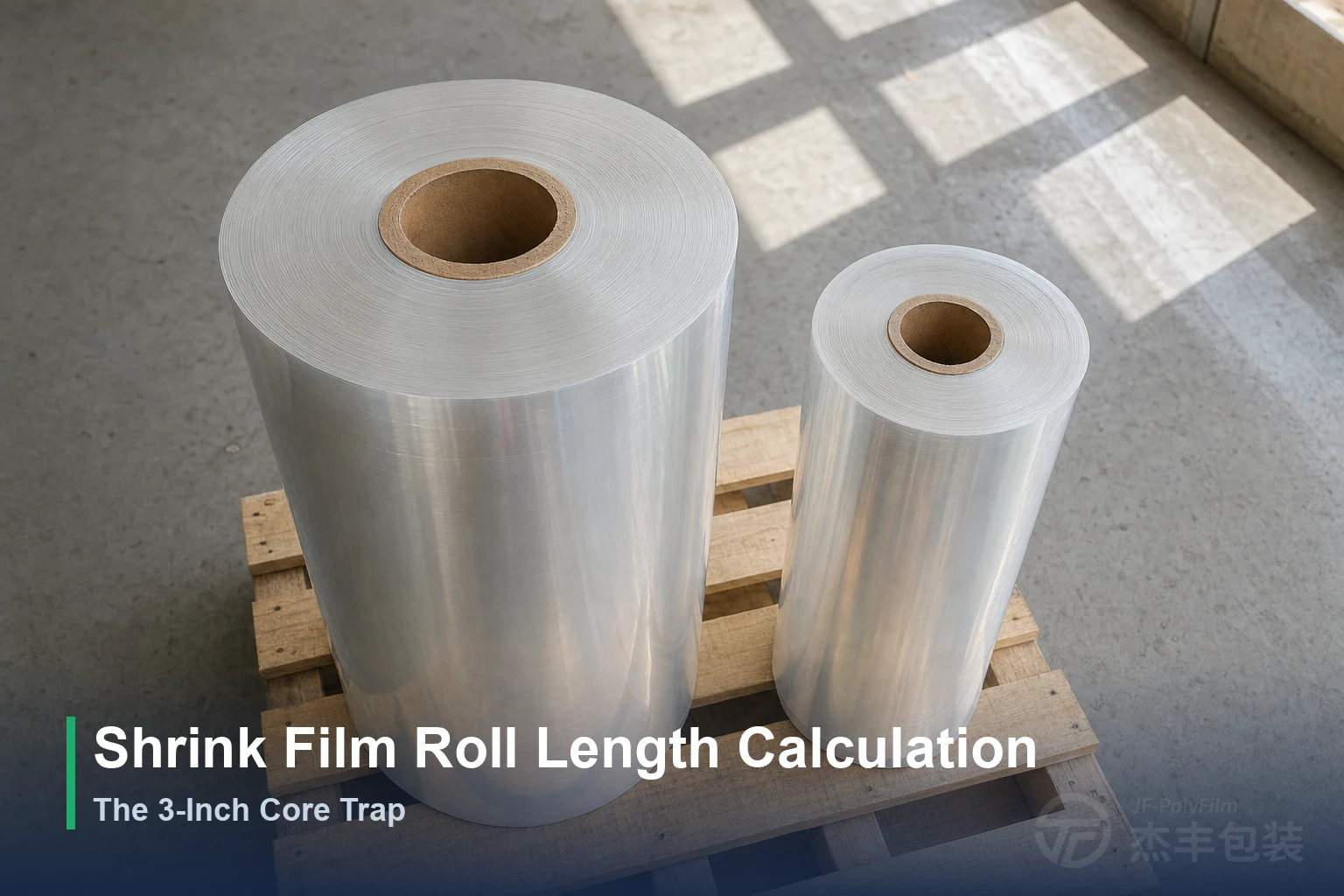
Shrink Film Roll Length Calculation: The 3-Inch Core Trap
Formulas linking roll diameter, length and weight, worked metric and imperial examples, a 30–60 μm diameter table, and why core size and trapped air shift the result.
Need Expert Advice on Shrink Film?
Our technical team can help you choose the right film for your application.
Contact Us