
How to Choose PETG Shrink Rate: 65%, 75% or 80%
Size a PETG shrink sleeve by bottle shape: measure the curve, calculate the shrink you need, and route it to the 65%, 75%, or 80% tier without over-buying.
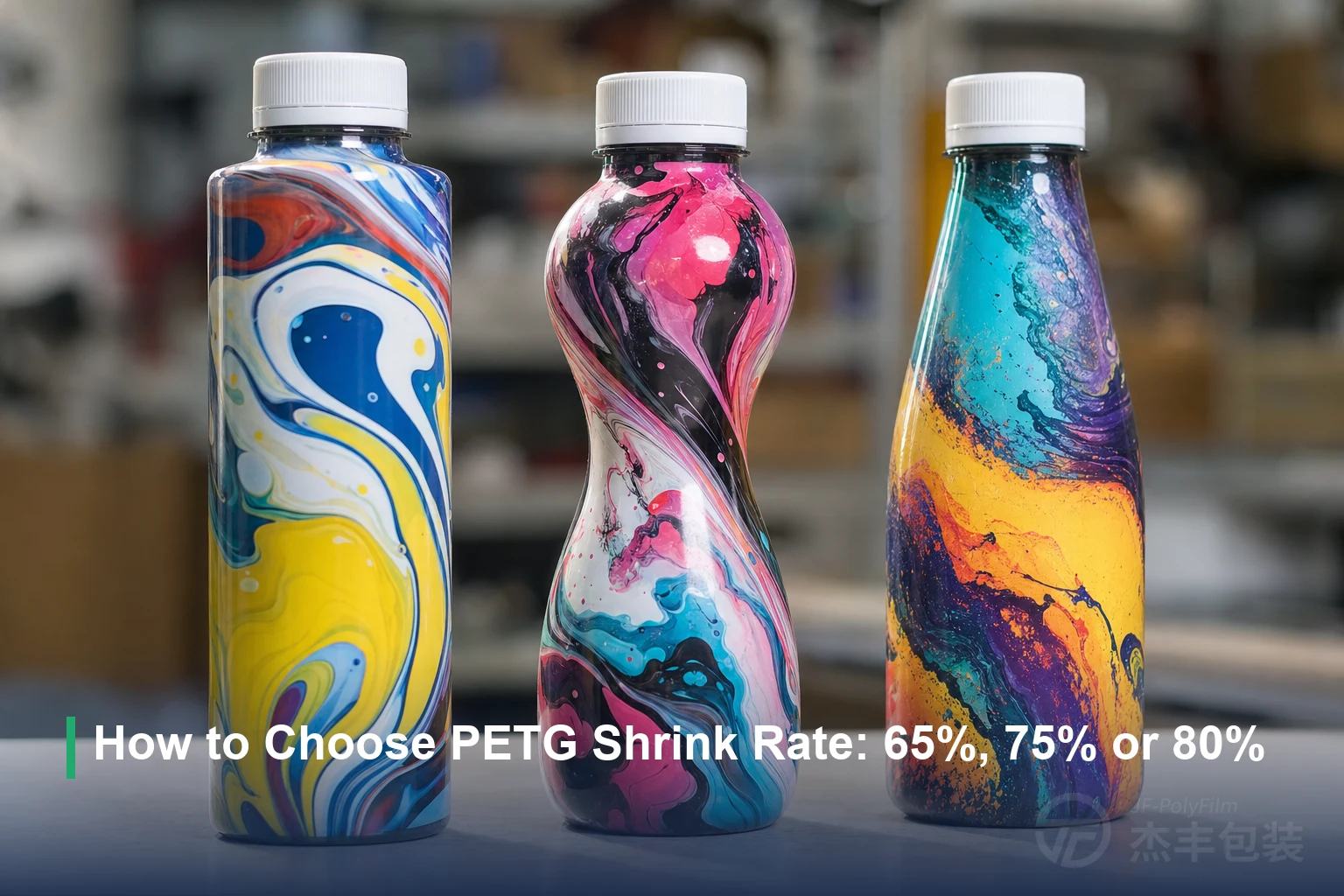
PETG shrink rate is the maximum percentage a printed sleeve can contract sideways in the heat tunnel, and the right figure — 65%, 75%, or 80% — is set by how deeply the bottle curves, not by which number reads strongest on a datasheet.
What the shrink rate actually measures: TD, not MD
Every 65/75/80 figure refers to one axis alone — the transverse direction (TD), the sideways draw that pulls a sleeve in around the container — never the vertical machine direction. Shrinkage is directional, and the two axes do opposite jobs, so reading the wrong one leads straight to the wrong grade.
JFPolyFilm’s clear and white PETG grades keep MD to 3.0% or below while delivering TD of 75% or above; the CPET grade runs MD to 5.0%.
How to calculate the shrink rate a bottle needs
The shrink a container needs is a measurement, not a guess: the required TD comes from two diameters — the narrowest the sleeve must hug and the widest it slips over — as (1 − narrow ÷ wide) × 100. Adding a 1–2% layflat margin, and specifying a film rated a little above the result, leaves headroom for line variation.
- Deep-waisted contour bottle. The sleeve clears a 76 mm shoulder and must tighten into a 34 mm waist: (1 − 34 ÷ 76) × 100 ≈ 55%. Adding the clearance to pass the shoulder and the layflat margin, the film at the waist works near the top of its range, which pushes the choice to a 75% or 80% grade.
Matching the required draw to a tier: 65%, 75%, or 80%
Once the required draw is calculated, it routes to a tier by a simple rule: pick the lowest ceiling that comfortably clears the deepest local contour.
| Tier (max TD) | Local draw it clears | Typical container shape | Example application | Grade fit |
|---|---|---|---|---|
| 65% | Up to ~55% (single to low double digits typical) | Near-straight cups, cylinders, straight-wall bottles | Wide-mouth cups, still water, straight jars | Clear or white PETG at the lower band |
| 75% | ~55–65% — standard bottle contours | Most beverage and household bottles, gentle tapers | Standard PET bottles, gentle-shouldered containers | Clear/white PETG (TD ≥75%), CPET (74±2%) |
| 80% | ~65% and above — deep curves, waists, sharp tapers | Deep-waisted, contoured, or complex asymmetric bottles | Craft-beer contours, hourglass or gripped bottles, ornate cosmetics | Highest-band PETG grades |
Why a higher shrink rate is not always better
Reaching for the highest tier by default is the most common mistake, because past the point where the sleeve meets the surface, extra shrink capacity has nowhere useful to go.
When over-shrink shows up as flowering, curl, or registration drift on the line, the fix belongs to process tuning rather than the spec, walked through in solving PETG shrink film problems.
Why too low a shrink rate leaves the sleeve loose
As a working rule, the rated ceiling should sit several points — roughly five to ten — above the calculated local draw, so the layflat margin, ink suppression, and line drift all have room before the film runs out of contraction.
Verifying a supplier’s stated shrink rate
A datasheet number is a ceiling, not a guarantee, so the last step before committing to a tier is confirming the film actually shrinks to spec.
The only conclusive proof a tier fits is a shrink trial at the target tunnel temperature on the actual bottle, so requesting short rolls or sheets before volume turns the calculated answer into a tested one.
Frequently Asked Questions
What shrink rate do I need for my bottle?
What is the difference between TD and MD shrinkage?
How much can PETG shrink compared with PVC or OPS?
Related Articles
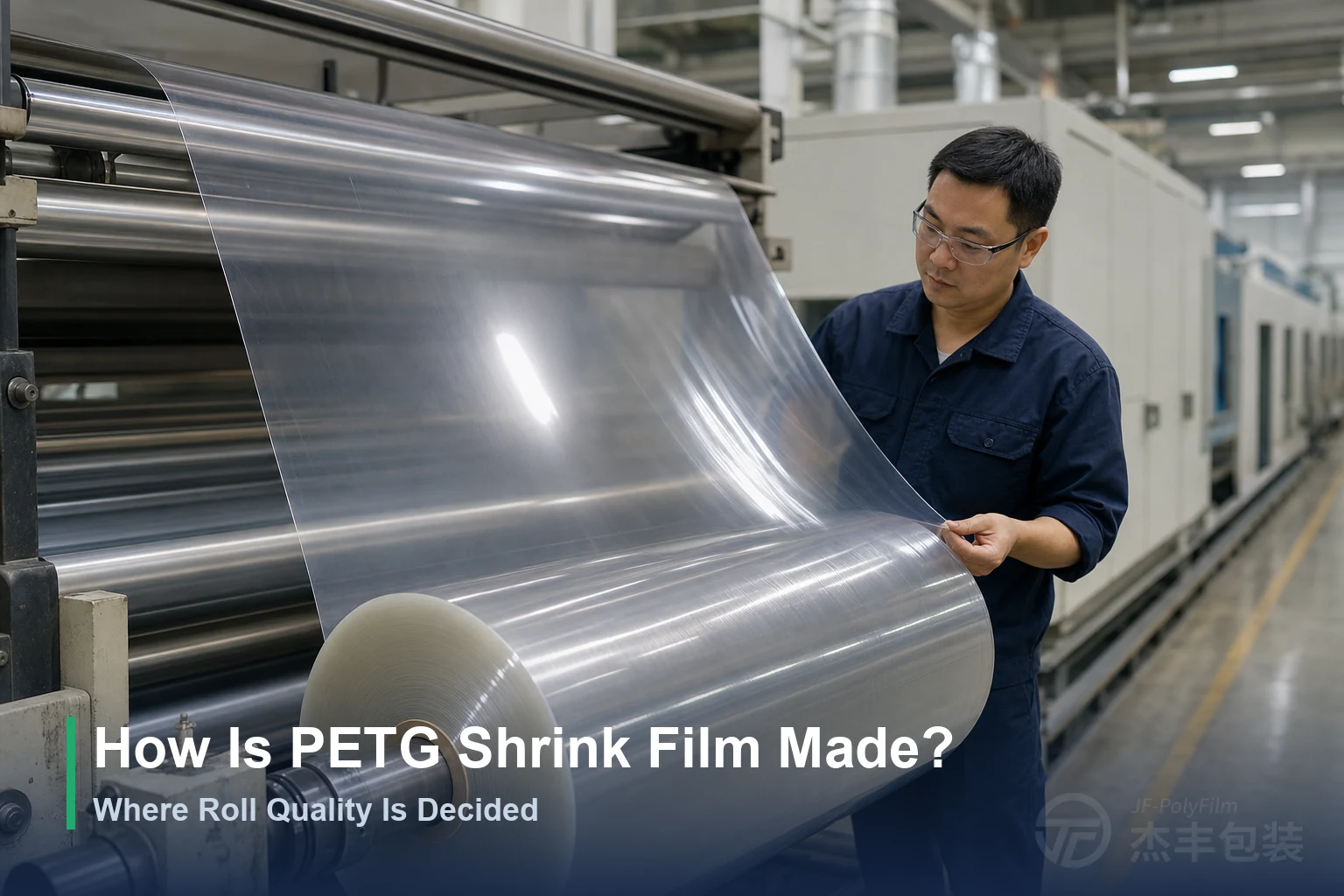
How Is PETG Shrink Film Made? Where Roll Quality Is Decided
How PETG shrink film is made, and which production stage sets each line buyers check on arrival: gauge tolerance, TD/MD shrink, haze, tensile strength, roll labels.
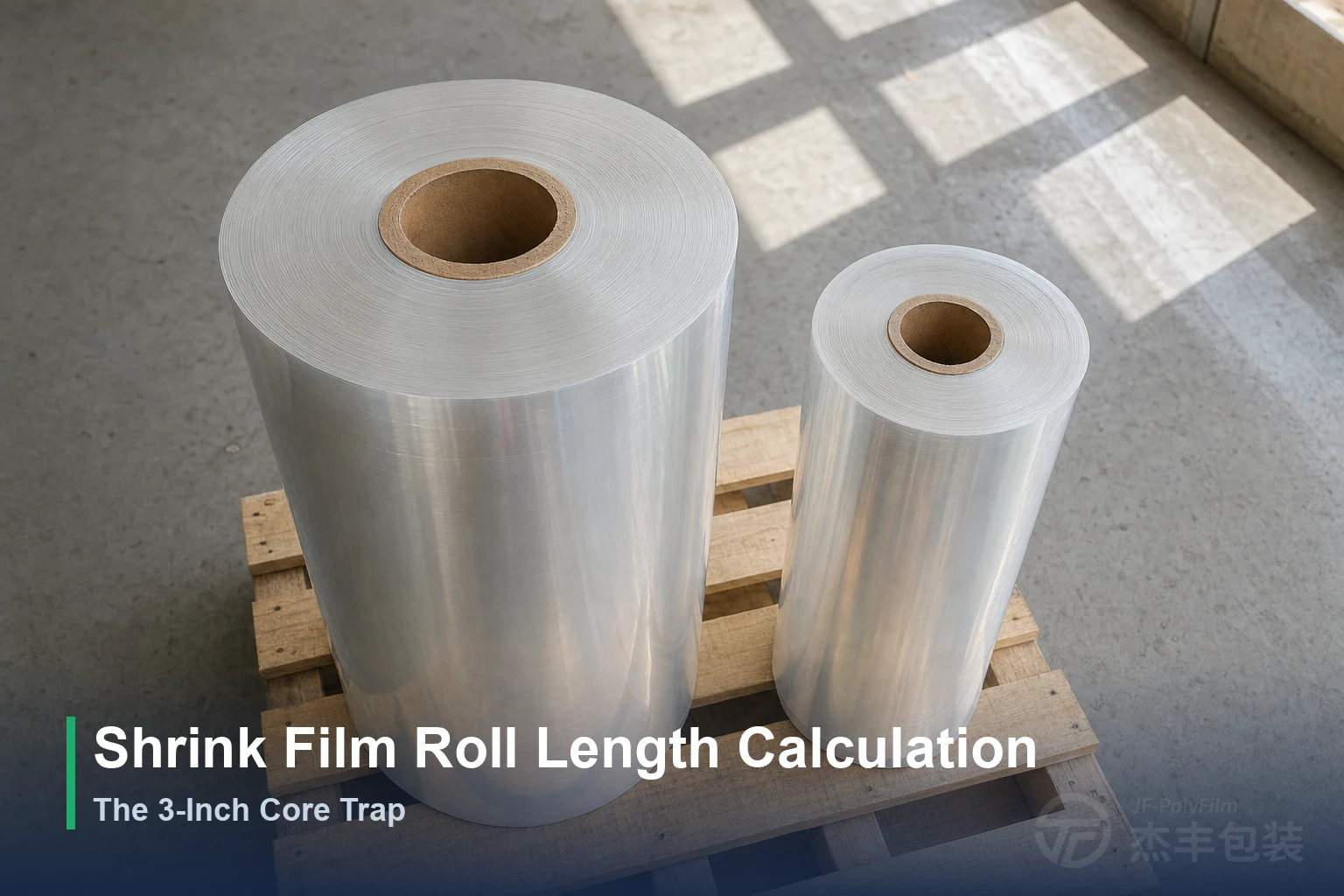
Shrink Film Roll Length Calculation: The 3-Inch Core Trap
Formulas linking roll diameter, length and weight, worked metric and imperial examples, a 30–60 μm diameter table, and why core size and trapped air shift the result.
Need Expert Advice on Shrink Film?
Our technical team can help you choose the right film for your application.
Contact Us