
What Is a Shrink Sleeve Label?
How shrink sleeve labels wrap a container 360°, why the film shrinks, the materials they use (PETG, PVC, OPS, PLA), how they print and recycle, and how to choose a grade.

A shrink sleeve label is a printed plastic film, formed into a tube, that is slid over a container and heated so it shrinks tightly around the full 360° of the surface — no adhesive, no separate front and back panels.
Shrink sleeves vs. pressure-sensitive labels
A shrink sleeve wraps the full body of a shaped container with no adhesive, while a pressure-sensitive label is a die-cut sticker pressed onto one flat or gently curved panel. The split decides which container geometries and which graphics each format can serve.
Why the film shrinks: heat memory and orientation
Shrink film contracts because of orientation locked in during manufacturing. Above its softening point the film is stretched, then quenched so the stretched molecular chains freeze in their extended arrangement; reheating in a tunnel lets those chains relax back toward their original, unstretched state, and the film pulls in.
TD vs. MD: the direction that makes sleeves work
Transverse shrink (across the film width, which becomes the circumference) is made high; machine-direction shrink (along the running length) is kept low.
The clear PETG grade in the JF range measures TD ≥75% with MD ≤3.0% — high circumferential pull, almost no vertical movement.
The films sleeves are made from
| Film | Shrink ceiling (TD) | Cost position | Recycling note |
|---|---|---|---|
| PETG | up to ~75-78% | premium | PET polyester family; sinks, so design-for-recycling matters |
| PVC | ~40-65% | low | sinks; releases chlorine compounds on incineration |
| OPS | moderate | low-mid | density near 1.0 g/cm³; lower shrink ceiling than PETG |
| PLA | moderate | premium/niche | bio-based; industrial-compost route, limited supply |
How a shrink sleeve is made: print to tunnel
A sleeve travels from flat film to finished package in four stages — print, seam, apply, shrink — and the film has to perform at every one: accepting ink, taking a seam, sliding over the container, and contracting evenly without distorting the artwork.
Recyclability: density, sink/float and the PET stream
Whether a sleeve is recyclable turns on what the resin does in the recycling wash, not on the number printed inside the triangle.
A floatable wash-off sleeve is built below 1.0 g/cm³ from a low-density resin such as a polyolefin, so it rises away from the sinking PET and is skimmed off the top of the wash tank.
The PET shrink-film family: PETG, RPET, CPET, BO-PETG
- PETG — the workhorse glycol-modified grade; a clear or white film is specified by two shrink figures and a gauge, which a buyer should see on the supplier’s datasheet and confirm by Certificate of Analysis (the JF clear and white films, for instance, measure TD ≥75%, MD ≤3.0%, thickness 30-60 μm).
- RPET — recycled PETG with post-consumer content specified per order (30%, 50%, or higher) and performance matching virgin film, certified under the Global Recycled Standard for verifiable recycled-content claims; how that supports packaging credentials is covered in RPET packaging explained.
- CPET — crystallizable PET that shares the bottle’s chemical family and a high enough melting point to survive PET recycling, so it is recovered in the RIC 1 PET stream with the bottle with no separation step; the exact shrink figures and melt point are on the grade’s datasheet.
- BO-PETG — a biaxially oriented (BO) wash-off grade that shrinks along both axes so an adhesive-backed label releases in a hot-water wash for glass-bottle reuse, with the dual-axis figures specified per grade.
Frequently Asked Questions
Are shrink sleeve labels recyclable?
What is the difference between a shrink sleeve and a wrap label?
What temperature does a shrink sleeve need?
Related Articles
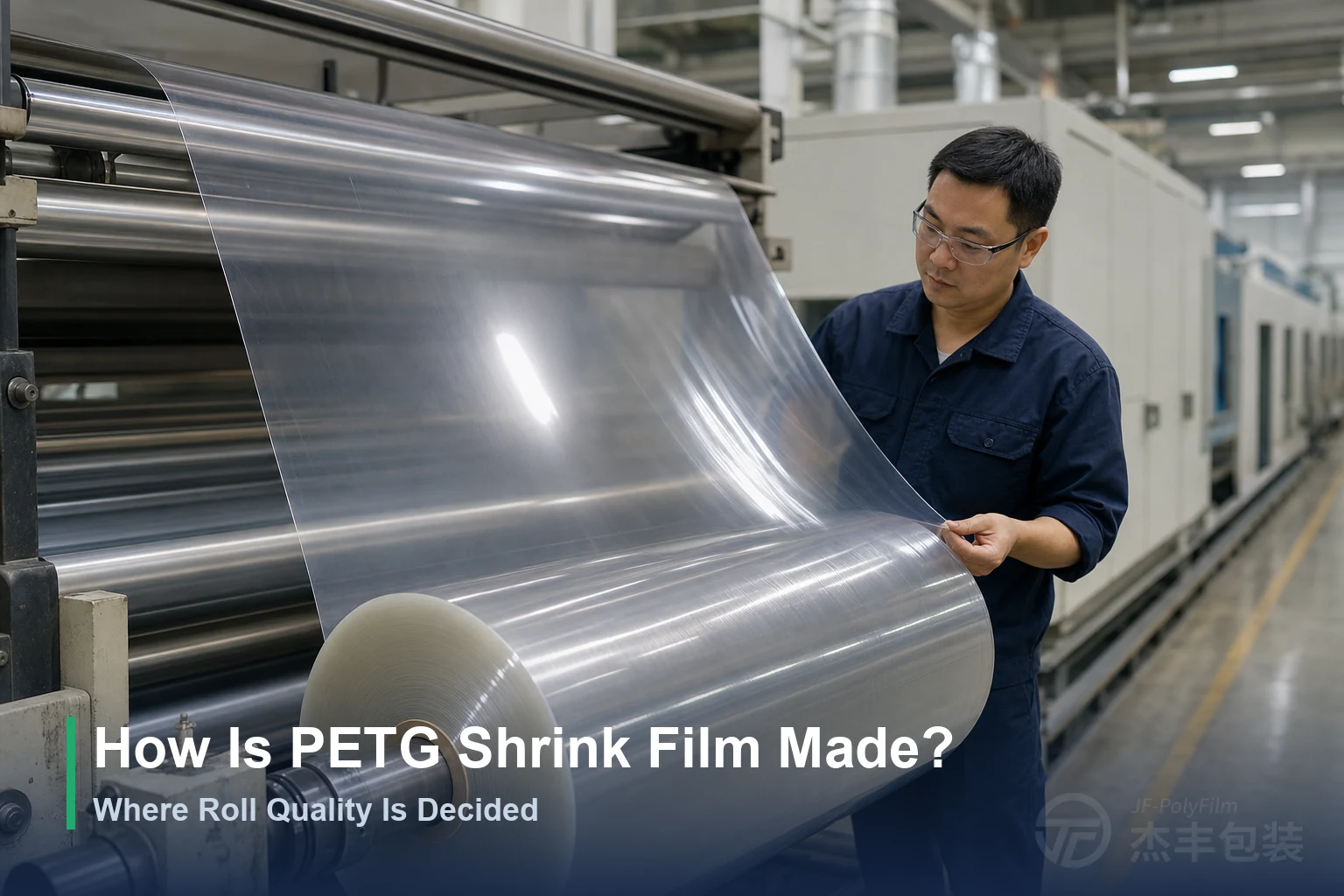
How Is PETG Shrink Film Made? Where Roll Quality Is Decided
How PETG shrink film is made, and which production stage sets each line buyers check on arrival: gauge tolerance, TD/MD shrink, haze, tensile strength, roll labels.
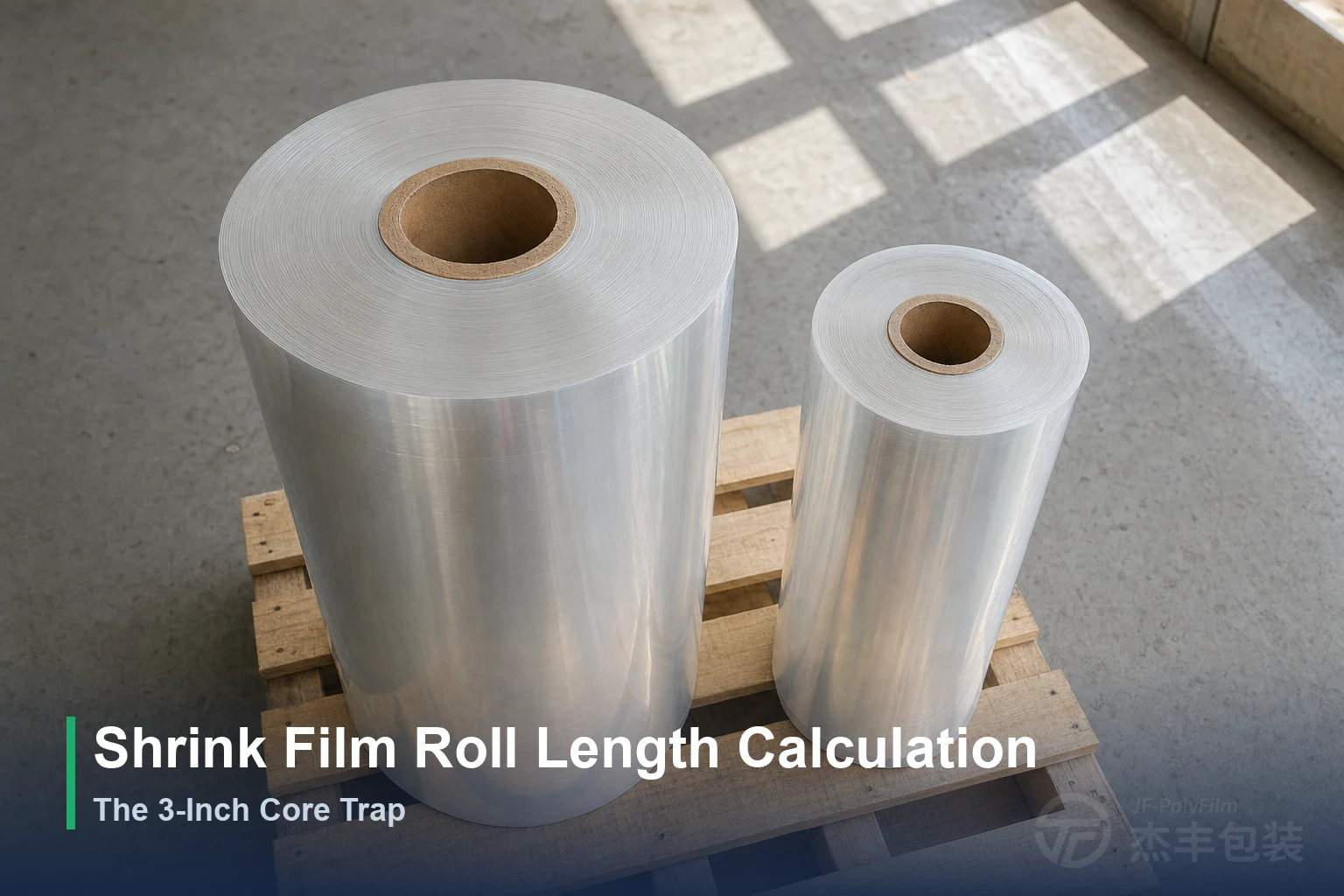
Shrink Film Roll Length Calculation: The 3-Inch Core Trap
Formulas linking roll diameter, length and weight, worked metric and imperial examples, a 30–60 μm diameter table, and why core size and trapped air shift the result.
Need Expert Advice on Shrink Film?
Our technical team can help you choose the right film for your application.
Contact Us