
PETG vs OPS Shrink Film: Polyester vs Polystyrene
How PETG and OPS shrink sleeve films compare on polymer family, softness, shrink temperature, clarity, and recycling stream — and which container each one fits.
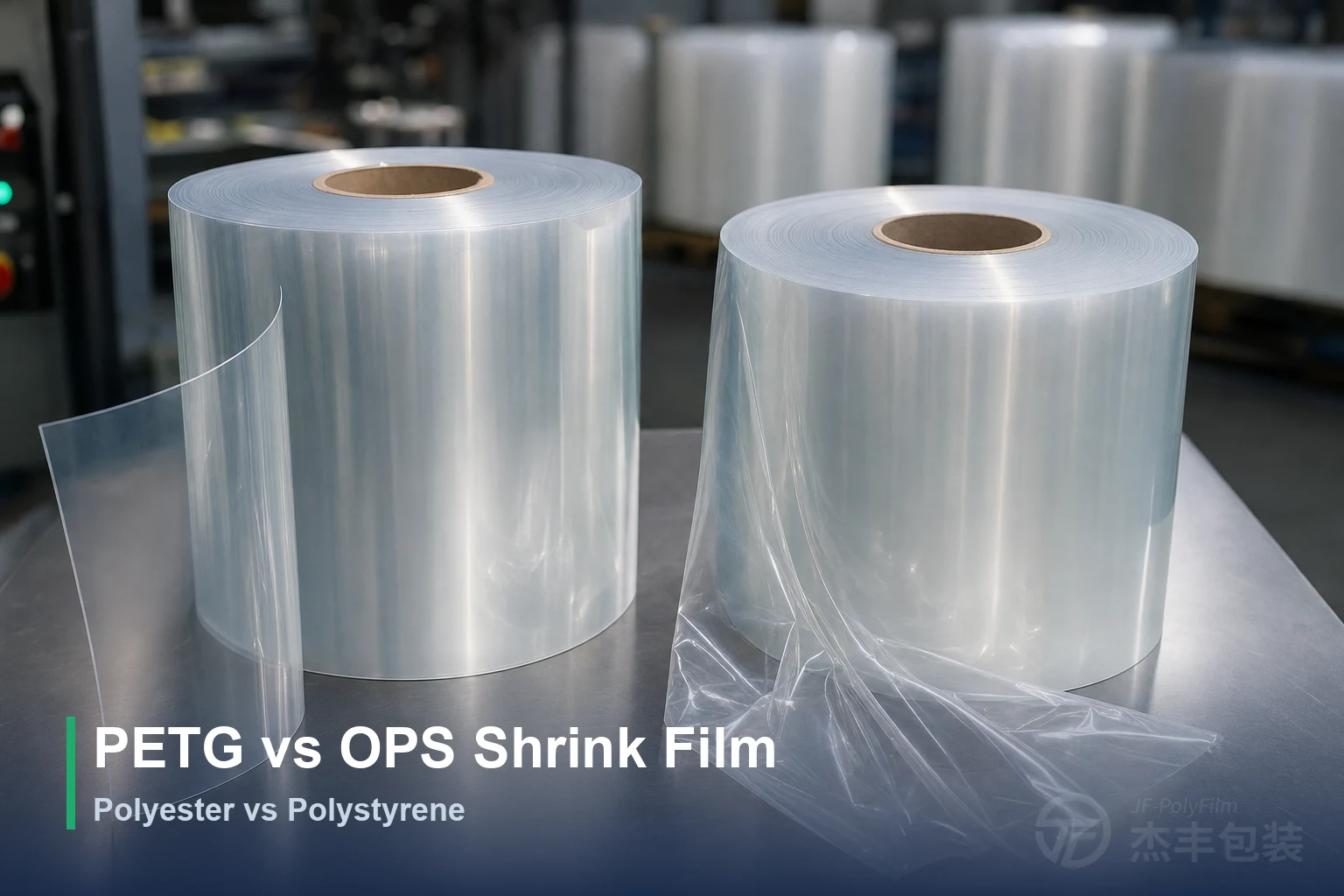
PETG and OPS are the two clear shrink-sleeve films most often weighed against each other, yet they come from different polymer families. PETG is a glycol-modified copolyester in the PET family; OPS is oriented polystyrene, a styrenic film with no PET lineage at all.
Two polymer families, not two grades of one film
The first thing to understand about PETG and OPS is that they are not two versions of the same material — they are different polymers. PETG is a copolyester built on the same PET chemistry as a beverage bottle, modified with glycol so it stays amorphous and shrinks rather than crystallizing.
PETG vs OPS at a glance
| Property | PETG | OPS |
|---|---|---|
| Polymer family | Glycol-modified PET copolyester (polyester) | Oriented polystyrene (styrenic) |
| Recycling code | Polyester; CPET grade recovers in RIC 1 PET stream | RIC 6 (PS), separate stream |
| Stiffness / feel | Rigid, firm | Soft, flexible, springs back under squeeze |
| Total shrink (TD) | Highest, commonly ≥75%, holds complex contours | Moderate-to-high; best on straight-wall shapes |
| Machine-direction shrink | Low, typically ≤3% | Very low |
| Shrink onset / tunnel | Higher onset, wide window, ~95-100°C for full draw | Lower onset, low-energy tunnel, low shrink force |
| Toughness | Tough, scuff- and crack-resistant | Brittle; cracks under impact and cold |
| Clarity / gloss | Glass-clear, high gloss, premium finish | Clear, generally less premium than PETG |
| Density | ~1.28-1.33 g/cm³ | ~1.04-1.05 g/cm³ |
| Chemical resistance | Better | Poorer |
| Cost positioning | Premium / high-performance | Economical / high-yield |
Soft and squeezable, or rigid and firm
Softness is where OPS earns its keep, and it is a genuine advantage rather than a consolation.
Squeezable tubes, soft dosing bottles, and flexible containers lean toward OPS; rigid bottles, jars, and containers where the sleeve should feel substantial lean toward PETG.
Low-temperature shrink and the energy it saves
OPS pulls in at a lower temperature than PETG, and for the right package that is a real operating advantage. Its shrink onset sits low, so it draws down in a cooler, lower-energy tunnel and with lower shrink force — gentler on the container and on the printed artwork, and less demanding on heat-sensitive contents that a hotter tunnel might disturb.
Why a film contracts around a container at all is a separate question, covered in how PETG shrink film works.
Brittleness and durability: the styrene trade-off
Polystyrene fractures rather than yields under a sharp impact, and it grows more fragile as temperature drops, so an OPS sleeve is more prone to cracking, splitting, or chipping at the seam — especially on a cold line, in cold-chain distribution, or under rough handling.
Clarity, gloss and the shelf impression
Both films are transparent, but they do not read the same on shelf. Oriented polystyrene is genuinely clear — orientation lowers its haze well below a film like polypropylene — and for many everyday packages its optics are perfectly adequate.
Two recycling streams: RIC 6 versus the PET family
OPS is polystyrene and carries resin identification code 6, a stream entirely separate from the RIC 1 PET bottles a shrink sleeve usually rides with — so an OPS sleeve and the PET container under it belong to two different recycling routes from the start.
Frequently Asked Questions
Is OPS shrink film the same as a PET bottle or a PETG sleeve?
Why does OPS suit squeeze bottles better than PETG?
Is OPS cheaper than PETG?
Related Articles
How Is PETG Shrink Film Made? Where Roll Quality Is Decided
How PETG shrink film is made, and which production stage sets each line buyers check on arrival: gauge tolerance, TD/MD shrink, haze, tensile strength, roll labels.
Shrink Film Roll Length Calculation: The 3-Inch Core Trap
Formulas linking roll diameter, length and weight, worked metric and imperial examples, a 30–60 μm diameter table, and why core size and trapped air shift the result.
Need Expert Advice on Shrink Film?
Our technical team can help you choose the right film for your application.
Contact Us