
How Does PETG Shrink Film Work? The Heat-Shrink Mechanism
The molecular reason a PETG sleeve grips a bottle: how stretching freezes shrink memory into the film, why the glass transition switches it on, and how the shrink curve runs.
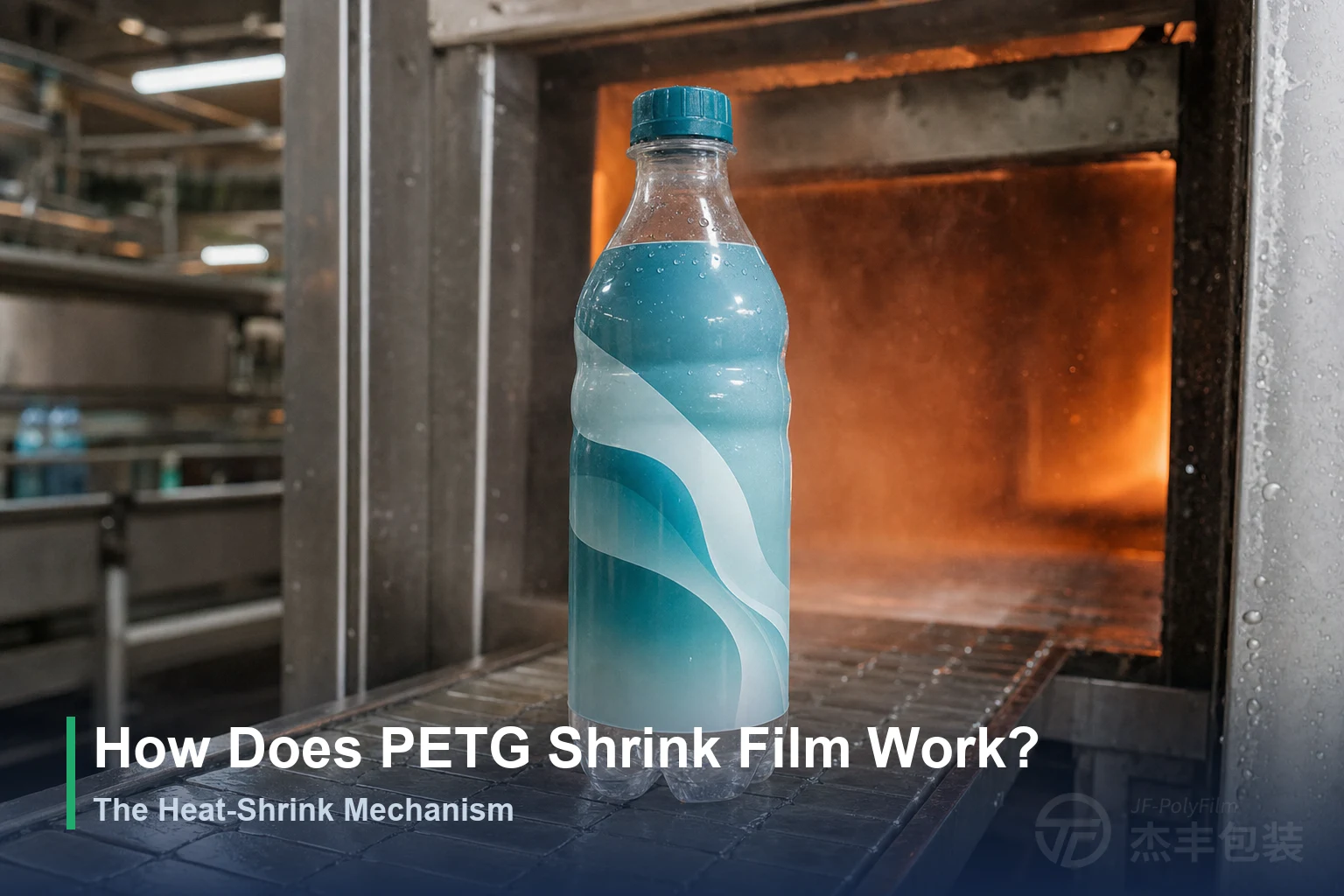
PETG shrink film works by storing a memory of how it was made. During manufacturing the film is stretched and rapidly cooled, freezing its molecular chains in a high-tension, extended state; reheating past a set temperature releases that tension so the chains recoil and pull the film tight around a container.
For a container with a known shape and shrink target, JFPolyFilm’s clear PETG shrink film can be matched to the grade whose curve and TD ceiling seat cleanly on it.
The molecular mechanism: frozen orientation and entropic recovery
Left relaxed above its transition temperature, a polymer’s long chains sit as random coils — the most disordered, and therefore the highest-entropy and most stable, arrangement available to them. When the softened film is stretched during orientation, those coils are pulled straight and lined up along the stretch direction. A rapid quench — cooling below the transition temperature before the chains can retract — freezes them in place and locks the strain in.
Once the film crosses back above the transition temperature, the chain segments regain mobility, the frozen-in stress relaxes, and the chains retract toward the coiled state they were driven away from.
The glass transition: one temperature doing two jobs
The temperature that unlocks shrinkage is the glass transition, or Tg — for PETG generally near 80°C, and reported across roughly 75-85°C depending on grade — and it governs the film in both directions at once: below it the film holds still, above it the film moves.
| Temperature vs. Tg | Molecular state | What the film does |
|---|---|---|
| Well below Tg (ambient storage, transit) | Glassy — chain segments frozen | Dimensionally stable; orientation stays locked, no creep or self-shrink |
| Approaching Tg (onset near 65-70°C) | Segments begin to regain mobility | Shrinkage starts; the film begins to draw in |
| Above Tg, in the tunnel (film at ~95-100°C) | Rubbery — segments fully mobile | Stored strain relaxes fast; the sleeve seats to the contour |
The shrink curve: onset, steep rise, and plateau
PETG’s curve is characteristically smooth and gradual with a relatively low onset, which means the film draws in progressively as it heats rather than collapsing the instant it reaches temperature.
How much total shrink a given container actually needs, and how the 65%, 75%, and 80% figures map onto bottle shapes, is a selection question worked through in how to choose a PETG shrink rate.
Direction is engineered in: gripping around, not down
Most sleeve film is stretched mainly in the transverse direction (TD) — across the web, which becomes the circumference of the finished sleeve — on a tenter frame.
The result is a film that pulls hard around the bottle and barely at all up its height.
Why PETG shrinks so smoothly
PETG suits shrink sleeves because it stays amorphous — glycol modification disrupts the regularity of the PET chain so it resists crystallizing — and an amorphous film gives a wide processing window and a smooth, forgiving shrink curve rather than a brittle, snappy one.
The full material-by-material comparison — shrink ceilings, cost position, and recycling behavior — belongs to a dedicated comparison rather than this mechanism piece, and is laid out in PETG vs PVC shrink film.
Frequently Asked Questions
Why does PETG shrink film shrink when it is heated?
Why doesn't shrink film shrink on its own during storage or shipping?
Why does a sleeve tighten around the bottle but not shrink up and down?
Related Articles
How Is PETG Shrink Film Made? Where Roll Quality Is Decided
How PETG shrink film is made, and which production stage sets each line buyers check on arrival: gauge tolerance, TD/MD shrink, haze, tensile strength, roll labels.
Shrink Film Roll Length Calculation: The 3-Inch Core Trap
Formulas linking roll diameter, length and weight, worked metric and imperial examples, a 30–60 μm diameter table, and why core size and trapped air shift the result.
Need Expert Advice on Shrink Film?
Our technical team can help you choose the right film for your application.
Contact Us