
How to Choose a PETG Shrink Film Supplier
A buyer's framework for sourcing PETG shrink film: which specs, COA line items, certifications, sample terms, and export-packing details to demand before paying.

Choosing a PETG shrink film supplier means judging it on records it will release before payment — verified specifications, a per-batch certificate of analysis, roll traceability, scoped certifications, and proof of stable supply — rather than on reputation or polish alone.
Key takeaways:
- Because finished PETG shrink film sits in a roughly 1.28–1.33 g/cm³ density band, two quotes at the same price per kilogram rarely deliver the same number of labels; cost per finished sleeve is what actually tells the two quotes apart.
- A Certificate of Analysis carrying a batch number is the single most revealing document, and a supplier that cannot produce a sample COA before an order is usually not testing every batch.
- Sourcing straight from the mill that extrudes the film keeps traceability, process control, and continuity of supply under one roof; the documents below are how a buyer confirms that control sits with the manufacturer rather than a layer removed from the line.
Which specifications must match — and how is a quote made comparable?
| Property | What it governs | How to make it comparable | Method anchor |
|---|---|---|---|
| TD shrinkage (~70–80%) | Conformance to container geometry | Stated alone, never blended with MD | ASTM D2732 / ISO equivalents |
| MD shrinkage | Lengthwise distortion of the artwork | Reported separately and held low | ASTM D2732 / ISO equivalents |
Grade datasheets put finished PETG shrink film in a roughly 1.28–1.33 g/cm³ band that shifts with formulation, against about 1.35 g/cm³ for PET. The arithmetic that turns this into a comparison is short:
- Area per kilogram ≈ 1 ÷ (density × thickness): a lower density or a thinner gauge yields more square metres — and therefore more labels — from each kilogram.
- Labels per kilogram = area per kilogram ÷ the area of a single sleeve.
- Cost per finished sleeve = price per kilogram ÷ labels per kilogram.
At an identical headline price per kilogram, a film at the low end of the density band returns more finished sleeves than one at the high end, which makes the denser quote the more expensive of the two per unit — the right basis for comparing them.
What a Certificate of Analysis and per-batch testing should contain
A Certificate of Analysis (COA) is the document that proves a specific batch met spec — a measured result beside the required range, each value tied to a test method and a lot number.
A film COA worth the name carries, at a minimum, the batch or lot number for the rolls in the container, the measured TD and MD shrinkage stated separately, the thickness with its tolerance, the haze or optical-clarity result, the tensile result with its method, and the test date and supplier identity.
Many of the faults a batch record helps trace are catalogued in solving common PETG shrink film problems.
A reusable PETG shrink film supplier checklist
- Roll labels, a documented splice count, and pallet SKU labels.
- Certification scans scoped to the destination market — recycled-content, substance-restriction, material, or quality-management — and no food-safety claim about an outer label.
- A sampling path priced as engineering, an MOQ and a lead time each stated against an exact spec, and storage guidance in writing.
- Supply-base verification up front, pre-shipment inspection, document-linked payment with a named Incoterm, and a written claim path agreed in advance.
Frequently Asked Questions
How can a quoted shrink rate be checked rather than taken on trust?
GRS or RCS — which recycled-content certificate should a buyer specify?
Does an ISO 9001 certificate remove the need for per-batch testing?
Related Articles
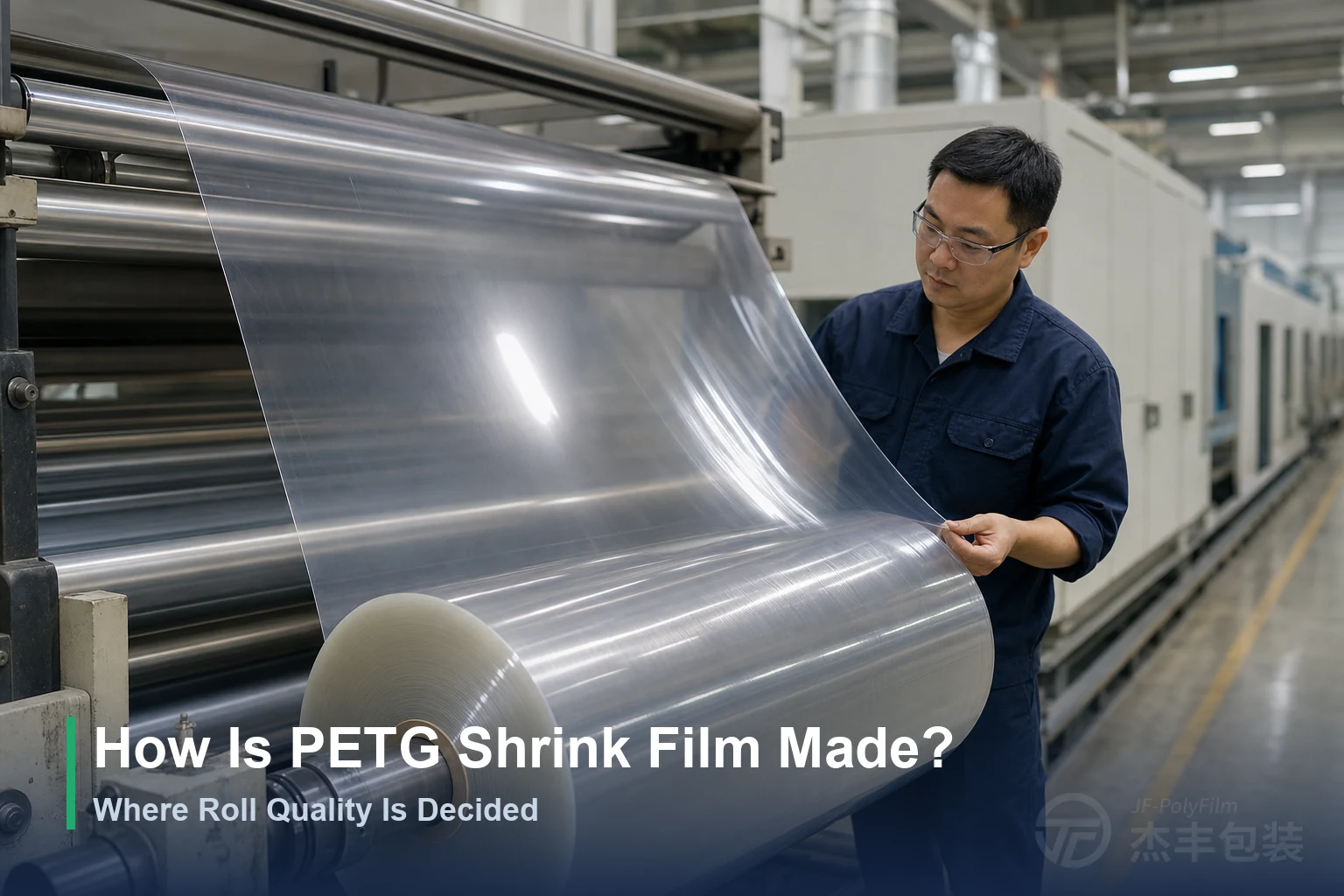
How Is PETG Shrink Film Made? Where Roll Quality Is Decided
How PETG shrink film is made, and which production stage sets each line buyers check on arrival: gauge tolerance, TD/MD shrink, haze, tensile strength, roll labels.
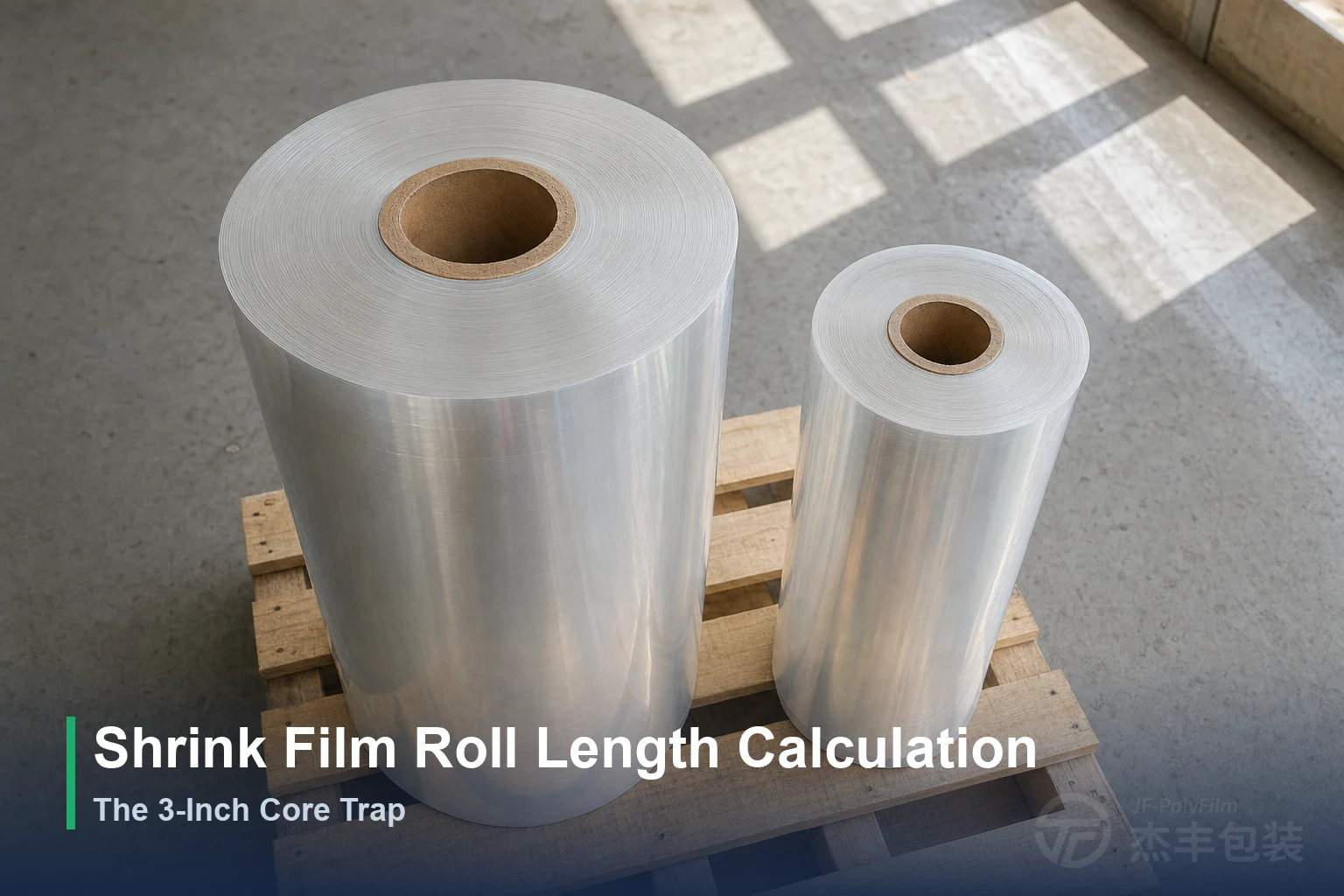
Shrink Film Roll Length Calculation: The 3-Inch Core Trap
Formulas linking roll diameter, length and weight, worked metric and imperial examples, a 30–60 μm diameter table, and why core size and trapped air shift the result.
Need Expert Advice on Shrink Film?
Our technical team can help you choose the right film for your application.
Contact Us