
PETG vs PLA Shrink Film: Recyclable vs Compostable
How PETG and PLA shrink sleeve films compare on shrink performance, heat tolerance, and end-of-life fate — and why the recovery stream usually decides the call.
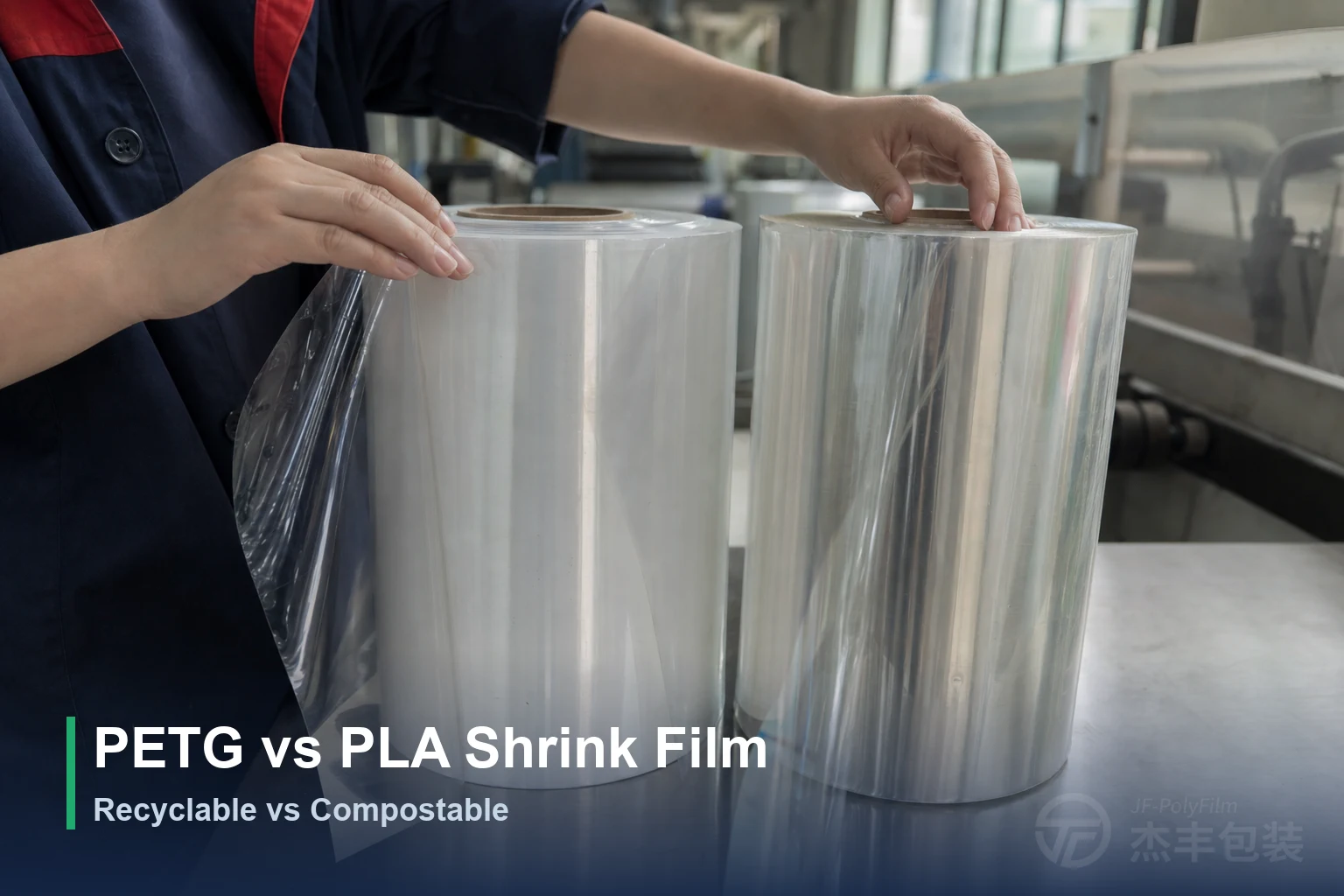
Choosing between PETG and PLA shrink sleeve film comes down to two questions: how each shrinks onto a container, and where it ends up after use. PETG is a glycol-modified polyester in the PET family; PLA is the plant-based alternative.
Key takeaways:
- PLA starts shrinking earlier — around 70°C versus roughly 80°C for PETG — but its usable window is narrow, because its glass transition sits low at about 55–65°C.
- PETG reaches the higher shrink ratios, up to roughly 78% transverse, which matters on deep-contour and waisted bottles; PLA tops out above 60%.
- PLA is certified compostable only in industrial facilities held near 58°C, not curbside-recyclable and not home-compostable.
- At about 1.24 g/cm³ PLA sinks alongside PET bottles (near 1.38) in float-sink sorting, so it contaminates the PET recycling stream instead of being separated from it.
- The PET-family answer — PETG, and especially CPET and RPET — stays inside the recovery system the bottle already uses.
Where PLA earns a place, and where it doesn’t
PLA has a genuine niche, and it is worth naming before weighing its limits: a brand that can back a certified-compostable claim with the infrastructure to honor it — a closed-loop event, a festival with controlled collection, a market served by industrial composting — has a real reason to reach for it. What PLA cannot reliably do is behave like a recyclable polyester, and most sleeve programs need exactly that.
The appeal is easy to state. PLA is made from corn or plant starch rather than petroleum, so the raw material is renewable, and set against the oil-based incumbents — chlorine-based PVC chief among them — it is the one mainstream sleeve film that starts from a plant. That single fact is what lands it on a shortlist next to PETG, still the workhorse polyester of the PET family. The trouble, as the rest of this comparison shows, is that a renewable input says nothing about what happens to the film as output, and the two get read as the same promise far more often than they should. (PVC carries its own recycling and chlorine trade-offs, weighed separately in PETG vs PVC shrink film.)
How each film shrinks onto the container
On the shrink line the two films part ways in two respects that decide how a sleeve looks and how forgiving the run is: the temperature at which the film starts moving, and how far it will travel before it stops. PLA begins shrinking around 70°C, roughly ten degrees below PETG, but it pays for that early start with a narrow, unforgiving window.
The reason sits in PLA’s glass-transition temperature, which is low — about 55–65°C. That low threshold is what lets the film start shrinking early, and it is also what makes it fragile, because anything above it softens the material. A warm warehouse, a sunlit pallet, or a hot transit container can begin to distort a finished PLA sleeve well before it reaches the shelf, and on the tunnel itself the same low Tg squeezes the gap between not-yet-shrunk and over-shrunk into a band that operators have to hit precisely. PETG carries its softening point higher, which is why the same line settings repeat cleanly across a wider range of tunnel conditions and why heat exposure in transit is far less of a worry.
Travel is the other half of the picture. PETG reaches the higher shrink ratios, climbing toward 78% transverse, which is what lets it hug a deep waist or a sharp taper without leaving slack; PLA tops out above 60%, enough for a straight-walled bottle but liable to run short on an aggressively sculpted one, where the shortfall reads as wrinkles and bridging at the very contours meant to look crisp. PETG also holds its machine-direction shrink low — our own film runs MD at or under 3.0% — so as the sleeve clamps down circumferentially the printed graphic barely drags, and text and barcodes stay in register.
That narrow window carries a cost beyond the occasional wrinkle. A film that tolerates only a few degrees of tunnel swing leaves little room for the variation any real line sees — a cold start, an ambient shift, a change in conveyor speed — so PLA runs tend to demand tighter control and throw off more scrap when conditions drift, while a PETG line absorbs the same swings and keeps yielding good sleeves. On clarity the two sit closer together, since both print cleanly and both can look sharp on shelf, though it is PETG’s glass-like transparency that premium brands usually reach for when the sleeve is meant to disappear against the container.
The recycling problem hiding in PLA’s density
The reason PLA struggles as a recyclable sleeve is physical before it is chemical. At roughly 1.24 g/cm³ it is nearly as dense as a PET bottle at about 1.38, and PETG falls between them near 1.28–1.33 — every one of them heavier than water at 1.0, so none of them floats. That single fact undoes the sorting step recyclers lean on, because float-sink separation only works when the contaminant and the target part company in water.
The mechanism is worth spelling out. A reclaimer grinds collected bottles into flake and runs it through a water bath: lighter plastics such as polypropylene caps rise and skim off, while the heavier PET sinks and moves on to washing. The step is cheap, fast, and entirely passive — it asks one question, float or sink, and trusts the answer. A PLA sleeve sinks, gives the same answer as the bottle, and rides into the PET flake instead of out of it, where the chemical mismatch only surfaces later, after sorting can no longer catch it. Recycling authorities treat PLA as a serious contaminant of the PET stream for exactly this reason: even minute amounts carried into PET cause haze and yellowing in the recycled resin, degrading a material whose whole value depends on staying clear. The relationship runs both ways, since small amounts of PET are equally ruinous to a batch of recycled PLA, which is why the two cannot share a recovery path. For a reclaimer the consequence is economic rather than academic: a load that yellows or hazes is worth less or gets rejected outright, so the whole point of designing a sleeve for recycling is to keep it from tripping that bath in the first place.
Here is the distinction that matters, and it is not the one the density numbers suggest. PETG sinks too, so the difference between it and PLA is not that one settles and one floats — both settle with the bottle. It is that PETG is a polyester, chemically part of the PET family, and can be engineered to belong in that stream, whereas PLA is a foreign polymer that density sorting has no way to remove. Crystalline PET (CPET) takes this furthest: with a melting point near 230°C its crystallinity carries the sleeve through the bottle’s recovery process intact, so it travels with the bottle in the same RIC 1 stream rather than having to be stripped off first. PLA has no equivalent path.
Compostable, recyclable, and degradable are three different promises
PLA’s environmental case rests on its feedstock, and that is the honest core of the story — a renewable raw material instead of petroleum. But feedstock describes the input, not the fate of the film after use, and three separate claims tend to collapse into one. Pulling them apart is the single most useful thing a buyer can do before accepting a PLA pitch.
- Recyclable means a material re-enters a stream and comes back as usable feedstock. PLA does not do this in any mainstream system; as the previous section showed, it enters the PET stream as a contaminant rather than a participant.
- Compostable means a material breaks down into water, CO₂, and biomass under defined conditions. PLA qualifies only under industrial composting. EN 13432, ASTM D6400, and China’s GB/T 19277.1 all set the bar in roughly the same place — temperatures near 58°C sustained across months, with disintegration and biodegradation thresholds a backyard pile or a cool garden bin never reaches.
- Degradable in the open environment, breaking down if it escapes into soil or water, is a claim PLA cannot make at all. Below its industrial-compost window it persists much like any other plastic.
The decisive gap is not the certificate but access to the infrastructure the certificate assumes. In the United States only a small minority of the population has collection that accepts compostable packaging at all, and the subset of facilities that actually process PLA rather than screening it out is smaller still, because many composters reject flexible PLA film that is hard to tell apart from conventional plastic on the line and can slow their process. The practical result is that “industrially compostable” often means compostable nowhere the package will realistically end up. For an exporting brand being offered PLA as a sustainability headline, the question is not whether the film is certified compostable, but whether a facility that will actually compost it exists in the market where the product is sold.
There is a second reason the distinction matters to an exporter, and it is regulatory rather than technical. A compostable claim the destination market cannot support is increasingly treated as an environmental claim that has to be substantiated, and several markets have tightened scrutiny of exactly this kind of packaging labelling. A brand that prints “compostable” on a sleeve headed for a country with no facility to compost it is not only overstating the benefit but inviting the charge that the claim misleads. That claim travels to the shelf on the sleeve, which is why the film underneath is worth choosing with the destination’s recovery reality in view — a promise the local system cannot honor is a liability the package carries, not a feature it earns.
Choosing between PETG and PLA for your sleeves
The decision resolves once two things are fixed: the recovery outcome the brand can genuinely deliver, and the demands of the container and the line. Where certified industrial composting is truly within reach and a renewable-feedstock story is the priority, PLA fits and fits honestly. Where the sleeve needs to stay recyclable — which describes most programs riding on existing PET collection — the PET family answers, and the two films line up like this:
| Attribute | PETG | PLA |
|---|---|---|
| Base feedstock | Glycol-modified PET, oil-based | Corn / plant starch, renewable |
| Optical clarity | High, glass-like | Good |
| Max transverse shrink | ≥75%, up to ~78% | >60% |
| Shrink onset | ~80°C | ~70°C (earlier) |
| Heat tolerance (Tg) | Higher, wide forgiving window | Low, ~55–65°C, narrow window |
| End-of-life route | Stays in the PET stream; CPET rides RIC 1 with the bottle | Industrial compost only; contaminates PET recycling |
| Best-fit use | Deep-contour and shaped bottles, recyclable programs | Certified-compostable, closed-loop settings |
Read the table by the constraint that cannot move — shrink ceiling, heat exposure in transit, or recovery route — and let it eliminate the film that fails it. For most PET-bottle programs the constraint is recovery, and it points away from the plant-based film. Our own PET-family range shows where that lands in practice: PETG at TD ≥75% with MD ≤3.0% for clean graphics on shaped bottles, CPET at TD 74±2% with a 230°C melting point so the sleeve clears PET-bottle recovery in a single stream, and RPET carrying GRS-certified recycled content for claims that hold up to verification. The full specifications sit on the PETG shrink film page.
None of this makes PLA a bad material — it makes it a specific one, right for the brand that can close the loop it depends on and misplaced everywhere else. The practical sustainability answer, for most bottle programs, is not the film that was made from a plant but the polyester the recycling stream already knows how to recover — measured by what the package becomes, not only by what it started as.
Frequently Asked Questions
Is PLA shrink film actually recyclable or biodegradable?
Why can't PLA sleeves be sorted out of the PET recycling stream?
Which shrinks tighter on shaped bottles, PETG or PLA?
Does PLA shrink film hold up in a hot warehouse or container?
When does PLA shrink film actually make sense?
Related Articles
How to Store Shrink Film: Rolls, Shelf Life, Handling
What the 10–30°C, 12-month storage window actually protects, how to stand rolls so they don't flat-spot, and why film has to acclimate before it reaches the line.
Shrink Film Test Methods: How Specs Are Measured
Every figure on a shrink film datasheet or COA traces back to a standard method. See which ASTM and ISO tests measure shrinkage, tensile, haze, and gauge, and how to read the report.
Need Expert Advice on Shrink Film?
Our technical team can help you choose the right film for your application.
Contact Us