
Laser Coding on Shrink Sleeves: Marking Without Ink
How end-of-line laser coders put permanent dates, batch numbers, and traceability codes on finished shrink sleeves — the marking mechanisms, laser wavelengths, how the film has to withstand the beam, and how laser compares with inkjet and thermal transfer.
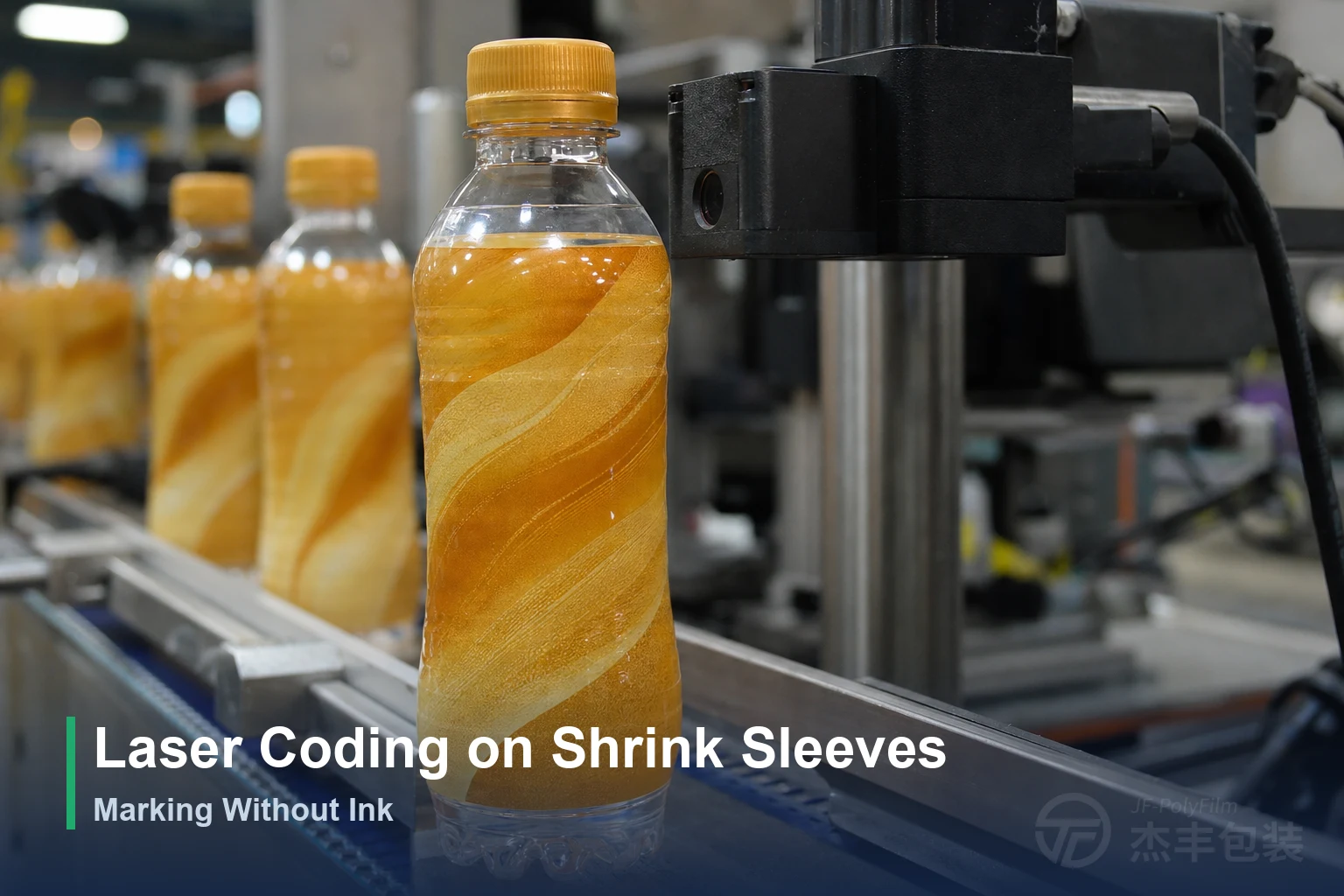
Laser coding on a shrink sleeve is the end-of-line step that marks variable data — a production date, a batch or lot number, a serial or traceability code — directly into the finished sleeve with a focused beam, permanently and without ink.
Key points
- The mark is not printed on. It forms inside the sleeve’s surface layer, where laser energy foams, carbonizes, or color-shifts an ink or coating, so the code appears with no material added and nothing raised to scuff off.
- Coding runs after the shrink tunnel, on the container-supported sleeve, because the date and batch are only fixed at the filling line — not on flat web while the sleeve is printed.
For sleeve stock matched to a specific shrink rate and container, JFPolyFilm supplies clear PETG shrink film built to hold its spec roll to roll.
What laser coding writes on a finished sleeve
Laser coding writes the data that changes from unit to unit — the date, batch, lot, serial, or a scannable traceability code — onto a sleeve that has already been printed, applied, and shrunk. A focused beam does the marking, so there is no ink, no solvent, and no ribbon involved.
How the artwork itself is put on the film is a separate subject, covered in the shrink sleeve printing methods guide; laser coding picks up where printing leaves off.
How the mark forms: ablation, foaming, carbonizing, color change
The code becomes visible because the laser physically changes a thin surface layer of the sleeve rather than depositing anything onto it, and it does that through one of four mechanisms.
| Mechanism | How the mark forms | Where the contrast comes from | Fit for sleeves |
|---|---|---|---|
| Ablation | The beam heats the surface to degradation and vaporizes it, etching a shallow recess | Usually low — a clear groove that also thins the material | Rarely used; it weakens a thin film |
| Foaming | Heat releases gas that is trapped as micro-bubbles under a sealed surface; the bubbles scatter light | A pale, light-scattering mark against a darker ground — high contrast, almost no penetration | The workhorse on PETG sleeves |
| Carbonizing | Polymer chains break down into carbon-rich residue | A dark brown-to-black mark against a light ground | Used on light-colored substrates |
Which laser suits a thin sleeve
The laser type comes down to how much of its energy the film absorbs and how much heat it leaves behind, and thin heat-sensitive sleeves are unforgiving on both counts. CO₂ lasers at 10.6 μm are the mid-infrared workhorse for organics and packaging, but that wavelength can scorch heat-sensitive plastic; the 9.3 μm variant is absorbed more efficiently by the PET polyester and produces the clean foamed white mark instead.
Ultraviolet lasers at 355 nm take a different route. They mark by a “cold,” photochemical process — high-energy photons break molecular bonds directly rather than melting the surface — so the heat-affected zone stays very small, typically under 5 μm, with pulses typically shorter than 20 ns.
What the film decides, and what the converter decides
Two practices keep the film intact: coding after the shrink tunnel, when the film is set and backed by the rigid container rather than suspended as flat web, and using lower power or a cold UV laser on heat-sensitive stock.
Frequently Asked Questions
Does laser coding use ink?
Why is the sleeve coded after it shrinks rather than during printing?
Can a thin shrink sleeve be laser-coded without burning through?
Related Articles
How Is PETG Shrink Film Made? Where Roll Quality Is Decided
How PETG shrink film is made, and which production stage sets each line buyers check on arrival: gauge tolerance, TD/MD shrink, haze, tensile strength, roll labels.
Shrink Film Roll Length Calculation: The 3-Inch Core Trap
Formulas linking roll diameter, length and weight, worked metric and imperial examples, a 30–60 μm diameter table, and why core size and trapped air shift the result.
Need Expert Advice on Shrink Film?
Our technical team can help you choose the right film for your application.
Contact Us