
Shrink Film Barrier: WVTR, OTR, and Where It Comes From
On a sleeved pack the moisture and oxygen barrier comes from the container, not the label. What WVTR and OTR mean, the real ASTM and ISO methods, and where PETG sits.
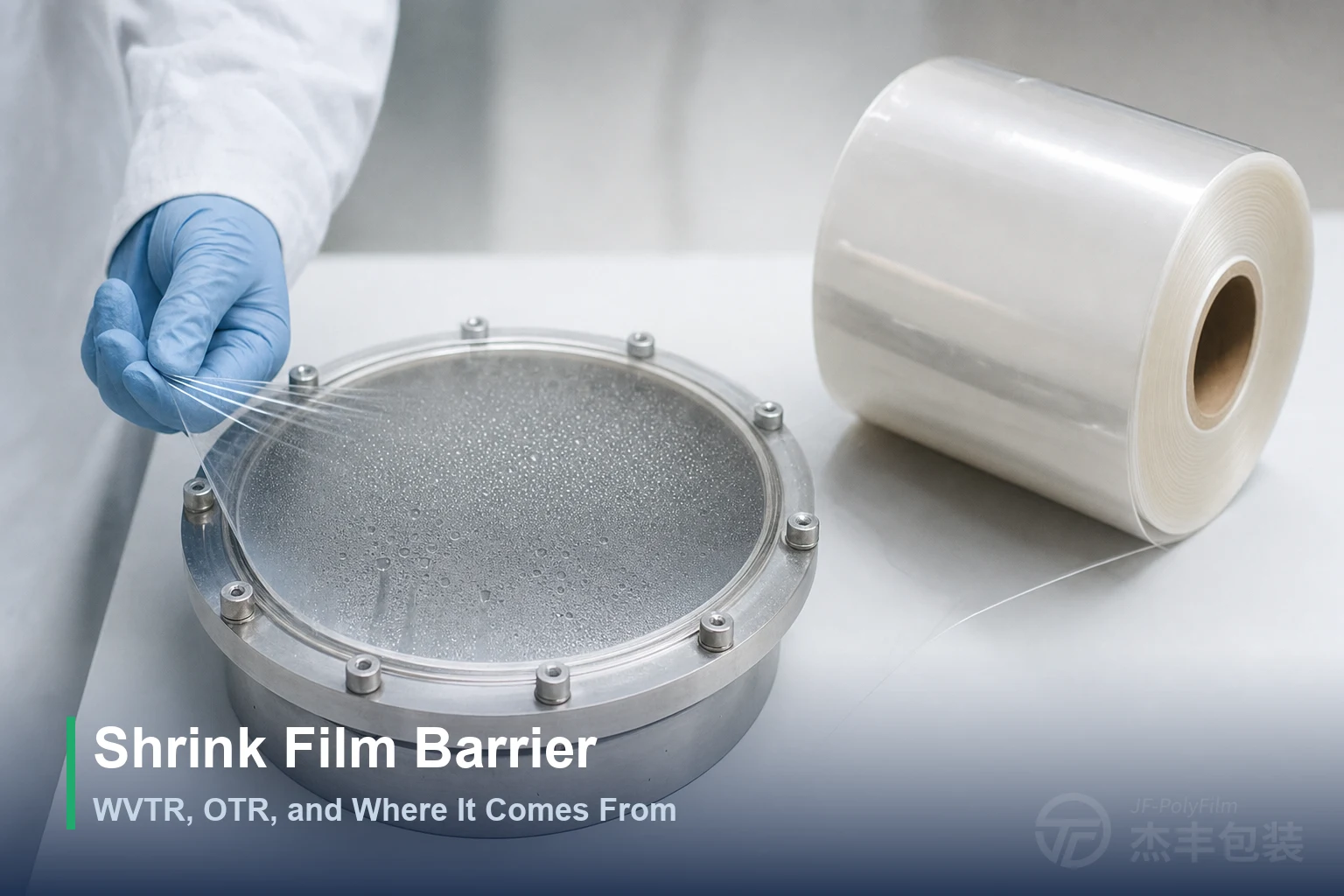
Shrink film barrier refers to how much water vapour and oxygen pass through the film itself, measured as WVTR — water-vapour transmission rate — and OTR — oxygen transmission rate. On a labelled pack, though, that barrier belongs to the container: the sleeve is a decorative full-body label, not the wall keeping air and moisture off the contents.
Where a spec genuinely needs a barrier number, JFPolyFilm’s clear PETG sleeve film can be tested to the method a customer specifies and reported against it — a measured value on the real film, rather than a barrier promise the label was never built to keep.
What WVTR and OTR actually measure
WVTR and OTR are the two transmission rates that describe a film’s permeability: WVTR is the amount of water vapour that passes through a unit area of film in a day at steady state, and OTR is the amount of oxygen that does the same.
| Spec | What passes through | Typical unit | Real standard methods | PETG’s level |
|---|---|---|---|---|
| WVTR (water-vapour transmission rate) | Water vapour, per unit area per day, at steady state | g/m²/day (US: g/100 in²/day) | ASTM E96 (gravimetric), ASTM F1249 (infrared sensor), ISO 15106 series | Moderate — not a high moisture barrier |
| OTR (oxygen transmission rate) | Oxygen gas, per unit area per day, at steady state | cc/m²/day (= cm³/m²/day) | ASTM D3985 (coulometric, run dry), ASTM F1927 (coulometric at controlled humidity), ISO 15105 series | Moderate — well above high-barrier EVOH |
Why a barrier number moves with thickness and conditions
For a given material the rate scales roughly inversely with thickness, so a thicker web of the same film transmits less and a thinner one transmits more. That alone is why two figures for “the same” PETG can differ several-fold — they were measured at different gauges.
PETG is a moderate-barrier material, not a high-barrier one
PETG sits in the moderate-barrier band for both gases — moderate to oxygen and moderate to water vapour — and calling it a high-barrier film would misstate what it is.
EVOH is the reference oxygen barrier, with an oxygen transmission rate one to two orders of magnitude below PET-family polyesters; PVDC brings both oxygen and moisture resistance. Where the moisture side specifically depends on the grade, the difference between clear and opaque stock is taken up in clear versus white PETG film.
On a sleeved pack, the container is the barrier — not the label
On a shrink-sleeved container, the oxygen and moisture barrier is provided by the container wall and its closure, and the sleeve contributes none of it.
It is a decorative label, and it is neither sold nor specified as a barrier layer.
When a shrink film’s own barrier actually matters
A shrink film’s own WVTR and OTR become relevant in a narrow set of cases, all of which share one feature: the film, not a separate container, is carrying part of the barrier.
Many procurement and quality templates were written for flexible packaging, where the film is the barrier, and they carry WVTR and OTR rows that a sleeve buyer inherits by default.
What JFPolyFilm states, and does not claim, about barrier
JFPolyFilm supplies decorative full-body PETG sleeve stock, and describes it for what it is: a moderate-barrier film selected for high clarity, controlled shrink, and 360-degree print coverage. The film has a real WVTR and OTR like any polyester, but on the sleeved packs it is made for, the barrier is the customer’s container — so the film is neither marketed nor specified as a barrier layer, and it carries no freshness, oxidation, or shelf-life claim.
Frequently Asked Questions
Does a shrink sleeve add a moisture or oxygen barrier to the product?
What are WVTR and OTR measured in?
Is PETG a high-barrier film?
Related Articles
How Is PETG Shrink Film Made? Where Roll Quality Is Decided
How PETG shrink film is made, and which production stage sets each line buyers check on arrival: gauge tolerance, TD/MD shrink, haze, tensile strength, roll labels.
Shrink Film Roll Length Calculation: The 3-Inch Core Trap
Formulas linking roll diameter, length and weight, worked metric and imperial examples, a 30–60 μm diameter table, and why core size and trapped air shift the result.
Need Expert Advice on Shrink Film?
Our technical team can help you choose the right film for your application.
Contact Us