
Shrink Sleeves for Bottled Water: Film Selection Guide
Speccing shrink sleeves for bottled water: thin-wall distortion on fast lines, the low-temperature shrink window, cold-chain grip, and clean bottle recycling.
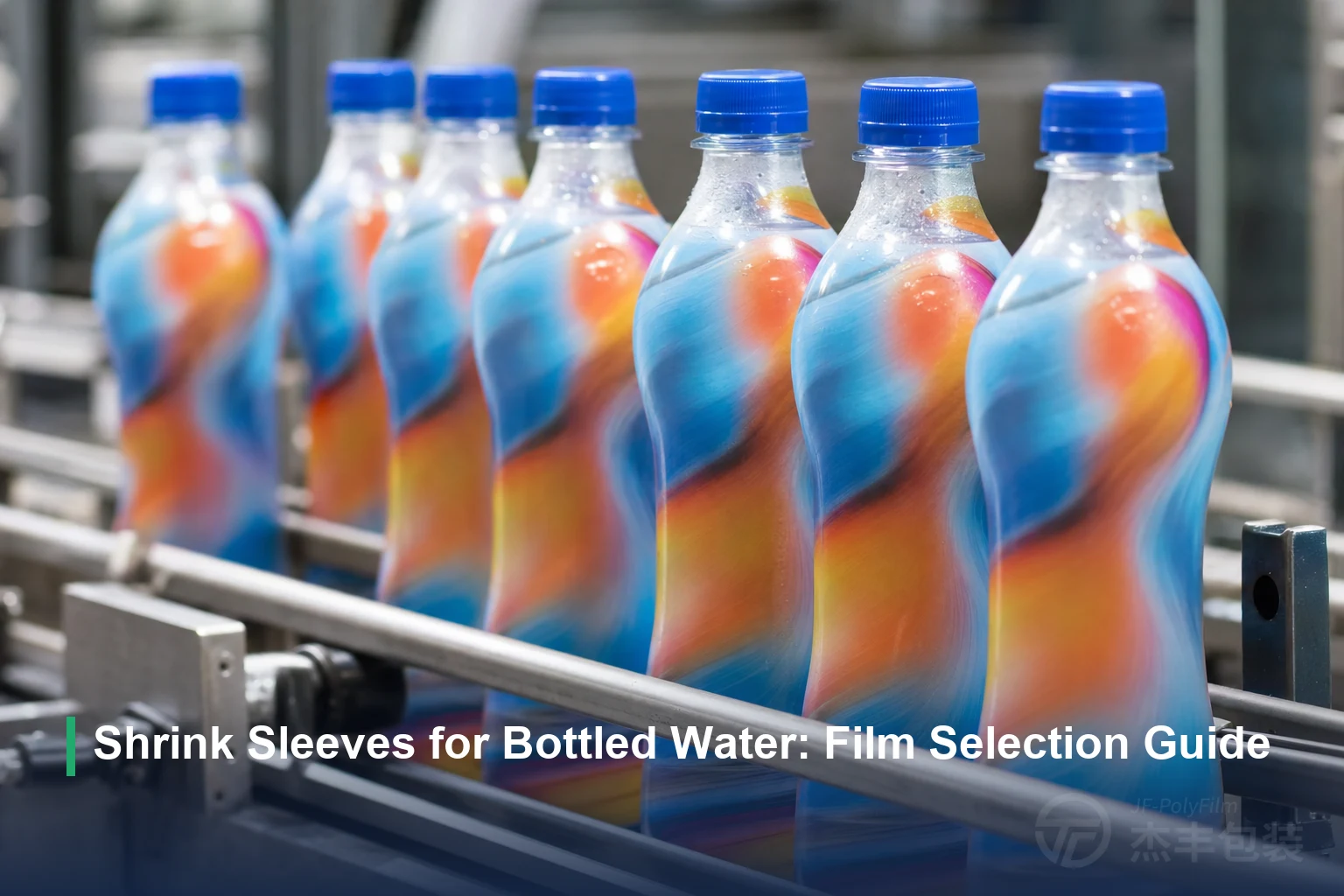
A shrink sleeve for bottled water is a printed PETG film tube slipped over a thin-walled bottle and heat-shrunk to grip it 360 degrees, serving as the decorated label and built to recover with the bottle. What decides the spec is less the graphics than three physical facts about the water bottle itself.
Key takeaways
- Water bottles are thin-walled by design — half-liter single-serve PET shed roughly 52% of its average weight between the early 2000s and the mid-2010s, to around 9.25 grams, per published beverage-industry data — so the sleeve’s real job is distortion control on a wall with almost no rigidity.
- A crystallizable CPET grade like the one supplied here melts near 230°C — inside the 225–255°C window North American recycler design guidance prefers — so it recovers with the bottle in the RIC 1 PET stream, and at 50 µm or thinner with the recommended perforation a full-body sleeve stays preferred without a sorting test.
The mechanics a sleeve carries across all beverages — how the tube grips, the tunnel families, the anti-counterfeit and light-barrier options — are set out in the shrink sleeves for beverage bottles guide; this article narrows to the water case.
Thin-wall distortion on a high-speed line
The core production risk on a water line is thin-wall distortion: a low-rigidity bottle and a short tunnel dwell mean any wrinkle set in the first seconds of shrink locks into the finished label, and a soft bottle can be dimpled where heat lands unevenly — so the fix is an even, controlled heat field rather than a hotter tunnel.
The low-temperature shrink window
The low-temperature shrink window is the thin wall’s safety margin: a film that draws down at a low, even temperature reaches full grip before the wall overheats, and PETG begins shrinking below the temperatures PVC and OPS require, with a crystallizable CPET film widening the usable window further for a fast line.
Will the empty bottle still recycle cleanly?
A sleeved PET water bottle can be recycled cleanly, but only by design, because water is a high-volume category and the empty bottle’s fate carries weight: the sleeve either recovers with the bottle, is removed mechanically before sorting, or floats off in the wash.
| Recycling route | How the sleeve behaves | What to specify |
|---|---|---|
| Recover with the bottle (RIC 1) | Crystallizable CPET stays intact through wash and dry, then melts with the flake | Crystallizable CPET, melt point inside the 225–255°C recycler window, ≤50 µm, recommended perforation |
| Remove mechanically before sorting | A thin perforated film is stripped from the bottle ahead of the wash | ~50 µm or thinner, full-height vertical perforation |
| Float off in the sink-float tank | A sub-1.0 g/cm³ film rises while PET flake sinks | Polyolefin-based floatable sleeve, wash-off or alkali-resistant ink |
A spec brief for a bottled-water sleeve
| Priority for the water program | Film to spec | Numbers to confirm with the supplier |
|---|---|---|
| Show the water through a clear sleeve | Clear PETG shrink film | TD ≥75%, MD ≤3.0%, 30–60 µm |
| Recover with the bottle, no separation | Crystallizable CPET shrink film | TD 74±2%, MD ≤5.0%, melting point 230°C |
| Carry verified recycled content | RPET shrink film (GRS) | TD ≥75%, stated PCR %, full batch traceability |
Frequently Asked Questions
Do shrink sleeves stay put on a water bottle through chilling and freezing?
Which film suits thin-wall bottles running on a fast line?
Is a full-body sleeve a problem for recycling the empty PET bottle?
Related Articles
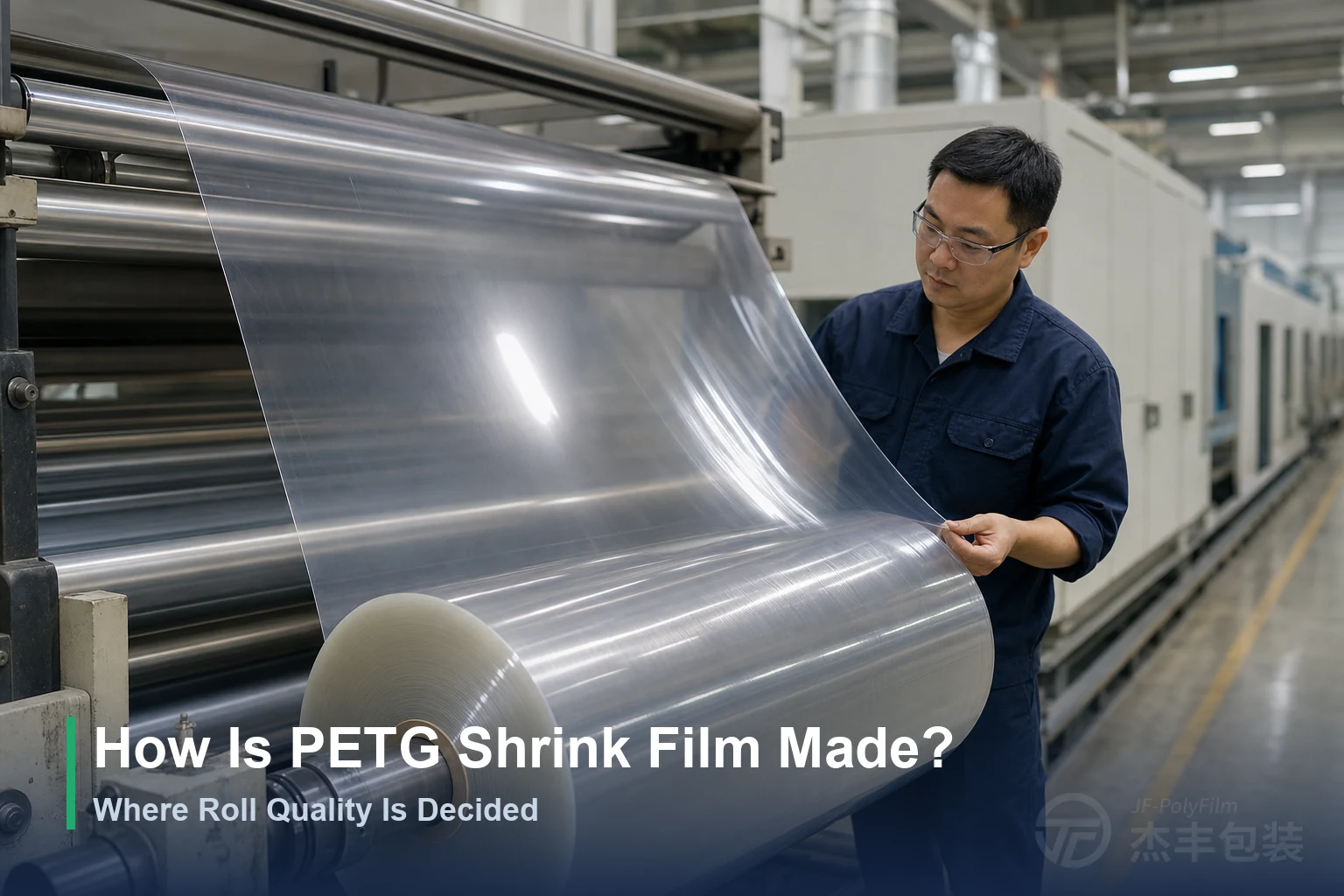
How Is PETG Shrink Film Made? Where Roll Quality Is Decided
How PETG shrink film is made, and which production stage sets each line buyers check on arrival: gauge tolerance, TD/MD shrink, haze, tensile strength, roll labels.
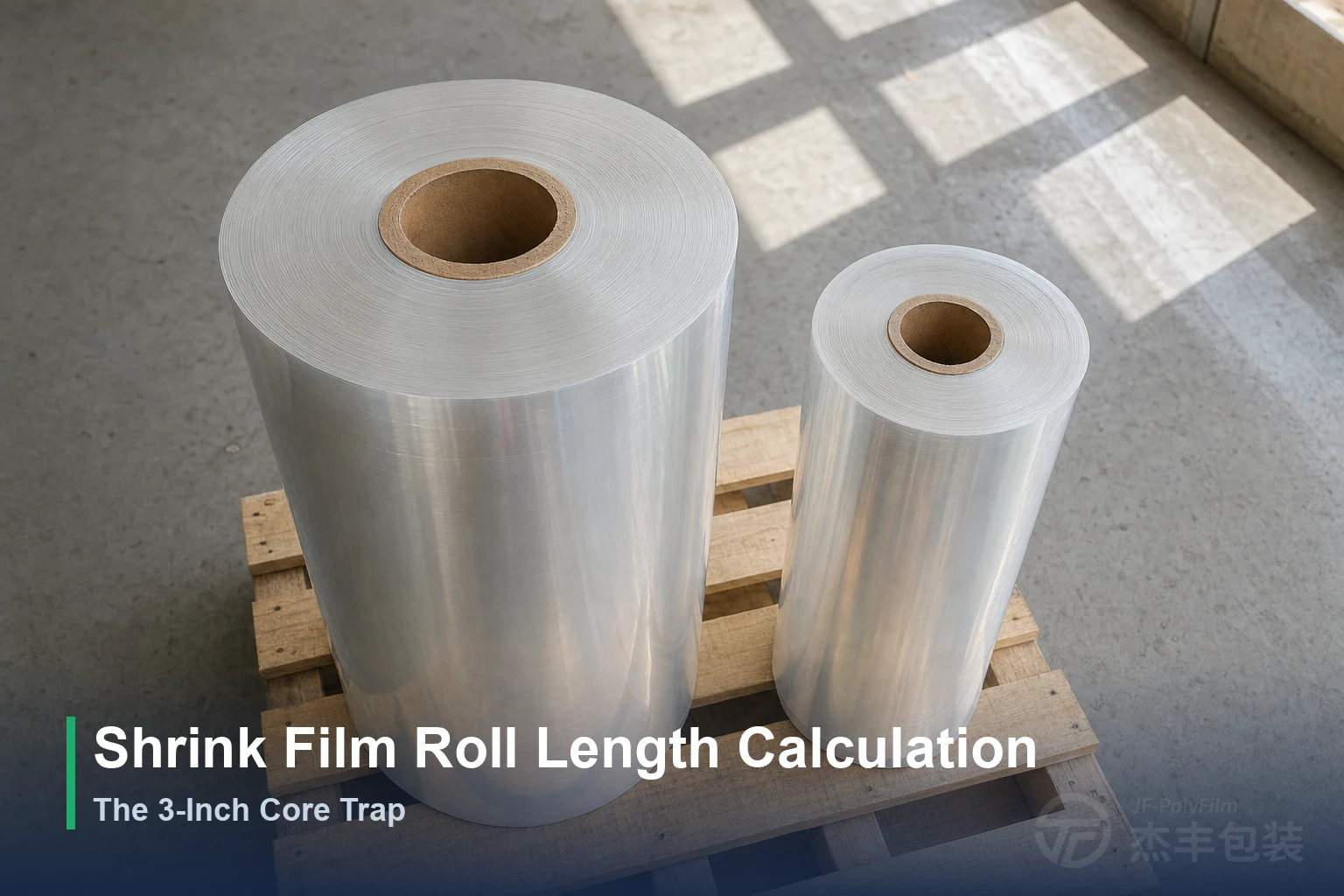
Shrink Film Roll Length Calculation: The 3-Inch Core Trap
Formulas linking roll diameter, length and weight, worked metric and imperial examples, a 30–60 μm diameter table, and why core size and trapped air shift the result.
Need Expert Advice on Shrink Film?
Our technical team can help you choose the right film for your application.
Contact Us