
Shrink Sleeve vs. Pressure-Sensitive Label: Which to Use
Shrink sleeves and pressure-sensitive labels suit different bottles. Compare the two on shape, decoration, tamper evidence, line speed, cost, and recycling.
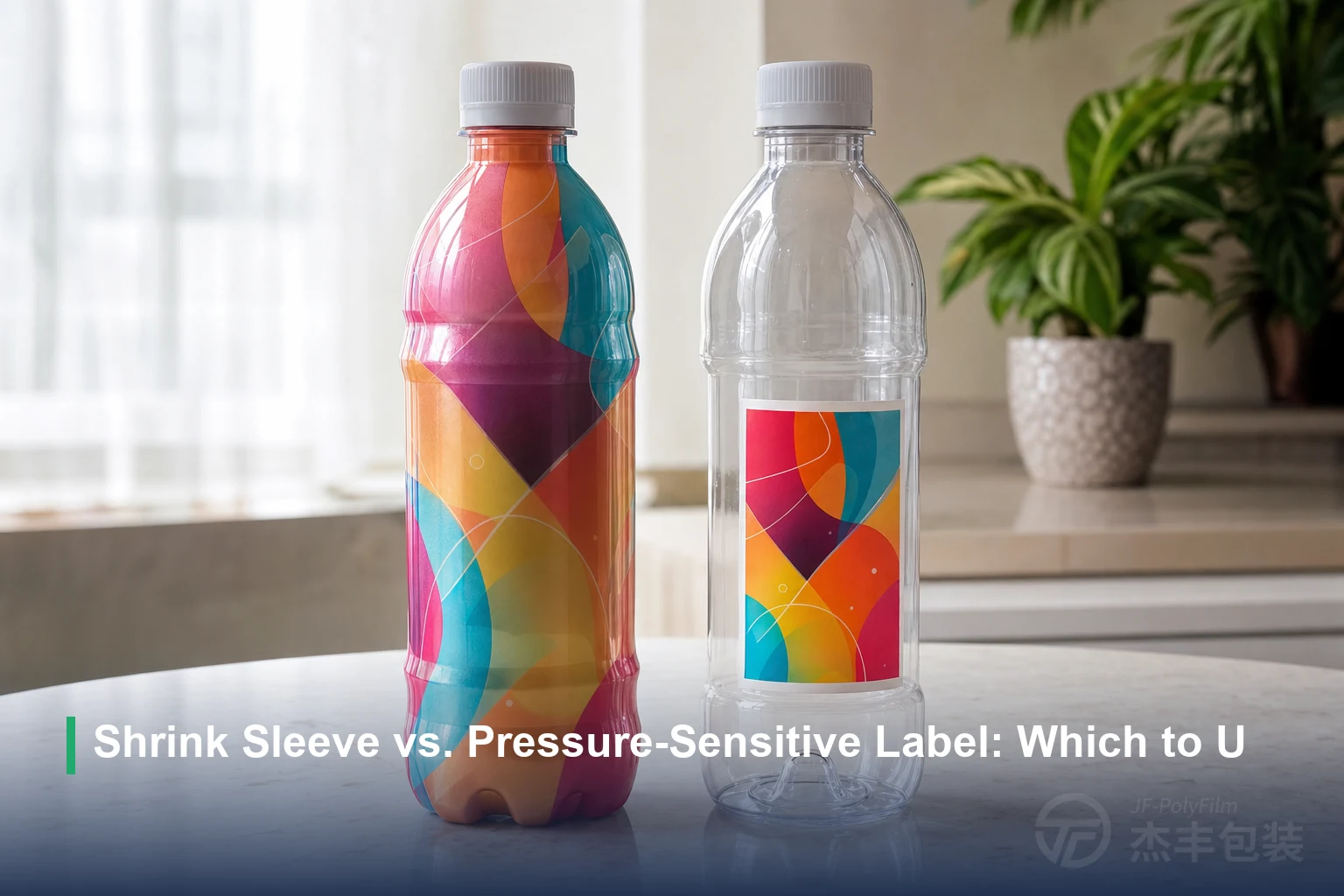
A shrink sleeve is a printed PET-family film tube heat-shrunk 360° around a container; a pressure-sensitive label is an adhesive-backed facestock pressed onto a flat or lightly curved panel. The choice turns on bottle shape, decoration, tamper needs, line setup, cost, and recycling.
Key takeaways
- Match the label form to the bottle: shrink sleeves wrap curved, tapered, and waisted containers 360°, while pressure-sensitive labels suit flat or gently curved panels.
- Following a deep curve takes a high transverse shrink. JFPolyFilm’s clear PETG is offered across transparent grades of 65%, 75%, and 80% TD, matched to how sharply the bottle turns, with machine-direction shrink held to 3.0% or below.
- “Sleeves are harder to recycle” depends on the film: adhesive glue and facestock can contaminate the PET stream, while CPET and RPET sleeves stay with the bottle in the RIC 1 stream.
The decision in one table
| Your situation | Shrink sleeve | Pressure-sensitive label |
|---|---|---|
| Contoured, tapered, or waisted bottle | Best fit — shrinks to the curve | Struggles — edges lift on deep curves |
| Flat or gently curved panel | Works well | Best fit — simple and fast |
| Built-in tamper evidence | Extend over the cap as a seal | Add a separate tamper feature |
| Fridge, freezer, or wet use | Backprinted, protected artwork | Edges can lift or curl |
| Short runs, samples, many SKUs | Higher setup to justify | More economical, quick changeover |
| Large, long production runs | Cost spreads over volume; one wrap replaces a label pair plus band | Mature, high-speed labelling |
| Recycle with a PET bottle | CPET/RPET stay in the RIC 1 stream | Adhesive and facestock can contaminate |
This guide stays on the two most brands weigh first; the sleeve itself is explained in what is a shrink sleeve label.
Decoration coverage: 360° full body vs. single panel
A shrink sleeve prints across the entire container — front, back, shoulder, and base — so the graphic reads as one uninterrupted wrap with no start or stop edge. A pressure-sensitive label covers the face it is applied to and leaves the rest of the container exposed, which is why brands often run a front and back pair to carry everything a single sleeve holds at once.
Container shape: where the label physically fits
An adhesive facestock lies flat. It sits well on straight walls and gentle curves, but on a taper, a waist, or a tight radius it lifts at the corners, wrinkles, or bridges across the low point instead of following it — the geometry simply outruns what a flat sheet can do.
Recyclability: where each one trips up the PET stream
A shrink sleeve uses heat and no glue, so it avoids the adhesive problem outright — but the sleeve’s own recycling behaviour then depends entirely on which film it is made from.
A conventional PETG sleeve melts cooler than PET and can clump in the dryer, so it has to clear recycling-industry protocols before it counts as compatible. Crystallizable PET and recycled PET, by contrast, share the bottle’s chemistry and heat tolerance, so they recover with the container in the same RIC 1 stream — no separation step, no downgrade.
Frequently Asked Questions
What is the main difference between a shrink sleeve and a pressure-sensitive label?
Can pressure-sensitive labels go on curved or shaped bottles?
Which costs less, a shrink sleeve or a pressure-sensitive label per unit?
Related Articles
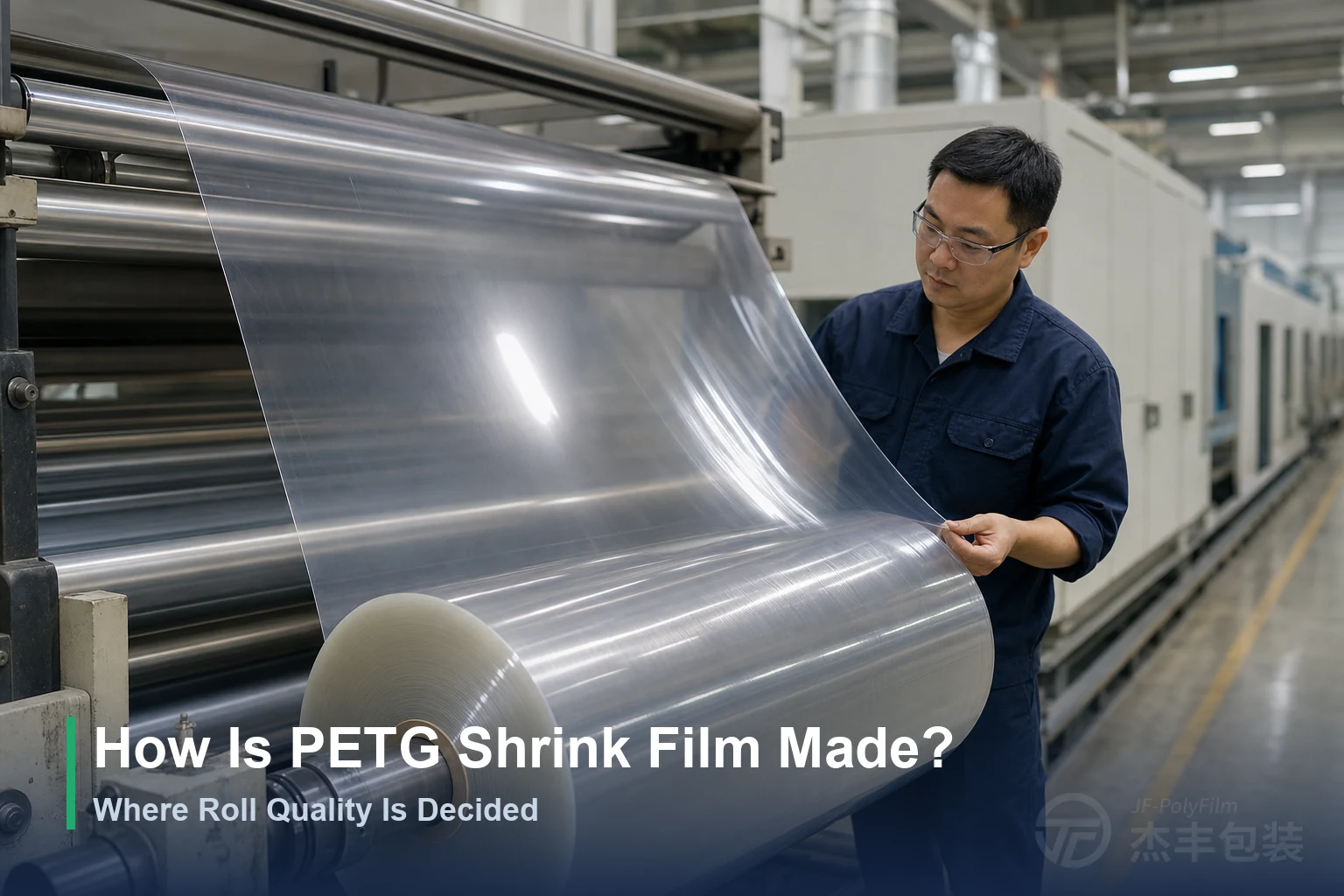
How Is PETG Shrink Film Made? Where Roll Quality Is Decided
How PETG shrink film is made, and which production stage sets each line buyers check on arrival: gauge tolerance, TD/MD shrink, haze, tensile strength, roll labels.
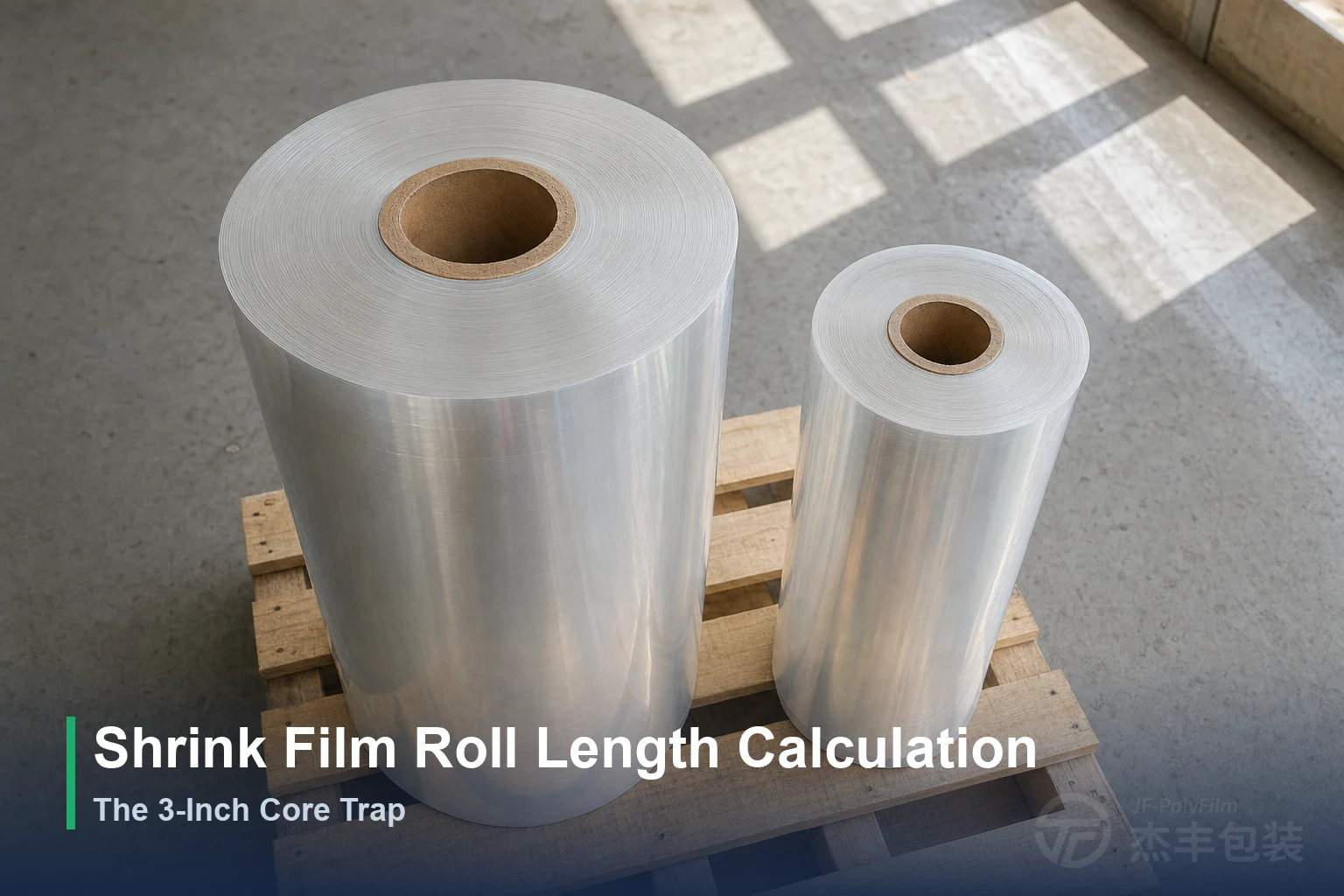
Shrink Film Roll Length Calculation: The 3-Inch Core Trap
Formulas linking roll diameter, length and weight, worked metric and imperial examples, a 30–60 μm diameter table, and why core size and trapped air shift the result.
Need Expert Advice on Shrink Film?
Our technical team can help you choose the right film for your application.
Contact Us