
Shrink Sleeves for Yogurt Cups and Dairy Bottles
A sourcing guide to opaque, light-blocking shrink sleeves for yogurt cups and dairy bottles: how to specify opacity and shrink, and keep the bottle recyclable.
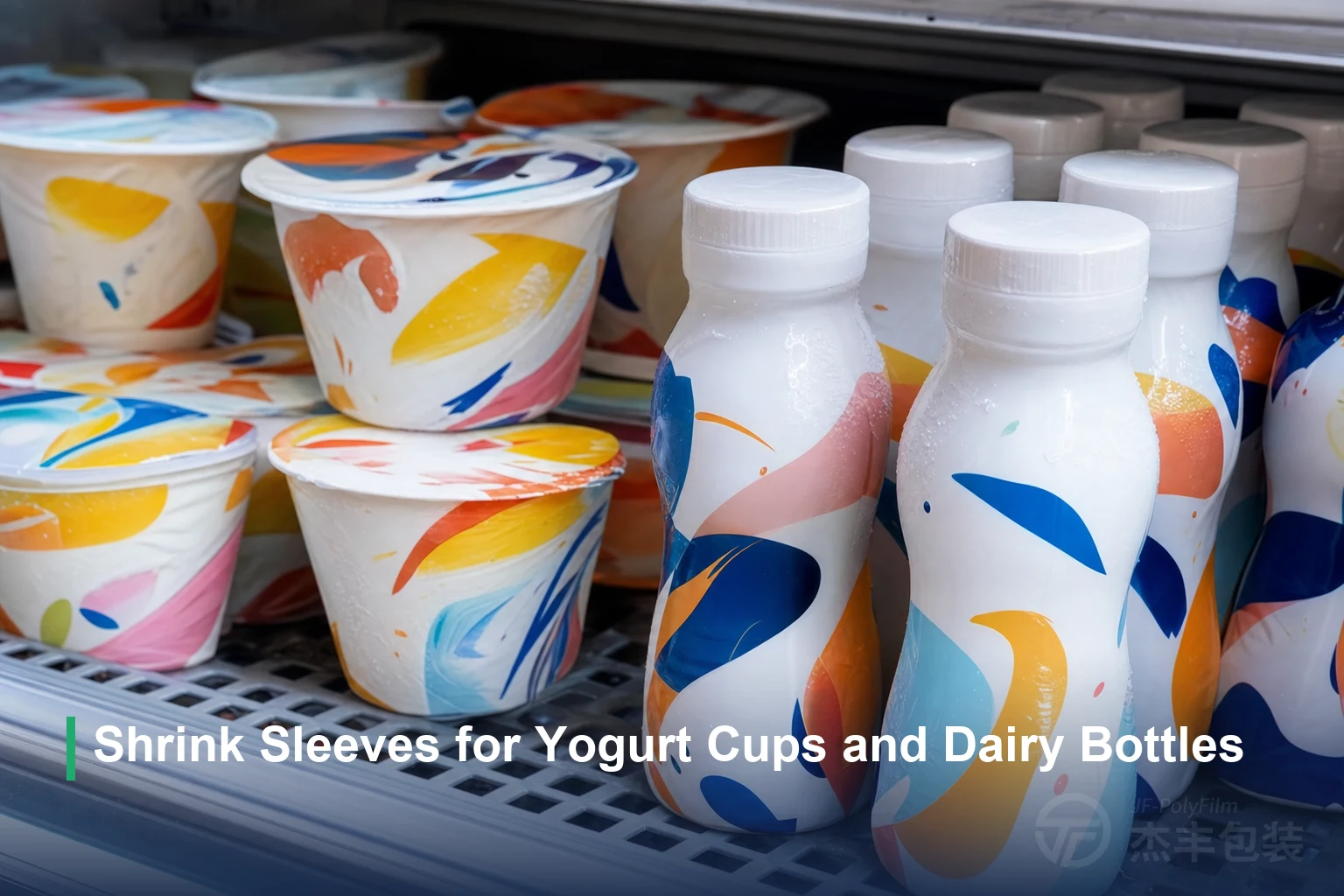
Shrink sleeves for yogurt cups and dairy bottles are full-body or neck heat-shrink labels that are printed flat, slipped over the moulded container, and tunnel-shrunk until they lock onto its exact contours. On light-sensitive dairy their decisive job is blocking visible light, which an opaque white film does and a clear one cannot.
Key Takeaways
- Riboflavin in dairy absorbs blue-green light near 445 nm, so flavor and color loss on the shelf is driven by light exposure, which an adequate barrier prevents.
- Opacity, not clarity, blocks that light. A light transmittance of 30% or less is the figure to write into acceptance testing; on the white PETG grade JFPolyFilm runs for dairy sleeves it pairs with a haze of 100% or more.
- Tapered yogurt cups need high transverse shrink, around 75% or more, with machine-direction shrink kept low so the print stays square.
- Opaque white film is made in PETG, CPET, and rPET, so the base resin can be matched to the container’s recycling route while the opacity stays on the label and the bottle underneath stays recyclable.
- Acceptance rests on two checks: a certificate of analysis on every batch, and a short line trial on the real container and tunnel.
How to specify a dairy sleeve
Specifying a dairy sleeve comes down to three linked choices: an opaque white film to block light, a transverse shrink high enough to grip the container’s shape, and a shrink tunnel matched to that shape. The same three choices carry over to plant-based and non-dairy milks — oat, soy, almond — and to other light-sensitive chilled formats such as spreads, dips, and coffee creamer, which face the same photo-oxidation concern. The table below routes the common formats to each, and the white, clear, CPET, and rPET grade comparison covers where each base fits.
| Container type | Conformance challenge | Transverse shrink needed | Film and opacity | Tunnel |
|---|---|---|---|---|
| Tapered yogurt or dessert cup | Wide rim, narrow base; large circumference change | High, around 75% or more | Opaque white, light-blocking | Steam |
| Drinkable yogurt bottle | Moderate taper, shoulder curve | High, around 75% | Opaque white, light-blocking | Steam |
| Straight-wall flavored-milk bottle | Minimal taper, full-body wrap | Moderate to high | Opaque white, light-blocking | Hot air |
| Deep-curved shaped bottle | Tight recesses, sharp contours | Highest available, low machine-direction | Opaque white, light-blocking | Steam |
Transverse shrink above machine-direction shrink is the constant across every row; the variable is how much circumferential contraction the geometry demands. A sleeve is one way to add a light barrier — a pre-pigmented container or a foil lid are others — but it wins where a single pass must deliver full-body graphics, a light barrier, and a container that stays clear and needs no new mould. In the shrink tunnel it is the container’s shape, not the base resin, that decides which heat source suits it, as the tunnel column above sets out row by row. There the film body needs to reach roughly 95 to 100°C, the window specified for the JFPolyFilm PETG and CPET grades, with a boiling-water bath as a short-run option and a heat gun for prototyping single units. Matching a grade to a specific container starts from two inputs — the container shape and a target transverse shrink — from which a supplier can recommend a base resin, an opacity grade, and a sample to trial. What a sleeve is and how it seats onto a container is covered in the shrink sleeve label overview.
Why light, not oxygen, decides dairy shelf performance
For most light-sensitive dairy the sleeve decision turns on one property: how completely the film blocks visible light. Milk-packaging research found that an adequate light barrier prevented light-induced oxidation across extended storage, which turns a brief that names “blocks light” into a measurable engineering target with a defined pass mark.
The damage runs through a photochemical chain that starts with riboflavin, or vitamin B2, the molecule widely identified as the main photosensitizer in milk. When riboflavin absorbs visible light it reaches an excited state and generates reactive singlet oxygen, which attacks fats, proteins, and vitamins to produce off-flavors and faded color. That absorption sits in the blue-green region, peaking near 445 nm, with the most damaging band spanning roughly 400 to 500 nm — and modern retail sharpens the problem, because LED chiller lighting carries comparatively high energy right inside that window.
Two consequences follow for sleeve design. First, the target is a defined wavelength range, so a barrier is judged by how completely it removes the blue-green band, not by how dark it merely looks. Second, because the sleeve is the largest printable surface on most dairy containers, an opaque sleeve is the most direct way to control light across the whole body — a film that passes those wavelengths leaves the reaction free to run regardless of what else the package does.
Why a clear sleeve does not block light
A transparent sleeve looks protective but is optically open: visible light passes through clear film almost unimpeded, so the contents still receive nearly the full band that drives photo-oxidation. The very clarity that makes a product visible on shelf is what lets damaging light reach it, so a glossy clear wrap adds shelf appeal but almost no defense — the optical trade-off is covered in the transparent film performance guide.
Partial measures fall short for the same reason. An oxygen barrier addresses a different variable; a UV filter screens ultraviolet but misses the visible blue-green band that does most of the damage; and a tinted-but-translucent film still passes a measurable fraction of it. Only a film that physically stops visible light from reaching the contents qualifies as protective, which is why an opaque sleeve is the working answer for genuinely light-sensitive dairy, ahead of a clear film with a coating on top.
Building light-blocking into the film
Opacity is engineered into the film at the resin stage, by either of two constructions. In the first, microscopic voids are drawn into the web as it stretches, and light scatters at every boundary between trapped air and polymer. In the second, white pigment such as titanium dioxide is dispersed through the film to scatter and absorb it. Either way little light reaches the contents, and the more complete that scattering, the lower the transmittance. Two numbers describe the result, and light transmittance is the one to specify. The white PETG grade JFPolyFilm runs for dairy sleeves holds a light transmittance of 30% or less — the value a buyer can write into a purchase agreement and verify on a certificate of analysis — alongside a haze of 100% or more. Transmittance measures how much light gets through the film at all, which is why it makes the cleaner acceptance line; haze expresses the share of transmitted light that gets scattered and can read at or slightly above 100% on a standard meter for a heavily diffusing film. Read together, the two describe opacity far more reliably than judging it by eye.
A film like this also accepts gravure, flexo, and UV-inkjet ink directly without corona pre-treatment, so one opaque base carries full-color graphics over the whole body while the white ground keeps colors reading the same on every panel — the practical differences between those methods sit in the shrink sleeve printing methods guide. Neither construction sacrifices the shrink a full-body sleeve needs: the grade still holds transverse shrink at 75% or more with machine-direction shrink near 3%, the high-transverse, low-machine ratio the format calls for. The structural payoff is that the barrier is intrinsic to the film: there is no separate light-blocking layer to delaminate, scuff, or thin at the seam, and the web that blocks light is the same one that prints. The same opacity can be built into CPET and rPET as readily as PETG, so the light barrier is not tied to one base resin; which base to choose comes down to the container’s recycling route, addressed below.
Full-body sleeves versus neck bands
Two formats dominate dairy: a 360-degree full-body sleeve turns the whole container into print area and light barrier at once, while a neck or shoulder band covers only the cap-to-shoulder zone for tamper evidence. The full-body sleeve suits cups and bottles that need full-wrap graphics, a large information panel, and complete light protection; the neck band, often applied over an already-decorated container, signals first-open integrity — a role the tamper-evident shrink band guide treats in full.
For light-sensitive dairy the choice is usually settled by opacity: a neck band leaves the body exposed to light unless the container itself is opaque, so a full-body opaque sleeve is the default wherever the contents need protecting, at the cost of more film per unit. Where a brand wants light protection and a visible tamper feature together, one full-body sleeve perforated at the neck does both jobs in a single pass. Both formats stay standard because each answers a different brief.
Keeping light-blocking and recyclable
Opacity and recyclability need not collide, because on a sleeved bottle the opacity lives on the label while the container underneath stays clear PET. That keeps a light-protected product aligned with a clear-PET recycling target instead of contaminating it, provided the sleeve is engineered either to separate cleanly or to travel with the right stream at end of life.
The industry reaches that compatibility by several routes, and both the base resin and the way opacity is built are chosen to match the route. An opaque white CPET sleeve is the same-resin option: it shrinks with the bottle and stays in the PET stream as RIC 1 material, the grade to pick when the target is single-stream PET recovery — the CPET RIC 1 recycling explainer covers it in depth. With a PETG sleeve the route depends on how the opacity is made. A pigment-filled white film carries titanium dioxide that reads as a contaminant in the clear-PET stream, so it is designed to be removed before recycling, or specified in CPET instead — chemically the same as the bottle, and recovered with it. A micro-void white film traps air rather than pigment and can be engineered below 1.0 specific gravity, so it floats off during the sink-float step that sorts ground PET and separates on its own. Beyond those, a low-density polyolefin sleeve rises in the same step, a mechanically removable sleeve tears away before granulation, and for glass dairy bottles wash-off inks and films release in the alkali wash so the glass and the print part cleanly. Each route preserves the same idea: protect the contents with an opaque label while leaving the container recyclable.
On the material side, a dairy sleeve is specified against material standards such as EU 10/2011, with GRS, REACH, and RoHS documentation available for buyers who need to evidence recycled content and restricted-substance compliance. The wider bottle-recycling picture sits in the beverage bottle sleeve guide and the broader PET shrink sleeve recyclability guide.
Qualifying the sleeve and the supplier
A light-protecting sleeve only earns its place if opacity and shrink stay stable across a whole job, so acceptance rests on a line trial plus per-batch evidence rather than a single spec sheet. Two failure modes matter on dairy: a thin spot or a patch of uneven opacity that lets a streak of light through, and a shrink batch that drifts so the sleeve wrinkles or distorts on the taper. Both are batch-to-batch risks, so the controls belong in the purchase agreement.
Acceptance starts with a line trial on the real container and the intended tunnel, read for two things: whether the sleeve conforms to the taper without wrinkles, and whether opacity stays even from rim to base with no light leak where the film stretches thinnest. Per-batch evidence then carries the run:
- A certificate of analysis with each shipment, reporting the properties that decide a dairy sleeve: transverse and machine-direction shrinkage, haze, light transmittance, thickness uniformity, and tensile strength.
- A sample of meaningful length drawn from every production batch for full property testing, so opacity and shrink are confirmed batch by batch rather than once at first article.
- Winding with as few splices as possible, ideally none, since a splice can surface as a shrink defect on a finished cup.
- Retained samples and a batch number on every roll, so a questioned lot can be traced and re-tested.
A few practical details round out acceptance. Our dairy sleeves ship wound on pallets — vertically at about 20 rolls each for density, or horizontally at 6 for sensitive jobs — and store for roughly 12 months at 10 to 30°C in their original packaging, away from direct sunlight, with a minimum order around one tonne. The opacity check belongs on the acceptance list as squarely as shrink, because a film that shrinks perfectly but thins at the seam has lost the property the dairy product needed in the first place. To size a real container, send the cup or bottle shape, a target shrink, and the target recycling route, and we will recommend a white PETG grade — or a white CPET grade for single-stream PET recovery — plus a sample to trial on the line.
Frequently Asked Questions
Do clear shrink sleeves protect dairy from light?
Can a light-blocking sleeve go onto an existing clear container?
Does an opaque white sleeve cost much more than a clear one?
What shrink ratio do tapered yogurt cups need?
Steam or hot-air tunnel for a dairy sleeve?
Related Articles
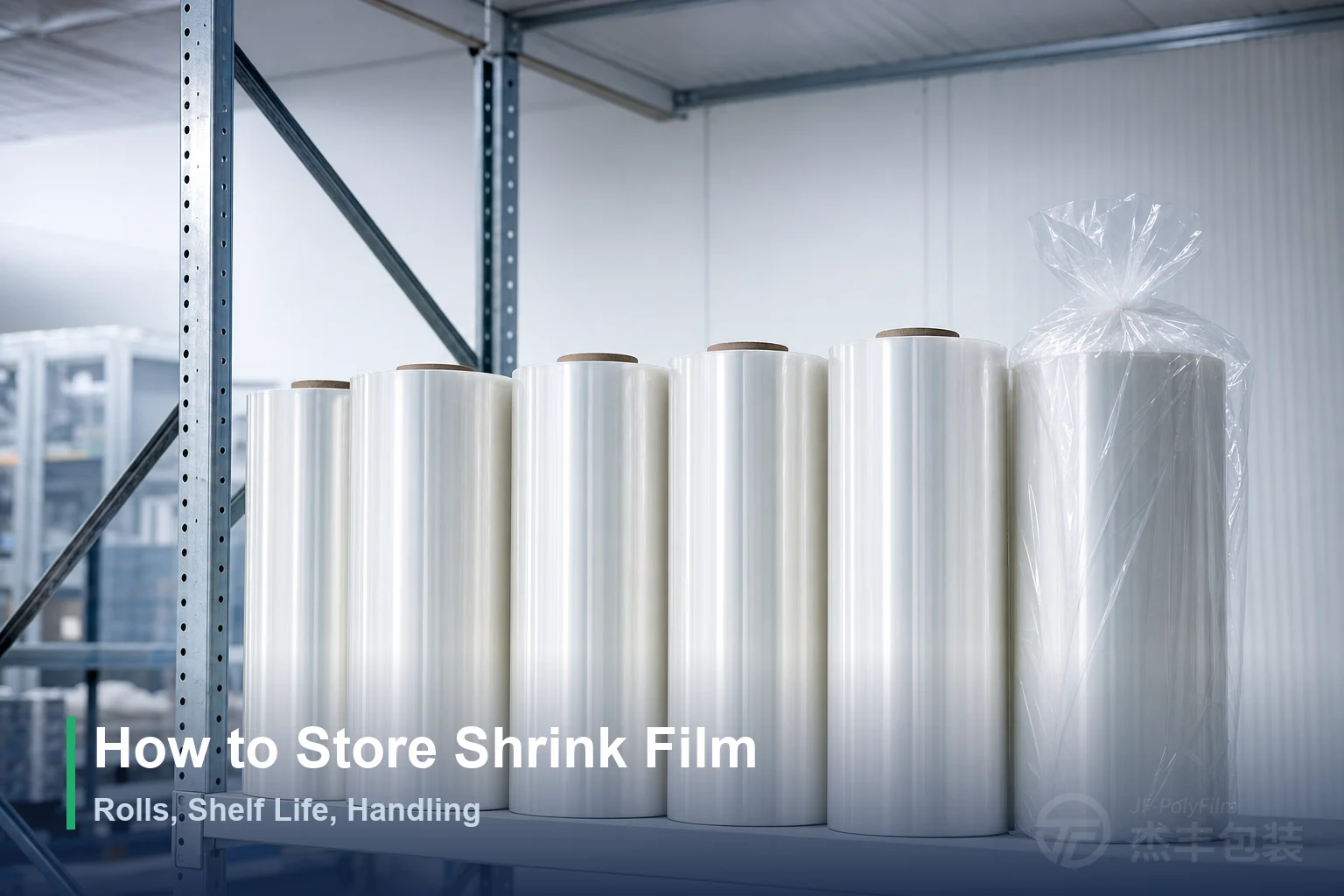
How to Store Shrink Film: Rolls, Shelf Life, Handling
What the 10–30°C, 12-month storage window actually protects, how to stand rolls so they don't flat-spot, and why film has to acclimate before it reaches the line.
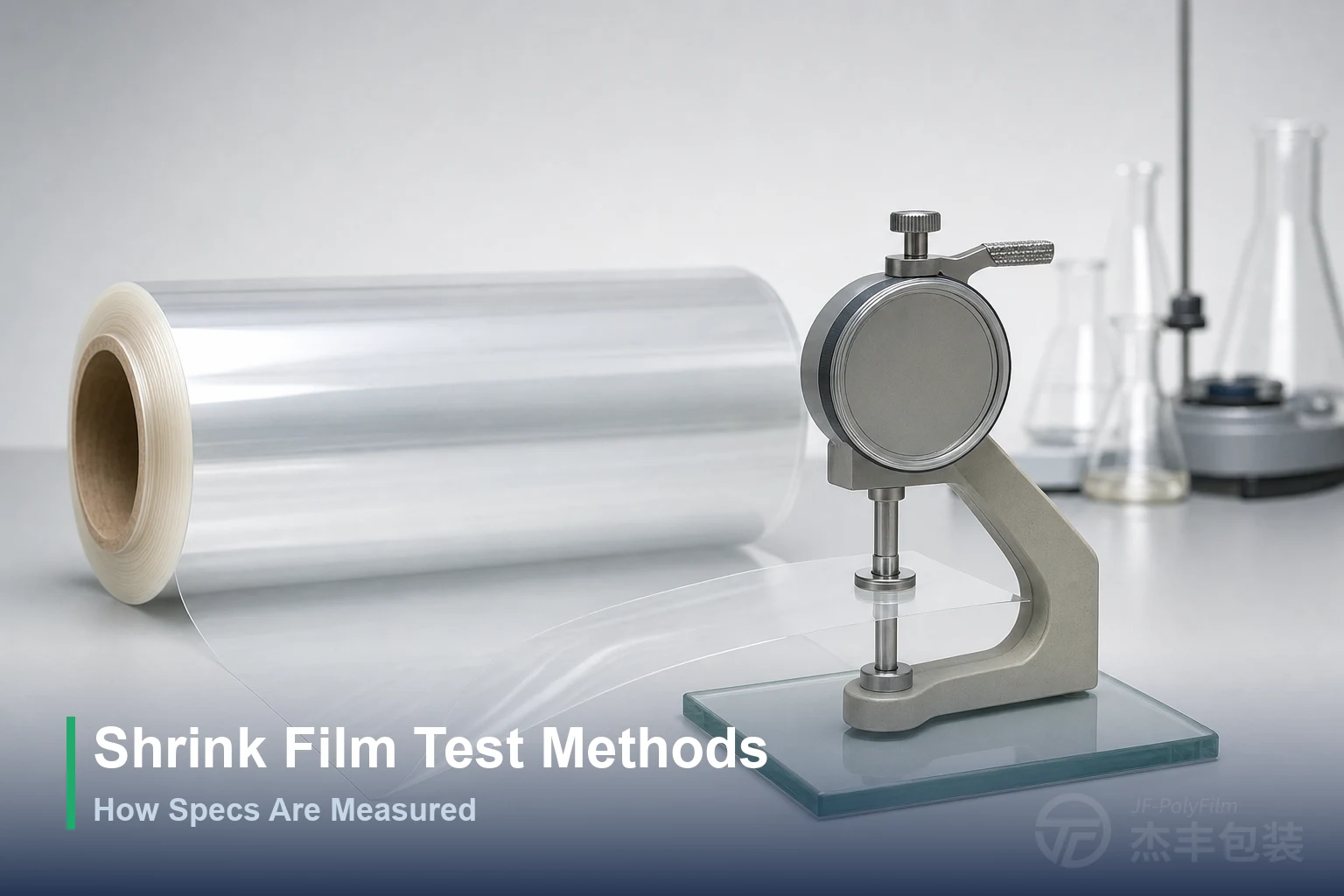
Shrink Film Test Methods: How Specs Are Measured
Every figure on a shrink film datasheet or COA traces back to a standard method. See which ASTM and ISO tests measure shrinkage, tensile, haze, and gauge, and how to read the report.
Need Expert Advice on Shrink Film?
Our technical team can help you choose the right film for your application.
Contact Us