
Light-Blocking Shrink Sleeves for Light-Sensitive Fills
Beer, dairy, supplements, and some medicines degrade under light. Which fills need protection, and how a full-body opaque PETG sleeve wraps the whole container to keep light off the contents.
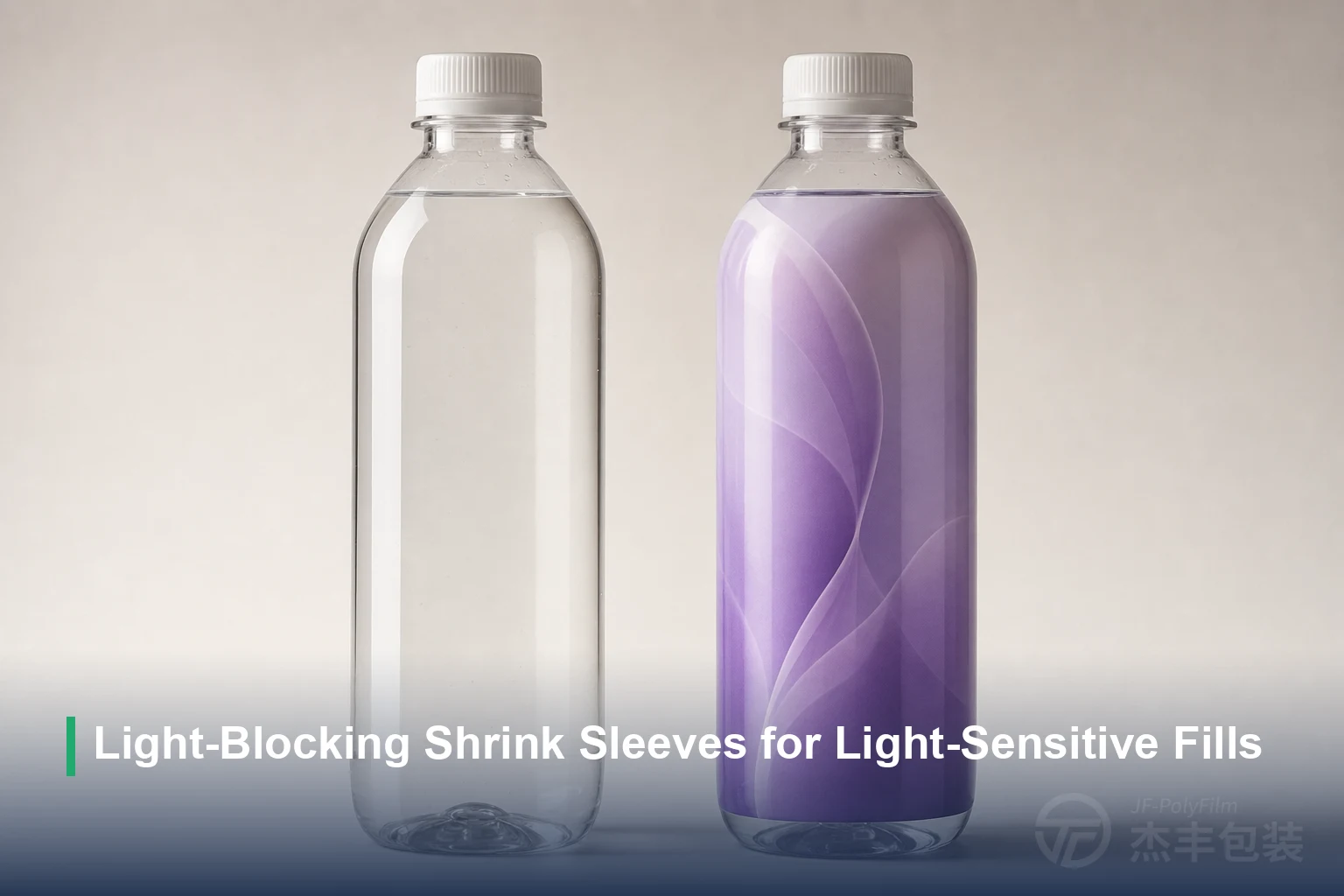
A light-blocking shrink sleeve is a full-body opaque label, usually white PETG, that wraps the whole container and, being opaque rather than see-through, keeps most of the visible light and UV that would harm the fill off the contents. The same sleeve carries the brand graphics, so it shields what is behind it while doing the labelling job.
JFPolyFilm’s white PETG is made for exactly this — an opaque grade that draws down onto contoured bottles with the same high transverse shrink as a clear film, so nothing about the fit is traded away to gain the coverage.
Which fills degrade under light
The common thread is a molecule inside the pack that absorbs light and starts a reaction — a spoiled flavour, a lost vitamin, a weakened dose. Beer, cultured dairy, vitamins and supplements, and a range of photosensitive medicines all share that vulnerability, each for its own chemistry.
| Light-sensitive fill | What light does | Off-target result | Light-avoidance approach |
|---|---|---|---|
| Beer | Blue and near-UV light (~350–500 nm) excites riboflavin, which passes energy to hop-derived iso-alpha-acids | ”Light-struck” skunky flavour from a thiol compound | Brown glass traditionally; an opaque sleeve covers what glass tint alone cannot |
| Dairy and dairy drinks | Riboflavin drives photo-oxidation while riboflavin, vitamin A, and vitamin C break down | Off-flavours and vitamin loss, detectable within hours under retail lighting | Opaque cartons or bottles, or an opaque full-body sleeve |
| Supplements and vitamins | Vitamins A, B2, B6, B12, folic acid, and D degrade under UV and visible light | Loss of potency over time | Amber or opaque bottles; opaque sleeves on otherwise clear containers |
| Photosensitive medicines | Near-UV and blue-violet light (~300–500 nm) drives photodegradation | Loss of the active compound | Amber glass and opaque or light-resistant containers |
Beer is the clearest case, and the dairy and supplement programmes each carry their own considerations, with the dairy side covered in depth in shrink sleeves for yogurt and dairy.
How light spoils these fills
The reactions behind the table run on the same basic idea: a light-absorbing molecule catches a photon and hands the energy off to something that then breaks. In beer, riboflavin — vitamin B2 — is the light absorber. When blue or near-UV light hits it, it becomes reactive and passes energy to the bitter iso-alpha-acids that come from hops.
Visible light and UV: what has to be stopped
Blocking light means blocking two different things, and a film that stops only one leaves the fill exposed.
Visible light is blocked by opacity: a film that is not see-through simply does not let it through, which is what an opaque white grade delivers across the whole visible range. UV is handled separately, by the film absorbing shorter wavelengths itself and, where more is needed, by adding a UV absorber to the film, which pushes the block further toward 400 nm.
Coverage: why a full-body sleeve beats a partial label
A partial label — a waist band, a wrap around the middle — shields only the strip it sits on and leaves the shoulder, neck, and base open to the shelf lights. A full-body shrink sleeve, by contrast, draws down around the entire container, top to bottom and all the way around, so there is almost no uncovered surface for light to reach.
Frequently Asked Questions
Which products need a light-blocking shrink sleeve?
Is a full-body opaque sleeve better than a partial label for keeping light out?
Does a light-blocking sleeve keep the product fresh or extend shelf life?
Related Articles

How Is PETG Shrink Film Made? Where Roll Quality Is Decided
How PETG shrink film is made, and which production stage sets each line buyers check on arrival: gauge tolerance, TD/MD shrink, haze, tensile strength, roll labels.
Shrink Film Roll Length Calculation: The 3-Inch Core Trap
Formulas linking roll diameter, length and weight, worked metric and imperial examples, a 30–60 μm diameter table, and why core size and trapped air shift the result.
Need Expert Advice on Shrink Film?
Our technical team can help you choose the right film for your application.
Contact Us