
Shrink Sleeve vs BOPP Wrap-Around Label: Which to Use
Shrink sleeves and BOPP wrap-around labels suit different bottles. Compare them on shape, cost, line speed, coverage, and how each separates in PET recycling.
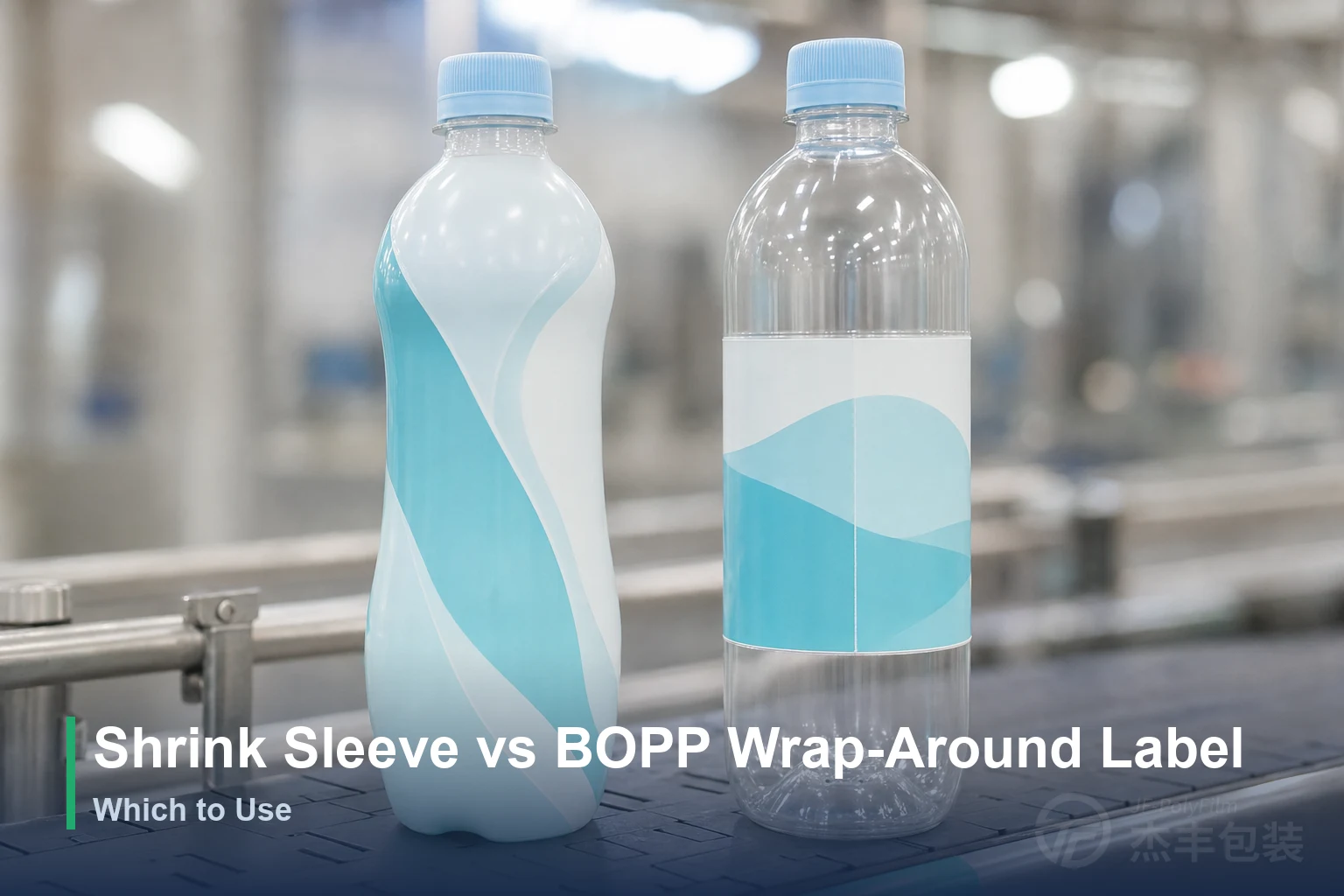
A shrink sleeve is a printed film tube slipped over a container and drawn tight under heat; a BOPP wrap-around label is a pre-printed polypropylene film glued in a band around the body. The split between wrapped-and-shrunk and glued-around-a-cylinder drives every other trade-off between them.
Key takeaways
- Bottle shape is the first filter: a flat BOPP band conforms only to straight cylindrical walls, while a shrink sleeve draws down onto tapers, waists, ovals, and contoured bodies.
- A reel-fed BOPP wrap-around labeler is the lowest-cost way to decorate a straight cylinder at high speed, which is why bottled water and commodity beverages lean on it.
- On a PET bottle, a polypropylene BOPP band floats off in the recycling wash (near 0.90 grams per cubic centimeter) and separates from the sinking PET, while a sleeve’s recyclability depends on matching the bottle — a crystallizable PET film recovers with it.
The two methods at a glance
| Axis | Full-body shrink sleeve | BOPP wrap-around label |
|---|---|---|
| Best bottle shape | Tapered, waisted, oval, contoured | Straight cylindrical walls only |
| Coverage | Full 360°, body and shoulder | A band on the cylinder |
| Application | Seamed tube, applicator, heat tunnel | Reel-fed film, glue, high-speed wrap |
| Entry cost | Medium, run-flexible | Lowest for straight-wall high volume |
| Recycling on PET | Grade-dependent; CPET recovers with bottle | Floats off (~0.90) and separates from PET |
| Tamper signal | Strong with sleeve-and-cap band | Body band only, no closure seal |
Pressure-sensitive and in-mold labels sit alongside these as separate routes, compared in shrink sleeve vs pressure-sensitive label and shrink sleeve vs in-mold label.
Bottle shape decides the shortlist first
A BOPP wrap-around label is a flat, pre-printed film, so it behaves correctly only on a straight cylindrical wall — a flat sheet rolls onto a cylinder without wrinkling, but the moment the diameter changes the band cannot keep up. On a tapered, waisted, or oval bottle the top or bottom edge runs short or long against the shifting circumference, so the film puckers, lifts at the corner, or bridges across the low point instead of following it.
A shrink sleeve solves the same shapes from the opposite direction: it goes on loose and contracts under heat until it draws down onto the contour, so a cone, an hourglass, or a shoulder transition ends up fully wrapped.
Cost: why reel-fed BOPP is the low-cost route for straight cylinders
For a straight cylindrical bottle run at volume, a BOPP wrap-around label is usually the lowest-cost decoration available: the oriented film is thin and inexpensive, the labeler is compact, and the line runs fast with little changeover overhead.
Recycling: which one leaves the PET stream cleaner
BOPP is a polyolefin — biaxially oriented polypropylene — with a density near 0.90 grams per cubic centimeter, well below water, so in the float-sink tank that sorts reclaimed PET the band floats while the heavier PET flake sinks.
A PETG film has a density near 1.28 to 1.33 grams per cubic centimeter, above water, so it sinks with the PET rather than floating off, which means float-sink alone will not lift it away. A crystallizable PET (CPET) sleeve shares the bottle’s chemistry and survives the wash, so label and bottle stay in the same RIC 1 PET stream and are recovered together instead of being pulled apart.
Frequently Asked Questions
Can a BOPP wrap-around label go on a tapered or waisted bottle?
Do shrink sleeves and BOPP wrap-around labels use the same equipment?
Does a BOPP wrap-around label recycle with a PET bottle?
Related Articles
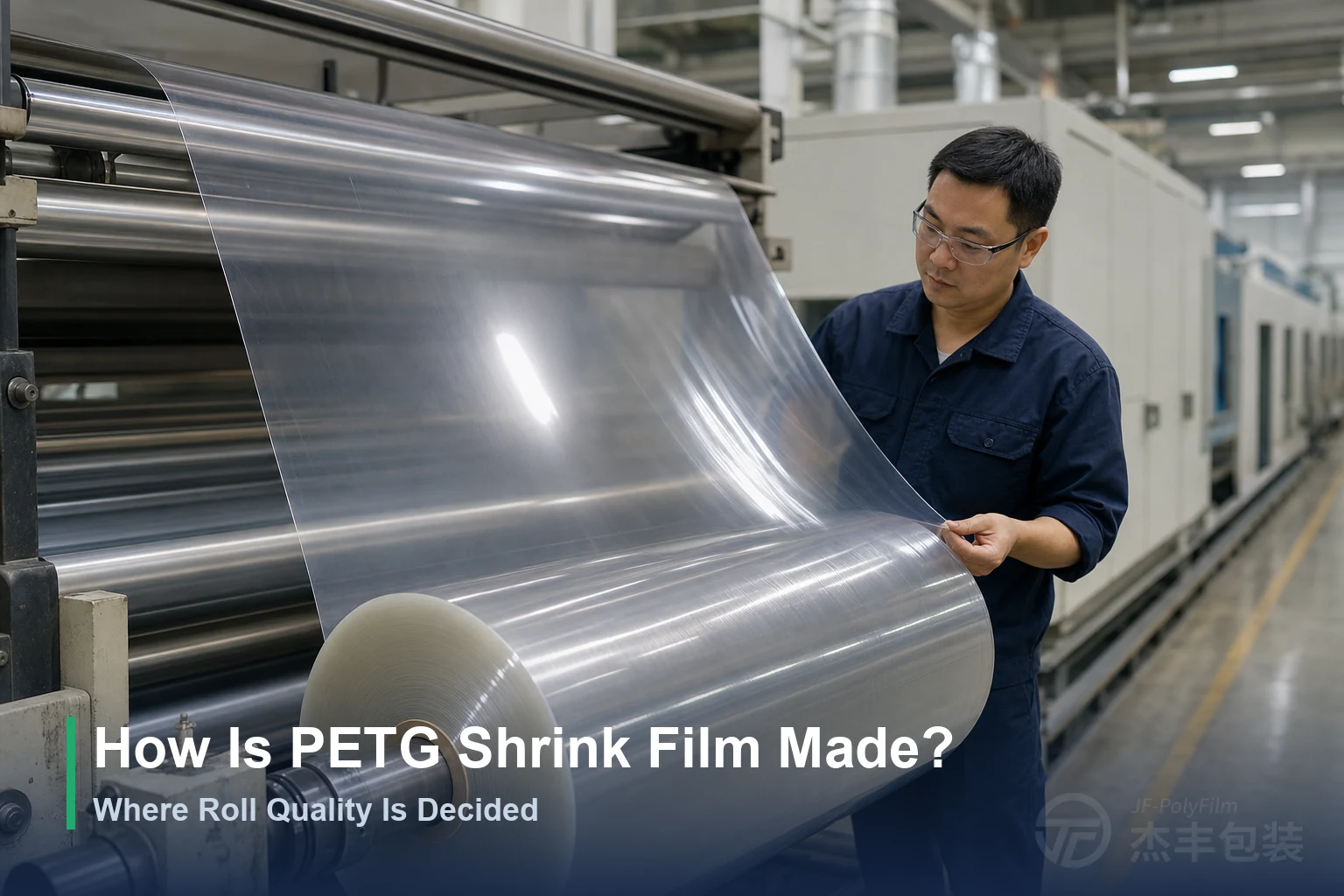
How Is PETG Shrink Film Made? Where Roll Quality Is Decided
How PETG shrink film is made, and which production stage sets each line buyers check on arrival: gauge tolerance, TD/MD shrink, haze, tensile strength, roll labels.
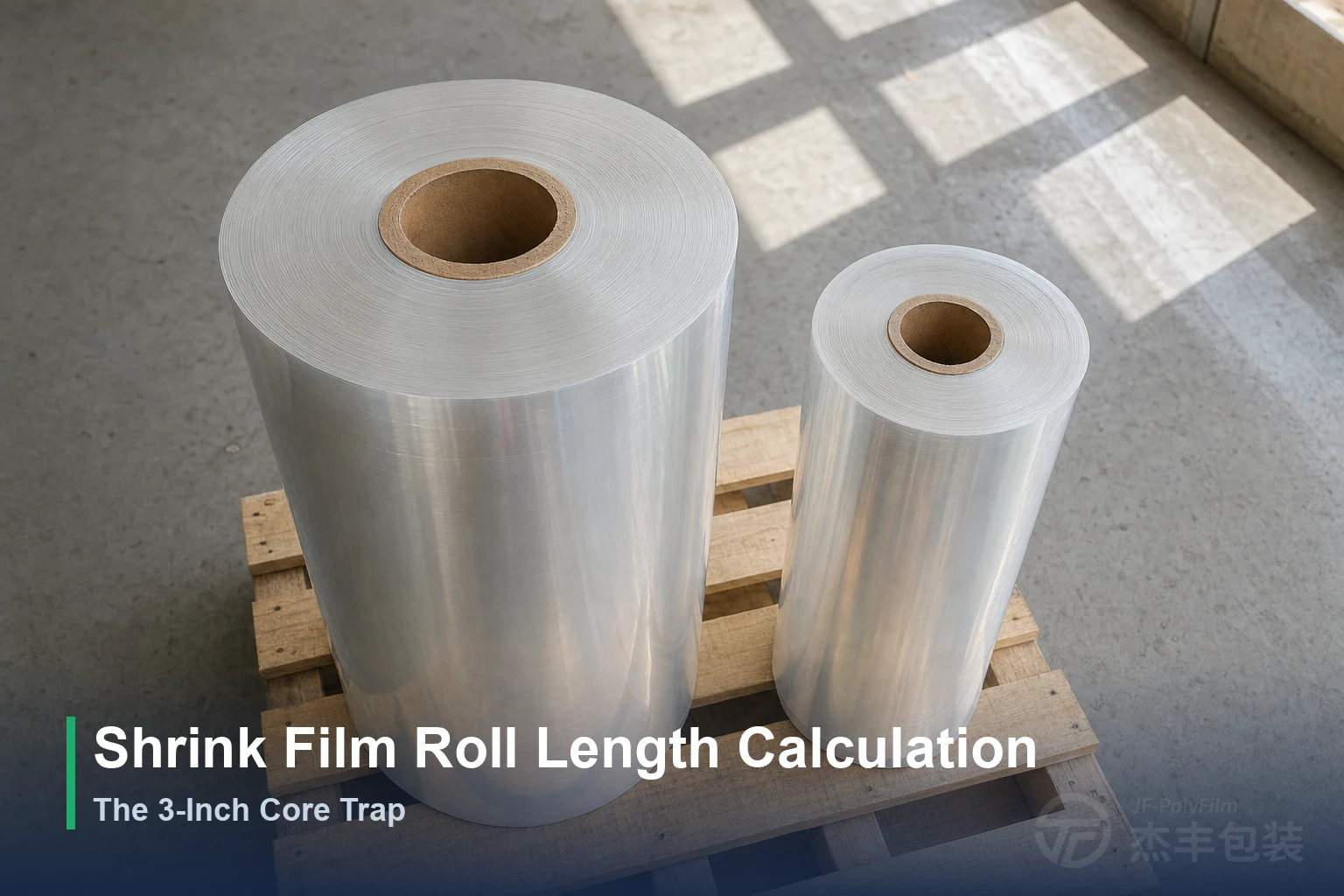
Shrink Film Roll Length Calculation: The 3-Inch Core Trap
Formulas linking roll diameter, length and weight, worked metric and imperial examples, a 30–60 μm diameter table, and why core size and trapped air shift the result.
Need Expert Advice on Shrink Film?
Our technical team can help you choose the right film for your application.
Contact Us