
Tamper-Evident Shrink Bands for Bottles: A Selection and Sizing Guide
How to choose, size, and apply tamper-evident shrink bands for bottle seals — material options, the lay-flat formula, closure fit, heat application, and the procurement specs that matter at volume.

A tamper-evident shrink band is a short tube of heat-shrinkable film slipped over the junction of a cap and bottle neck; brief heat draws it tight into a one-piece seal that tears along a perforation on first opening and cannot be put back. Because it spans both the closure and the neck, a broken band reads at a glance as a container that has been entered.
Key takeaways
- A band must cover the cap and the neck together and tear along one vertical perforation; covering the cap alone is not a tamper seal.
- PETG film for bands carries verified transverse shrink of 75 percent or more and machine-direction shrink held to 3.0 percent or less, with a recommended shrink tunnel of 95–100°C.
How a Tamper-Evident Shrink Band Works
A band proves a breach by being destroyed when the container is opened. The tube spans the cap-to-neck junction, and a single vertical perforation runs its full height; lifting or twisting the cap tears the film along that line so the cap can come off.
Choosing the Material: PETG, PVC, PLA and OPS
| Film | Shrink behaviour | Optical clarity | End-of-life note |
|---|---|---|---|
| PVC | High shrink at low heat input | Good gloss | Contaminant in the PET recycling stream |
| PETG | Very high shrink, holds contoured necks | High clarity and gloss | Recyclable; PET-family, no chlorine on incineration |
| OPS | Moderate shrink at a lower temperature; suits soft, squeezable containers | Good clarity | Sorted separately from PET |
| PLA | Moderate shrink; narrower heat window | Good clarity | Bio-based; compostable only with industrial composting access |
A full performance comparison of the two leading films — grade-by-grade clarity, shrink curves, and printing — sits in the PETG vs PVC shrink film breakdown rather than here.
Sizing a Shrink Band: Lay-Flat, the Three-Number Spec and Overhang
Sizing decides whether the band seals or fails, and it turns on a measurement most buyers get wrong on the first attempt: lay-flat width is the band laid flat and measured across, not the diameter of the cap or bottle. For a non-standard finish, the formula is the finish circumference in millimetres divided by two, plus about two millimetres of relief.
Bands are commonly called out with a three-number spec written as diameter × circumference × height — for example 26 × 50 × 26 mm — where the circumference is the cap’s outer wrap, slightly larger than the bottle, and the height is the band’s length up the neck. Height is set so the band overhangs the closure by roughly five millimetres at the top and bottom; that overhang is what lets the film catch the neck rather than balancing on the cap.
Applying the Band: Heat Gun vs Shrink Tunnel
For prototypes, short runs, and sampling, a handheld heat gun is enough: the band is slipped on by hand and the nozzle is swept evenly around it so the film draws down without scorching one side.
For PETG band stock, a tunnel set around 95–100°C is the recommended window; steam tunnels run roughly 90–100°C, while hot-air tunnels hold a higher surface temperature with the film itself reaching close to 95°C. When a band wrinkles, finishes loose, or shows dog-ears, the cause is usually temperature, dwell, or band size rather than the film itself; that diagnostic ground is covered in solving PETG shrink film problems.
Procurement Specs That Matter for Bottle Seals
- Thickness and shrink rate — stated as a verified transverse and machine-direction pair, not a single number; band film usually runs in the 30–60 micron range.
- Lot traceability — a lot number on the roll label tying back to width, length, and production date, so a downstream defect can be traced to its batch.
Recyclability and Compliance for Pharma and Food Bottles
A PET bottle carries resin identification code 1, so a band drawn from the PET family keeps that single-resin stream clean where a PVC band breaks it.
The deeper sorting and single-stream mechanics behind that choice are set out in PET shrink sleeve recyclability.
Frequently Asked Questions
Can a standard PVC band be swapped for PETG on the same line?
How is lay-flat width measured for a non-standard bottle finish?
Which closures and bottle shapes do not accept a neck band?
Related Articles

How Is PETG Shrink Film Made? Where Roll Quality Is Decided
How PETG shrink film is made, and which production stage sets each line buyers check on arrival: gauge tolerance, TD/MD shrink, haze, tensile strength, roll labels.
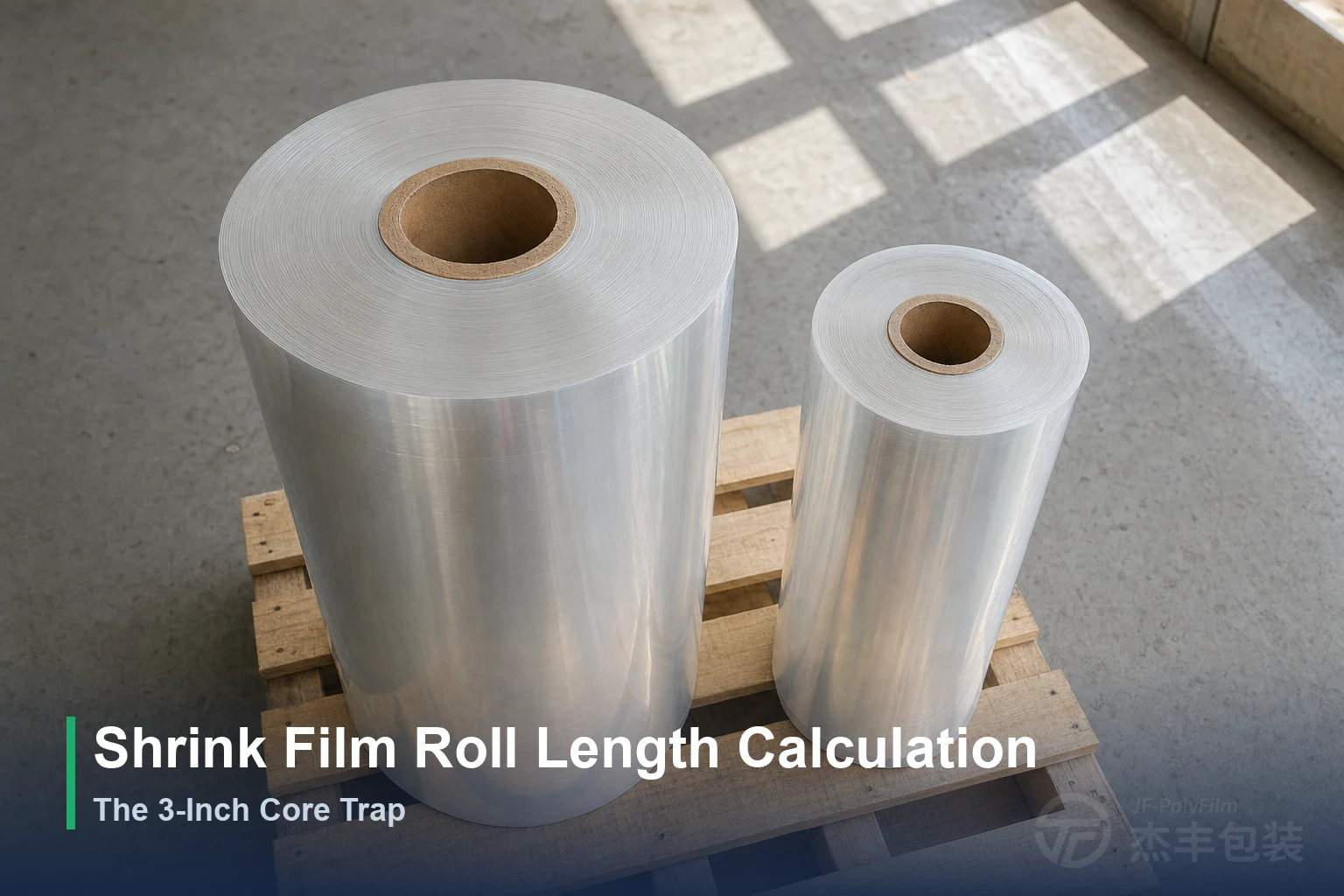
Shrink Film Roll Length Calculation: The 3-Inch Core Trap
Formulas linking roll diameter, length and weight, worked metric and imperial examples, a 30–60 μm diameter table, and why core size and trapped air shift the result.
Need Expert Advice on Shrink Film?
Our technical team can help you choose the right film for your application.
Contact Us