
Shrink Sleeve vs Stretch Sleeve: Which to Use
Shrink sleeves and stretch sleeves suit different bottles. Compare them on heat, fit to contours, film clarity, line speed, and how each behaves in PET recycling.
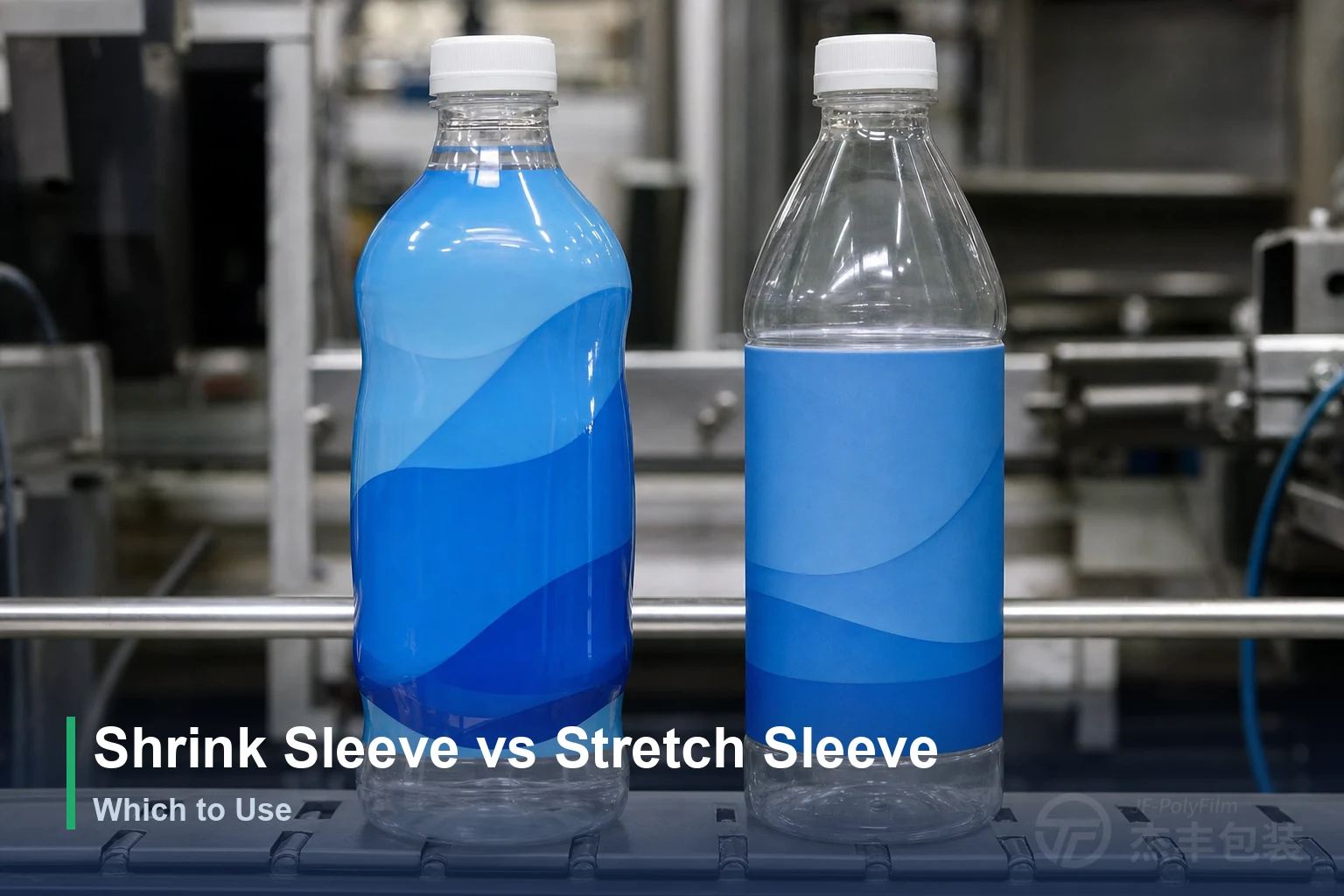
A shrink sleeve is a printed PETG film tube slipped over a container and drawn tight by heat; a stretch sleeve is an elastic polyethylene tube pulled wider than the body, dropped over it, and released so it springs back and grips with no heat and no glue.
Key takeaways
- A stretch sleeve applies cold — the polyethylene tube is stretched, slid over the body, and released to snap back mechanically, so there is no tunnel, no glue, and nothing to heat, which suits heat-sensitive fills and fast lines.
- A shrink sleeve draws down onto the tapers, waists, ovals, and shoulders an elastic sleeve bridges over instead of gripping; transverse shrink runs to 80 percent across its grades while lengthwise shrink stays at or below 3 percent, so the label tightens without stretching out of shape.
- A PETG shrink sleeve carries higher clarity and a brighter gloss for a premium, near no-label look; a stretch sleeve’s polyethylene film is thicker and tougher but hazier and flatter in print.
The two methods at a glance
| Axis | Shrink sleeve (PETG) | Stretch sleeve (PE) |
|---|---|---|
| How it attaches | Heat tunnel contracts the film to fit | Elastic film snaps back cold |
| Best bottle shape | Tapered, waisted, oval, shoulder | Straight cylinder, shallow taper |
| Coverage | Full 360°, body and shoulder | 360° around the body, not the shoulder |
| Film look | High clarity, high gloss | Tougher, hazier, flatter print |
| Tamper seal | Can seal over the cap | Body band only |
| Recycling on PET | Sinks; CPET recovers with bottle | Lighter than water, floats off and separates |
Pressure-sensitive, in-mold, and BOPP wrap-around labels each get their own head-to-head — shrink sleeve vs pressure-sensitive label, shrink sleeve vs in-mold label, and shrink sleeve vs BOPP wrap-around label.
The heatless difference: cold stretch versus a shrink tunnel
The clearest divide is heat — a stretch sleeve goes on entirely cold, while a shrink sleeve has to pass through a heat tunnel to take its shape. Once the tube is over the container, a tunnel — steam, hot air, or infrared — lifts the film to roughly 95 to 100 degrees Celsius so it contracts down to the wall, and films like ours settle cleanly across that window.
Fit: elastic snap-back versus heat draw-down
Shape is where the two physically part ways: a stretch sleeve grips only by elastic recovery, so it holds what a stretched band can spring back against, while a shrink sleeve contracts under heat onto nearly any contour.
Recycling: floating off versus recovering with the bottle
A stretch sleeve is polyethylene, a polyolefin lighter than water, and it stays on the bottle by elastic grip alone — no adhesive is ever applied. A PETG shrink sleeve sits on the far side of that water line — heavier than water, it settles with the PET rather than rising off, so a density bath alone will not part it from the flake, and its recyclability turns instead on the film grade. Choose a crystallizable PET grade and the sleeve carries the same chemistry as the bottle and holds up through the caustic wash, so the two stay together in one RIC 1 PET stream and are reclaimed as a single material. How that same-stream recovery works is traced in the CPET same-stream explainer.
Frequently Asked Questions
What is the difference between a shrink sleeve and a stretch sleeve?
Do stretch sleeves need a heat tunnel?
Which separates more easily in PET bottle recycling, a shrink sleeve or a stretch sleeve?
Related Articles
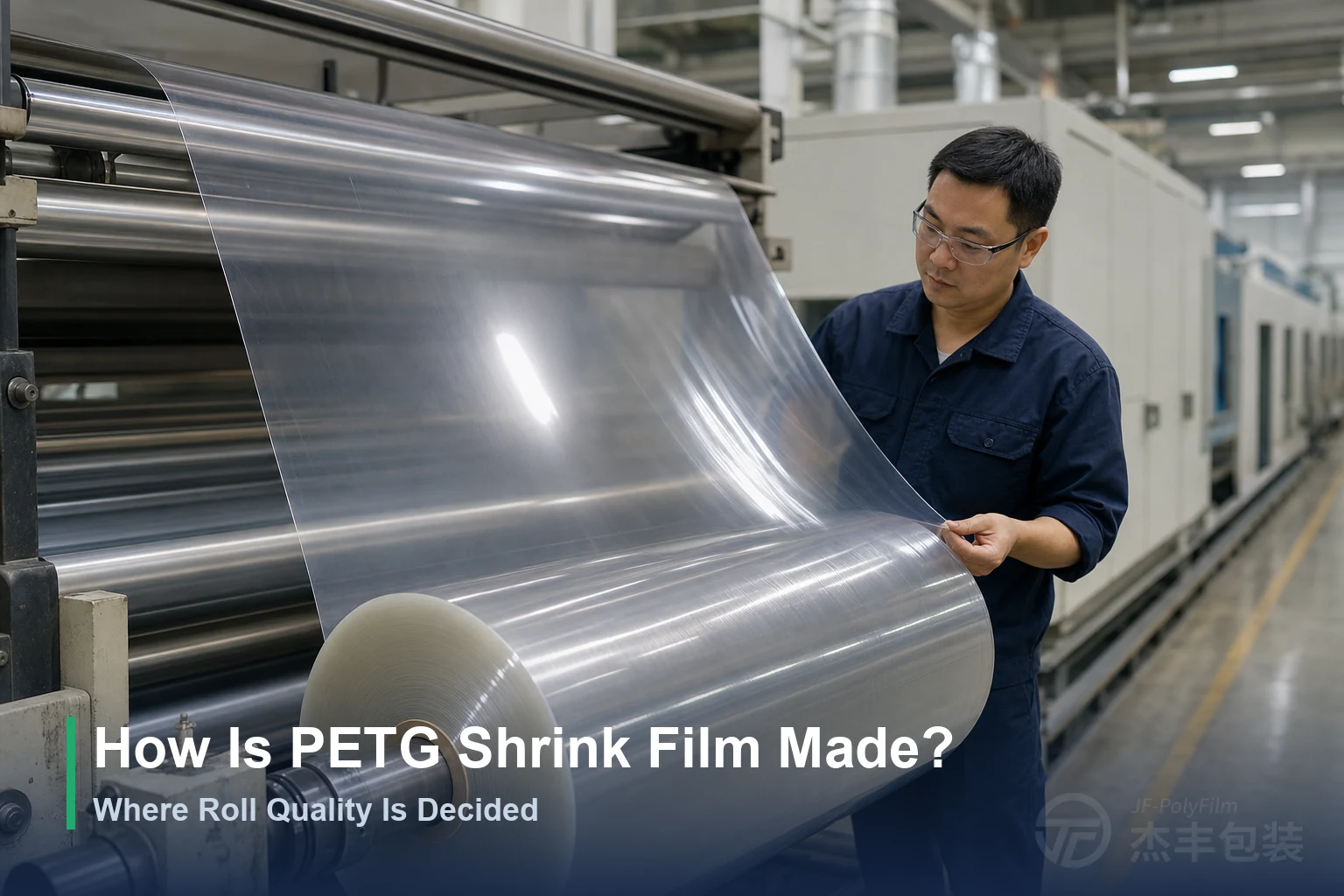
How Is PETG Shrink Film Made? Where Roll Quality Is Decided
How PETG shrink film is made, and which production stage sets each line buyers check on arrival: gauge tolerance, TD/MD shrink, haze, tensile strength, roll labels.
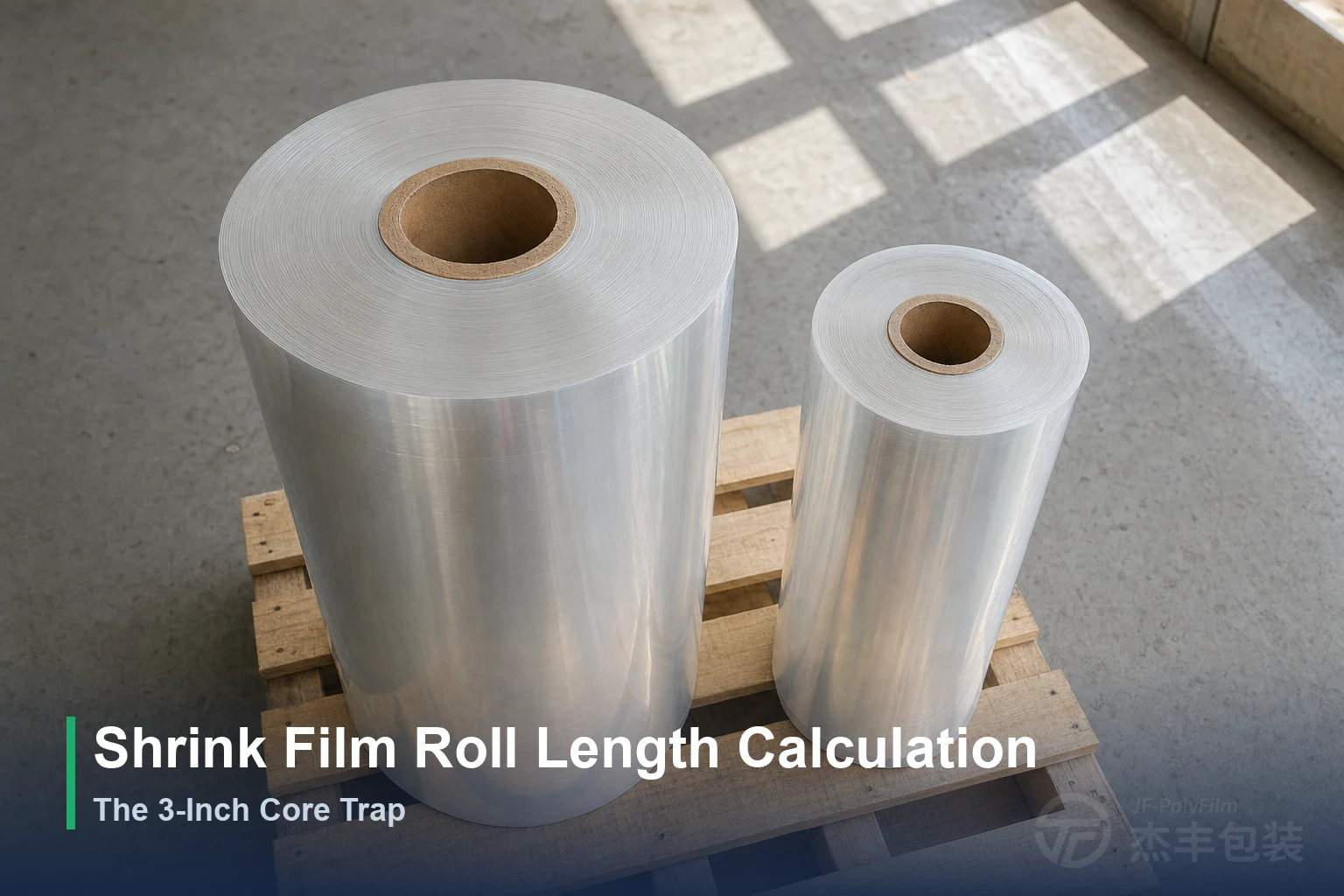
Shrink Film Roll Length Calculation: The 3-Inch Core Trap
Formulas linking roll diameter, length and weight, worked metric and imperial examples, a 30–60 μm diameter table, and why core size and trapped air shift the result.
Need Expert Advice on Shrink Film?
Our technical team can help you choose the right film for your application.
Contact Us